Let's Talk Board Games #40 – 4 Modern Classic Board Games & Impressions
Games in This Video
4 games are featured in this video — they unlock as you watch.


Transcript
Hi everyone, my name is Monique.
I'm Naveen from Before You Play
and welcome to another episode of Let's Talk Board Games where we talk about a few games that we played recently and how we feel about them. Now, today is going to be a quicker episode, I think, because we went to our local convention a couple of weeks ago and we set off on a mission and this mission was to play as many classics or older games
game classics as possible. Yeah. So, Strategic Con, our local convention, has a pretty robust library. And on the website, you can actually check out what they have in stock and what's going to be at the convention. So, we kind of set out saying like, let's play some of the old classics, ones that I have actually never played before. So, all four I had never played before. Two of these games that we're going to talk about, you had played once.
Long time ago.
Long time ago. So, it's almost like you've never played them.
Yes. And we know that a lot of people like to hear about older games and so we figured we'd make a video and just kind of share our thoughts on the one play that we did. Okay, this is a first impressions.
Yes, please keep in mind that especially for Naveen who had never played any of these games before, this was all based off of one play.
And by the way, just a little bit of backstory on Strategic Con and what it is. Naveen sort of briefly mentioned it, but Strategic Con is our local convention, uh, one of them in Southern California. It's been going on for a really long time.
We talk about it quite frequently on the channel.
Yes, we've been attending for probably about 10 years now. like before we even before we started the channel, uh when we started getting into the hobby, we started attending this convention. It happens three times a year.
And over the course of these 10 years, you know, we've made a lot of friends, some of which we only see when we go to the convention. And this last time we went was the first time that we were back in about a year.
A full year. Yeah. Cuz we were out of town in May and then we couldn't make it in February earlier.
Yeah. So, it was really nice just being able to reconnect with people who you only see there. You know, you really see the whole spectrum of life
in all of these people. Like Yeah. You get updates, people get married, people move away, people, you know, it's just this whole spectrum of life that we sort of just experience every time we're back.
Yeah. Like this time like we saw people that we hadn't seen in a couple years like so, you know, with COVID and and kind of everything that happened like people weren't going to the the con as frequently. So, it's nice to kind of just see the the flow and kind of uh the reemergence of people that you haven't seen in your life in a long time.
It's just a beautiful time. And I guess all of this to say that the convention is not just about board games. So, uh if you are interested in board gaming and you haven't explored whether or not you have a local convention, I highly recommend you check it out and kind of see what it's about because it's just a really beautiful way to make friends and sort of build a community of people, right? So, anyway, we had a really good time this time around. We played a lot of games and four of which we're going to be talking about today. Shall we begin?
Yes.
All right. Let's go from oldest to newest.
Let's I think this is seems like a right way to do it. Yeah.
All right. Well, the first game that we're going to be talking about is a kind of a surprising one probably. This is like the grand uh parent of all Thailand games.
Yeah. Grandparent in the name of board games. Yeah.
Yes. It is called Carcassone.
Carcassone.
So, this is a game that was released in the year 2000. So, 25 years ago now. And from what we understand, it started the whole any Thailand game that you're kind of playing nowadays that has to do with connecting roads and fields and stuff kind of came from this.
Yeah. I mean, there might be something before this, but not that I know of.
This is the most popular one.
The most popular one. Yeah. Uh, so this one was designed by Klaus Yordan Re and came out in 2000. Um, I think it's published by Zman Games now. Uh, I think it's probably had several publishers over years. These are all older games, so we're not going to mention the publishers just in case they've changed hands and stuff. There have been a lot of versions of Carcassone that have also been released throughout the years. This was the original.
Yeah, we only played base Carcassone original. Um, we played the very tattered old box that was in the the library and I had never played it before. Mo'Nique had played it once.
Do you remember how long ago?
A long time ago.
Probably before the channel. So,
uh, maybe
eight, nine years ago, maybe.
We only played it up to Yeah. And we also for you know there are a lot of people out there who really really love this game and know it really well. We didn't. So we played it the way that the rules have you play it which is drawing the tile at the start of your turn. So we didn't do the variant where you draw the tile at the end of your turn.
Yeah. We were talking to some friends uh uh afterwards letting them know we finally played Carcasson. And they're like, "Oh, did you play to speed it along where at the end of your turn you draw a tile so that you can think about your turn while your opponent is taking their turn?"
Very So this is a very simple game. uh you draw a tile
and then you must place that single tile. It's not like you have a choice of which tiles to place.
Yeah.
Into a shared uh community. You're building out the city of Carcasson.
Yeah.
And uh you have to uh honor kind of the roads that that are uh being built.
All of the features on the tile. Yeah. They have to connect properly.
Like water must touch water. Grass must touch grass. Something like that.
Yes. And roads must connect. It has to be exactly connected so that the whole image makes sense. And so that is as simple as it gets. You draw a tile and place it. Like that's pretty much it. Y
However, each player also has their own supply of meeples, which I believe is the appropriate term for this game, right?
Yeah. No issues there.
And uh on your turn, you also have the option of putting out a mele on one of the features on the tile that you just placed. And depending on the feature, it becomes a certain type of person. So like a farmer or like something. So, and you're putting them on like the castle so that once the castle is like fully built or the city maybe it's like a enclosure once it's fully built then you have to score for that feature and remove your mele because your mele supply is limited.
So like if you place out a a tile and it has a road and you say okay I'm going to put this mele on this road it'll act as a certain thematic some somebody on this road. Uh, I think it's like the thief maybe on the road. So, yeah,
we're really trying.
I really want to make sure I know it, but I can't remember. But, um, you will not be able to score that until that road is fully finished.
Yes.
So, you are trying to once you put that mele down, you're trying to make it so that every tile that gets played because you have to follow the rules of placement can continue to add potential scoring. Yes. But you also want to do it uh where you only have a limited supply of meuples. So, you want to get that thing back so you can try to go and get some better And there are other things that you can score like uh I forgot what it's called now, but there's a building that you want to fully encircle so that there are nine tiles that are part of it basically and you'll score the nine tiles, right?
You can also place your mele on the grassy area and that'll score at the end of the game. So that's kind of like a long-term investment and it scores at the end of the game depending on the number of these I think cities enclosed cities or kingdoms within the city itself.
And that's pretty much the extent of the game. You keep playing tiles back and forth until all of the tiles in the bag have been played out
and then you calculate final scoring and that is the extent of it. It is very simple. Yeah.
Take a tile, place it, maybe put out a mele and then see how well you do. But in a two-player game, you know, there is some hate placing.
Oh, yeah.
Like you're really trying to maximize your points while minimizing the other players points.
Yeah. Because some of the tiles they may have like if if she sees that I'm in a position where I can close off this city.
Mhm.
And it's like perfect, I close it off. Then she might place a tile where I have meuples where I'm trying to score and really open up and rebranch that thing.
Yes. So it makes it hard for
makes it hard. Now I got to figure out tiles to come back around, swing it, and then actually really close it in.
Or if it's like the He just put out a meuple at the start of a road and just close the road. Right.
Close the road. So like great, you wanted multiple points here. Here's only two points. Yes. Now, we are not experts at this game, obviously. So, I'm sure there's way more, you know, strategy that has unfolded over the course of 25 years,
but that is the extent of it. And so, um I'm actually very curious to hear what you have to say because I don't know, do you typically love Thailand games? I feel like you're just kind of like I enjoy them.
Well, I like Isisle of Sky, which I was always told as so I've played that game many, many times. Alexander Fister game probably came out in like 2015 or something, 2016. Yeah. We actually did a two-player variant playthrough on the channel years ago
during our Fister series.
Fister series. Yeah. And so I like that game a lot and I like the Tile Lang aspect of that particular game. And then I was always told as I'm playing that game for years, oh this is based off of the Kyle Lang kind of rules of Carcasson.
So I didn't really know too honestly I didn't really know what Carcassone was all about. I never actually like did a review like you know when you're getting into the hobby. Yeah.
You watch reviews of stuff and you're you know you're trying to figure out these games. I actually never went back flew over.
I never went back and actually looked at what was involved in carcassone. So when you actually taught it there at the at the convention was when I fully got an understanding of the game. How rare is which is very rare for somebody who's
somebody who's been in the hobby
makes videos and puts them on the internet
this many years. Did not did not know.
I knew nothing of that. So yeah, I I actually really enjoyed it. Um I and when our friend told us about the variant to kind of speed it along, especially in higher player counts of drawing a tile at the end, I was like that that makes it probably perfect. Um, it is just the right balance of just light, kind of casual. Um, it it's like one of those games where you can just be sitting around the table and having a conversation, catching up with people, but also still strategizing and still making meaningful decisions as you place out the tiles,
still focusing on what other people are trying to score, where their meuples are, and when you put your meuples out, when you try to get them back, so you can go do better things. So, there's there's a lot going on in it, and it was pretty fun. I actually liked it a lot.
Yeah, it's great. It's very simple. It's very laid-back, but there's just enough strategy to it that it's quite enjoyable. Um, and I don't think that I have played a Thai laying game that's truly been like a carcassone killer.
Because usually when they when you describe a game that's like an X killer that basically replaces this other game. It gives you an experience that is that and more. That is like why would I ever want to play this game because I now have this one.
And I just don't think anything that I've played so far has really truly captured the essence of what that game brings. I'm sure many many games have come out but this one you know that deal with the tile laying but this one what still makes it kind of unique when you taught it oh we're all just contributing to the same shared board
versus like most tile laying games like this is my kingdom I will do this
and maybe it's just somebody hate drafted a tile that was in a display
then that's where kind of some of the competition comes in but versus this one is like you're you're adding to this board so people can make opportunities after something that you've played on your turn you know and so So simple. So simple. I think that that one stands the test of time. If anybody's interested in just like a simple yet strategic game, try Carason. Although you probably have already.
Uh and if you are an expert at this game and this is like one of your top 50 of all time, let us know why and what player counts you love to play it at and maybe which expansions and such you incorporate. I'm actually curious because I think there's a lot of people in our situation or at least in my situation that are in the hobby have been maybe for years and also have not played Carcassone. So I'm curious to know has any are people out there that watch the channel are you have you played Carcassone? Yes or no? Like let us know. Yeah. Let me know in the comments. I really relate to something.
I want to relate because like it's like 25 years later I finally played this thing. Obviously I wasn't in the hobby for 15 of those 25 years.
Right. Right. Right. But still, it's like one of those games that like I still heard about Carcasson, I'm like I would like typically pass on it.
Yes. Yes.
And so I think I had like these lowered expectations every single year that I would just pass on Carcasson as a game to play. And so finally playing it, it's like, oh well then, you know, it's nobody hyped it up at that point for me.
And for such an older game, I don't know if we were playing like the anniversary edition or something, even though the box was tattered. Uh the tiles themselves are actually really nice.
Pretty good. Yeah,
they're good quality and the art on them is actually pretty nice for a game for what it is. So anyway, uh this is a continued journey by the way. We are not stopping at just these four games. We are always constantly on the lookout for the older classics that we've never played. So if you have any recommendations for those as well, let us know. But that is Carcassone.
All right, moving on to the next game. This is one that we have been really trying to play for a long time, but we weren't able to because we were told it does require a lot of people and
better at higher player counts. Yeah.
Yes. And it is a game called Citadels. This was also designed or released, sorry, in 2000, similar to Karkstone. Yep.
And it was designed by Bruno Futi. So, this is an an older game that has also been re-released within the past 10 years.
I think they've done like new editions of it. The version that we played though was the original 2000.
Yeah.
Yes. Okay. So, if you've never played this game before, this game is all about just building buildings. It's like players have a hand of building cards to start the the game and over the course of the game you're just trying to build as many of them as you can. In fact, the seventh building that you build that a player builds ends the game.
Triggers it. Yeah.
But the main sort of part of the game is that there are a number of roles that players will draft every single round. So each round you're going to be a different role that can be somebody like the thief or the king or something or the assassin, but you don't know who anybody is for that round. Once the round starts, then players take turns in order of their roles. So there is a certain uh turn order that the roles go in every single round.
There's a sequence that you resolve the various roles. Yes.
And so you keep your role hidden until it's your time to resolve.
Yes.
So that's a really big key in this game.
Really big. So somebody might be like the thief and we'll say, "Okay, who's the thief? It's your turn to go next." and then they'll reveal themselves. Then on your turn, you can take money, you can build buildings if you have enough money uh from your hand, and you can also activate the effect of your role, which um a lot of them are sort of take that.
There's some there's quite a bit of take that in there. Um everybody's money that they have, the money that you have in hand is what you use to build the buildings on your turn.
Uh so on your turn, you have the right to build one building unless you're like the architect or something like that. Something like that.
You could build two buildings if you have enough money. Yeah.
And so basically your money's up front and so if somebody like takes I think it's called the thief or something like they can steal some of your money so that they can use it on their turn.
Yes. Now again we've only played this game once. So uh and that was two weeks ago. So where I was struggling remembering the actual roles. I just know that there's a role that allows you to assassinate the assassin.
There's an assassin
that allows you to assassinate one of the roles. So you're not saying like well I assassinate Naveen. You're saying I assassinate the king. Right. And you won't actually know who that person is until it's the king's turn to go.
So if the king go activates like fourth or fifth, then they say, "Okay, who's the king?" It's like me. Well, the king was assassinated. You don't get to take your turn this this round.
Just the round because again, at the end of each round, we're going to return our rules and then reddraft them. So
yeah. So there's like I think there's like 10 roles at the beginning. You shuffle all of them and then you discard one. So there's not perfect information for the f for the person who drafts it. Yeah.
Uh as you start drafting, it's just a simple draft. If you take the nine cards, take one. That's your role. Pass it to the next person. They have
It's actually going to be two or one more role than the number of players, I think.
Yeah, maybe. Okay.
Because you remove one or maybe it's two more roles than the number of players because the first player knows which role was discarded previously,
the first player to draft, and then the last player will know
another role that's not
that's definitely not in the game because they have choice of
we could be we could be messing that up. But, uh, just all of this to say that there is there are more roles than the number of players that are in the game. So some people will have some information as to which roles were not actually taken.
Um and that's actually a really big deal. I think the game is really more about the roles.
Oh yeah.
The fact that the roles play the drama that ensues around the table because of how you utilize these roles and really less about the building of cards. Now the cards themselves like you can destroy people's buildings depending on the role that you take and depending on the type of building. and you really want to build highscoring buildings, but also at the end of the game, you'll score additional bonus points depending on the set that you were able to build,
but it's that that's it. Like that's the simplicity of it. It's just rolls and buildings.
And some of the buildings, they have text on it. So, it's like if you are this role, uh this building cannot be destroyed or you're this this role. So, it's like, okay, that's good to protect it. So, that can kind of like
make your decision as to which role you draft when the when the different roles come to you. Uh, for me the pacing of this game is is a little off. Um,
wait, some some background information. I think the game plays up to eight.
Eight. We played six.
We played it at six.
And there were a number of people around the table who hadn't played it before. So we
half played it, half hadn't played.
Yeah, half I Yeah, exactly. I think half and half. And uh, we really didn't know what we were getting ourselves into, including the people who hadn't played it before. We didn't know how take that e it would feel, meaning like, you know, how uh, not good. some of the roles. Yeah.
Would would would make you feel
Yeah. One of the players was just getting like accidentally targeted.
Yes.
And it was like not on purpose. It's like every round they would pick a different role and that was the role that it just happened to be kind of messed up with. Yeah. Or stolen from or something like that. So,
uh the pacing of the game like with every Okay, everybody stop for the draft and then do the draft. Okay. Who's one? Okay. Do your thing. Who's two? to get to the built
just didn't feel quite like
Yeah, it did feel a little long for what it was.
I don't know if that's a player count thing, but I just feel I kind of feel the same way where it it is interesting, you know, especially the drama that sort of ensues. And I think that's kind of the point, but it feels a little drawn out,
right, each round.
Yeah. just to get to the point like where you're actually building all the buildings and you're you're trying to get you have a certain amount of money which is like what you're going to use to build the buildings.
You have a certain you know combination of cards and if you put like weak buildings out there you might be trying to speed up triggering endgame but they're easier to get destroyed.
Yeah.
So then you're like trying to pick like roles that it's like well if I'm I'm like the bishop or whoever it was like I can protect these buildings from getting destroyed. Yeah.
It's just the decision points for me throughout the game were not quite there. Like I just didn't really
Yeah. I think it's hard to formulate like a true strategy. I feel like the game is sort of playing you or leading you.
Yeah.
Because by the time depending on when you actually go to select your roles. You only have a few options. You can choose
the most strategic, but you also never know who's going to target you. You're not truly targeting somebody specific.
I do appreciate the targeting of roles and not the targeting of a player. So like, oh, Mon'nique has six buildings. If she gets a seven, she can trigger it. Well, I have no idea what it is that she picked. So I can't be like Mon'nique target her.
And maybe I think part of it is like what role did Mon'nique pick. Yeah. Like what role would she have picked?
But she was she was fourth. So that means four cards were gone. So did she even have the choice of what she wanted, you know?
Yes. Yes.
So I'm sure the more you play it, the more stuff like that unfolds. And initially we were told that the game is sort of like coup. So if you've ever played a game called coup or um love letter, so it was explained to us as kind of a combination of those. But the thing that is sort of special about those two is that they're very short. So it's like the drama but also just like a very quick game. You're in and out of it. And I think that's a a big part of what makes those sorts of games successful.
I think I was hoping more for like the building aspect of it to be more the focus with like the roles playing.
You wanted it to be more euroy.
Yeah. Yeah. It was it was definitely more cerebral and it just felt like I like like just kind of like the pacing of to get to that cerebral part was just
it felt more party
kind of. Yeah, kind of like
just like chaotic.
A little more chaotic. A
little bit more chaotic.
Yeah. So, wasn't too enjoyable for me personally. Yeah.
It was a little bit of a miss.
I will say I think out of all the people who hadn't played it before, I I enjoyed it the most.
I was kind of into it, but I also wasn't really getting targeted much. I was building my
You were building? Yeah. I think you had like four or five buildings early on. Like everybody else was like stuck at two.
Yeah.
Yeah. And I was it, you know, it kind of even though it's not I didn't do anything like strategic or anything to get to that point. I just got lucky,
but I didn't really feel a lot of the the pain that everybody else was feeling.
So anywh who, I don't think there's too much more to say about that one. I'm glad that we played it because I want to say every year we'd always see that game on the shelf and think, h, is this the year that we're going to play Citadels? because it was something that people talked about for a short amount of time there.
Definitely when we first started going to the hobby or got going to the con. Yeah.
I remember seeing groups of people playing citadels and it looked like they were having a good time
because I think that's when they re-released it in 2016. Something like that.
Maybe that's why. Yeah, it looked like they were having a good time. You you see a lot of table discussion but like you're kind of hear something and then you're going back and playing your game.
But now that we've actually played it, I'm like h it's not the experience that I really want.
Now we know.
Yeah. So that is 2000's Citadels.
All right, moving on to the third game that we want to talk about. Similar to Carcassonne, this is sort of a uh legend, I guess, in its genre, but this time it is worker placement. It was released in 2008, and neither of us had played it.
We both had not. Yes. This one is called Stone Age. Uh Stone Age is designed by Burnt Brunhofer
and um we had not played this one before. We played a four-player game of it.
Yes.
Compliment. Full compliment. We've heard you want to play it at three and four and now we kind of understand why because it is a worker placement game.
Uh you are in the stone age in this game. You are trying to gather different resources and use those resources on cards so you can score points
and other things. Other things you want to build your scoring hut tiles.
Hut tiles. Yeah.
Um but yes, a majority of it is cards.
And there is a feeding your people mechanic. You can also grow your family. It's a lot of different things. This was a game that was described as like a gateway or like an entrylevel worker placement game. So, you can play this with families and such. It's not too complicated. There aren't too many spaces on the board, but it has sort of stood the test of time. The way the game works is each round is split into, I believe, two phases. It could be more, but two main things happen. The first thing is players are going to take turns putting their workers out onto the various worker placement spots. And not all spots are treated equally in terms of the number of workers they require. Some spots only require one worker. Um, some spots require you to reserve certain cards, even if you don't even know if you'll have enough resources to get them. And then there are a few spots that just gain you resources. And when you place workers out there, the number of workers you assign will dictate the number of dice you get to roll when you actually try to get resources there, which will make sense in a second. There are other spaces such as the hut that allows you to gain family members, which I think requires two, I think. Yeah.
Right. Thematically, yes. And then there are some other spaces where you just get some bonus tiles and such that only require one. But on your turn, you're just choosing a spot and and assigning workers to it. So depending on the spot that you choose, that's the number of workers that you'll be sending out,
which means during this phase, people can sort of drop out in at uh unequal times.
Yeah. Like if I know I want stone and and I want a higher chance of getting stone, I might put out three of my five workers. Yeah. So that leaves me with only two, but maybe Mo'Nique might be on her turn putting out one worker in different places. So you can kind of end that this phase at different times with your opponents.
And you don't resolve the action space during this phase. Once everyone has put out all of their workers, then you move on to the second main phase where in turn order, you resolve all the workers that you placed out on the board. And you can decide the order that you resolve them in.
Yeah. Cuz some areas is like go get wood, go get stone, or go get gold. And maybe you might have put a worker out on a card that you're trying to reserve that nobody else can get. And you need to make sure you have at least two wood in order to get that card. So you kind of place it out there, you hope for the best, and then if the best happens, then you get the thing.
You get the thing. Or maybe you have, you know, resources that you save from round to round and you can buy it already. But sometimes that's not going to happen. Yeah. And that is sort of the heart and soul of the game. It's this resource gathering mechanic where you place out x number of workers in one type of resource gathering space, be it wood or stone or gold.
And depending on the type of resource, you're going to roll one dice per worker that you assign there. And each type of resource has its own uh value. Yeah. Ratio. And let's just say I don't remember what the ratios are. Let's just say a certain amount a certain type of resource is worth a value of five.
Sure. Then you're going to add up the sum of all of the dice that you rolled and divide it by five and that is the number of that type of resource you actually get.
So if Mon'nique took two workers out there, she rolled a perfect, you know, 66, she got 12, then she could add like tools to it to get to a a 5:1 multiplier. So if she had three tools, then she can make it 15 in value and a bonus tile she would get in the game. Three items or three whatever you know that resource. This is all made up ratios, by the way. But um so you're hoping that you can put out the most amount of workers and get the best bang for your buck.
Yes.
Uh and so that's kind of like if you roll bad, if you roll lows like ones and twos and not the six fives and sixes, then you're going to find yourself behind on those particular workers.
Yes. And that is the thing about the game because of this resource valuation. You can put out, you know, you can try to be as safe as you want to be and still roll really badly, really poorly, and not get the amount of resources that you actually needed. And so these other two sections of the board, the cards and the um the hot tiles, they require you to turn in a certain combination of resources in order for you to actually get the thing that you reserved. So if you uh didn't get it, then you can't
if you're like, I just need to roll a three on the wood. If I can roll a three on the wood, I'm fine. And then you roll a two and you're like, well, that's going to so that was kind of useless and then now I'm going to go to this card and I don't have the thing I need to get there. So you have to like kind of chance it a little bit.
Yes. And that is like when you're playing the game, I feel like that is the true essence feeling of Stone Age. It's this chance, resource gathering chance mechanism. There really are no ways to mitigate the dice. Like if you just didn't roll well,
um the only mitigating thing, I guess, are those tool tiles that you can acquire acrew over the course of the game.
You typically have to go to a spot in a four-player game that's like, I sent out this worker. I have a tool. Now I can use this tool for the rest of the game
to add one pip. to add one pit value. Give us some.
But if you can kind of hoard those early on, uh, then it's good because you never actually quite know how many rounds you're going to play in the game.
Yeah,
cuz the game actually ends when the deck of cards runs out or I think if there's no more huts left,
some a number of stacks, something like that.
If you c if you think you can kind of just tread water and just grab and kind of build up, you know, you you you can get passive food, which means you don't have to feed your workers. That is a very nice strategy. If you can get a lot of that then you don't have to waste resources and time going and just hunting for food which is one of the areas
that is another thing at the end of each round we have to pay for we have to pay food for the workers that we have. It is a it is a food feeding game and uh if you are having trouble just gathering resources that can be a really big struggle and there's only one space on the board that allows you to go up this track that basically for for each step up on the track you go that is one less food you have to pay from round to round. There's only one space on the board
those can compound. Yes, there are there are other effects that kind of let you kind of go up. There's like these like grab all cards that if somebody uh tries to resolve it, then they roll a dieice and then depending on that die, it kind of cascades as to what everybody gets from that point. M
um that's getting into like really specifics about it, but there are ways to go up on that track. But um I definitely saw
one person who has a lot of experience in this game
knew I'm going up on this track because then I can focus my workers instead of sending two workers out just to get food to feed everybody. I can go send them out to the gold and then roll pretty well over there so that I can then get better resources to get them
on that track.
Yeah.
I
don't allow your opponent just to get up on that track. Yeah, for sure. you want to pull them back a little bit.
Early on, um, it was recommended that you, you know, in a worker placement game, you want to have more workers. So, I tried to just gain as many more workers as possible.
When the opportunity arose, you you took it.
I took it without going up on that track. So, I was just accumulating more workers without actually having an engine to feed them. So, I was spending so many of my rounds just trying to gather resources to feed them, which was leaving me with fewer resources to actually get things. Yeah. Yeah. Yeah. So, that's essentially it. That is the basic premise really of Stone Age. There's it's not uh it's not more complicated than that. Like I said, there's not much like in terms of mitigating the dice rolls besides the tools. Like there's nothing that's like reroll this or like now that you've unlocked this, I have an ongoing ability for the rest of the game. It's not like that at all. Yeah.
Like this is just as simple as it gets with with a lot of chance.
Yeah. The the rule set is not too bad for me. I would play this game again. Uh I did enjoy my play like playing with our friends over there. I wish there was a little bit more to the dice um than than kind of the way it is because like if you roll bad
like you're you're going to you're going to be behind. I mean if somebody's rolling uh five, you know, a bunch of fives and sixes and you're rolling ones, twos, and maybe threes, your ratios are just not going to work out. And then if you can't feed your family, then you're just kind of like spinning your wheels just like I just got these workers, you know, I bred my workers just for them to go out and get the food for everybody else and I'm just kind of just doing the same back and forth. Uh, so you have to find ways to to to get those dice to be mitigated so that you can actually get the good ratios to get the cards that kind of help you out.
I actually really liked it. I like the fact that there are no there isn't much else to it. You know, it has that classic euroy feel of like you don't have the bells and whistles. This this is what it is. And it's there is more to the feeling of the game than just the resource gathering chance. Like the drama of oh, are they going to take that spot? There are only so many spots. the actual worker placement phase of the game is is entertaining. Like that being involved in it and being like, I want that, but I also want that.
I also want that, too. It's like, oh, you went to Oh, no. You went to both of those. Okay, fine. I'll go to plan C first.
And then there's those certain cards that Naveen was kind of alluding to that kind of benefit everybody. Uh, if somebody takes that card but doesn't actually utilize it and maybe you're counting on them to give you a little something extra,
passive something,
then that can cause drama, too. I don't I think it especially for an older game like that with just like basic work of placement. I thought it was executed pretty well.
Yeah, like I said, I enjoyed my play of it. I just wish the dice just kind of worked out a little bit better for me in that play. Um
you want it to be easier
just a little bit. Yeah, a little bit easier for me. But you're in the Stone Age, of course. Very different.
Stone Age, but that's essentially it. You know, if you've never played Stone Age before and um you like worker placement, I highly recommend you try it because I just like Carcassone, I don't think I've played a game that encapsulates that sort of feeling.
Yeah.
That like pivoting, but also h you you're really in it like you're you're in it. It's not it it's like dry but not at the same time. It's interesting game.
Yeah, it was definitely head down focused. Still having conversation, you know, in a fun it it was like a fun experience.
Yeah. You're invested for sure.
Yeah. And so like I'm actually focusing like I'm looking at like the cards are going down. I'm like if I could just have one really good round.
Yeah.
I could really make it back, you know?
Yeah. The dice rolling chance thing is actually uh kind of exciting.
So anyway, that was a classic worker placement game called Stone Age. All right, moving on to the final game that we want to talk about today. This is a game that I had played a long time ago, like getting into the hobby. Um, I was really enthused by it. Bought a copy.
We have a copy.
Still have on our shelf and just never played it because it's another one of those where you really want to play with more people.
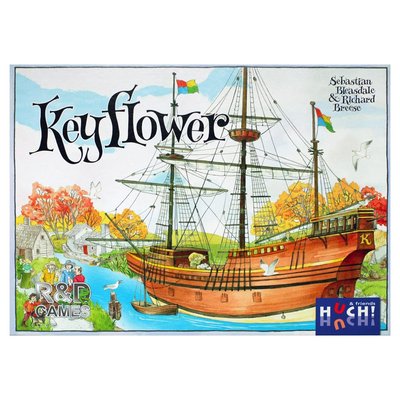
Yeah. This one is called Keyflower. Came out in 2012 designed by Sebastian Blesdale as well as Richard Breeze. And this is a Euro style auction game where you're trying to also build uh kind of like your city town.
It's hard to explain. That sort of started the entire key series. So, I forgot the names of the other key games.
Key market.
Yeah, Key Market was one.
Key something, but Keyflower was actually the only one that I played of the series. And in this game, you're trying to build out your own sort of village, I guess, of tiles.
But there are two parts to the game. There's this auction mechanic where all of the tiles start off in the middle of the table and can be both used and auctioned off sort of in the same time phase. Yeah.
Yeah. And so you're bidding with different colors of workers, but you're also using those workers to activate the tile if you don't necessarily want to bid on them. Yeah.
So your entire economy is built off of these workers that you have. And there are three different colors of workers and you have to keep them hidden. So nobody knows exactly what color combination of workers you have. This is important because as soon as a worker gets assigned to a tile that's maybe in the market, whether it's to activate the ability of the tile or just to bid on it, then everybody else has to follow the same color. And if you maybe don't have any of that color or only have one, then that could be a big problem for you. So, you kind of have to zag.
Yeah. So, if Mo'Nique wants a tile and she's bidding on it, she could put maybe one red mele out there. Mhm.
Uh if you want to outbid her, you have to put at least two red, specifically meeples on there. You can't use white. You can't use blue. It has to be red. And that's the significance of the colors of the meuples. It's it once a a tile is being established with at least one particular color on it, then forever for the rest of that phase around, only that color can be used to either bid or activate that tile.
And the auction mechanic is actually a lot more robust than that. there's there are a ton of rules in terms of well if you're out bid then you can use the meuples that you had assigned to that uh tile to bid on a different tile instead. So there are ways to jump ship. You can also add additional ones from behind your screen. But the whole point of this is each tile does something different. Some tiles will gain you these resources that you can use to eventually turn in for points or each tile is upgradeable. So, some tiles allow you to deliver more resources around your village because at the end of the round, the player who bid the most amount of meuples in each uh tile will actually get the tile to add to their own sort of village area. Starting with the next round onwards, other people can place their meuples on the tiles that are in your area. So, that is sort of the thing that makes Keyflower unique is it's worker placement, but you are auctioning the tiles to keep for yourself and other people can still place their workers to activate your tiles. Like everybody is like working on their own individual parts of the community. So you can still use their tiles.
I can use your buildings just as much as you can use mine. So let's say I put out a red worker on Mon'nique's building to activate it. I get to use all the benefits of it.
And if she wants to use it, then she has to put out at least two on top of that and the next person has to put three on top of that. But no building or tile can ever have more than six total workers on it. So that's kind of the cap. But the thing that's nice if you own this particular building that everybody wants is all the different workers that end up on top of it become yours for the next round
for bidding power for bidding power
or activation power. Just these workers are like the key currency in the game.
Yeah. And so also when you go into the auctions phase um any workers that were actually used in the winning bid
go into the bag. So they're out of your personal supply. So like okay I won this thing with three of my workers. Well, now I have three less workers going forward. But any uh workers that you maybe had in an area that didn't win uh the bid that were basically part of the loss, you can take them back into your own personal supply. So, you're not completely hosed on that.
Yeah. And you will get workers from round to round additional ones that are coming to you, but you also bid on the number of workers and combination of resources that you'll get for the next round. So, it's a really interesting uh combination of this this auction plus worker placement that you don't really see in other games. You know, this is a worker placement game or like a game that has a euroy feel, but just so much player interaction. It's constant player interaction and you're really head down in the game the whole time because of this like really interesting combination of do I auction, do I um activate the tile, what is going to be the most beneficial to me, especially in the long run. Now, it's also kind of difficult to figure out how to score points because some of these tiles, you can win them, but they don't they won't score you points at the end of the game.
Y
So, certain tiles will allow you to upgrade them in order to score points, but you need to there's like this mechanic in the game where you have to deliver resources to that tile in your area. And delivering resources is also sort of a limited type of action.
So, it's really a little bit complicated to explain without like actually playing the you have like a tile that has like this horsedrawn carriage on it and that basically indicates like how far can you send out these resources because the tiles that you need to upgrade they may be branched off by several different tiles and it's like I need to get this one upgraded
but I have this wood sitting here and I need to have enough action points to actually move that wood along to get to the tile that needs it to be upgraded so that you can score points and make that action on that particular tile better. So there's a lot going on. Uh we played I think did we play a full six? Yes,
I think we played a full six. So, there's a lot of competition. Um, a lot of different workers that are going to go around and kind of get mixed and matched. And what the part that I really enjoyed about the game or I appreciate about the game that the rule was made was the fact that if you're getting outbid on a particular tile, you can still use the the workers that you had previously bid there. You can basically pick them up, attach them to somewhere somewhere else, and then go to a different tile and bid with them as long as you're following the uh the color rule for the workers.
Yes. and you just cannot move bids uh from a tile that you are currently winning, right? So those those uh workers become locked in there. And that is really interesting. I think it's done really really well. This is the heaviest of the four games that we played.
Yep.
Um you know, two two of the games that we mentioned today are more of the the entry sort of style or weight of game. This one is definitely more meteor. And I think you really want to play at minimum four, right?
Yeah. because of the way the auction like works out like you want competition on all these different tiles. Yeah. And there's x amount of tiles out depending on player count. So with the full complement, I think there was like 10 tiles to bid on.
Yeah.
Um you just never quite know. You know, you can try to track like what color workers people have, but over the course of the game as tiles start getting taken and there's workers on them and people's cards they come, you know, you start to lose track. Uh there is also a special uh green worker that players can get and that that can kind of create an issue where you have to follow the rule. If somebody has this green worker
and they are first to act and they go and put that green worker out to be the thing that you use to bid. If you have no green workers, you can't be participating in that either activating the tile or bidding on it. So
they can lock people out.
They can lock people out, but it's not it's not punitive or anything like that. like it because you can still activate it in a future turn. Like one player gets this tile by using the green, then that green is now out of of supply on the next round when that person has that tile and it's like, "Okay, I'm going to activate it. I'm going to use my white mele to go over there and do it." So, uh, it's clever. Very, very clever. Smooth. Uh, lots of interaction.
The tempo of the game is really nice, too, because you're the entire round, you're literally just going around and around, and on your turn, you're either bidding or you're activating.
Yeah. You can also uh pass and get back in which I really appreciate because you can see kind of what people are doing.
Yeah. So, the tempo is really nice. The you know, the round doesn't end until all players have passed consecutively. So, it's it's really well done. This is a game that I enjoyed at the six, the full six,
but probably the more the better. And so, I enjoyed Keyflower a lot. I'm really glad that we have it that's going to stay in our collection.
Uh again, we've never played any of the other key
titles in the series. If you played any of them, let us know which one your favorite is. Or
I think there's one where like you fold cards like
I think they have a different mechanic.
Yeah. Every every single one is a little different. Yeah.
Yeah. I don't think they're like expansions of Keyflower are built off of it. It's just the same sort of world,
but different mechanics or mechanisms. But anyway, let us know what you think of the game or any of the other uh key games in the series. But that is Keyflower.
There you go.
Well, there you have it. Those were four older games that we wanted to talk about today. Yeah, let us know if you have any recommendations for any older classics, especially now that we're in 2025.
What What is the definition of a classic now, right?
2015 or before, maybe.
Maybe. I guess 2015 like that doesn't even sound that long ago, but I guess it was years now.
So, let us know because this is a continued journey for us. You know, we we really love uh exploring and finding just like older gems and this is going to be an ongoing adventure, I think. So,
well, thank you all so much for watching the video. We hope you enjoyed it. If you'd like to see more videos like this in the future, please consider subscribing.
Thank you.
Thanks.
Bye.