/pic25644.jpg)










Stratego Deep Dive
What the Community Thinks About Stratego
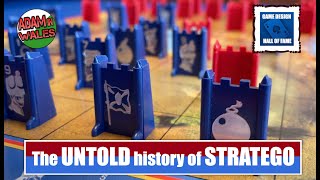
Stratego occupies a rare space in board gaming history: a 1946 classic that has remained genuinely enjoyable to revisit across multiple generations. Reviewers like Adam in Wales and Grant Lyon consistently highlight its elegant simplicity and the psychological depth it achieves through hidden information. Unlike many decades-old games that feel quaint or cumbersome by modern standards, Stratego has aged remarkably well, earning respect not just as a historical artifact but as a game worth playing right now.
Core Mechanics That Define Stratego
Hidden Ranks and Information Asymmetry
The heart of Stratego is its central asymmetry: you see your own army's strength but nothing of your opponent's until pieces make contact. Each player deploys ranked pieces facing away from the opponent on a ten-by-ten grid, and ranks are revealed only when combat occurs. Higher ranks defeat lower ones, but the lowly Spy can defeat the highest-ranked Marshal, and only Miners can safely defuse Bombs, creating a web of hard counters. This tiered system means no single piece dominates, and every unit has a moment where it matters.
Deduction Through Memory and Bluffing
As pieces are revealed through battle, both players build a mental map of the opposing army's composition and positioning. Bluffing separates casual players from tactical ones: moving a weak piece confidently across the board can trick opponents into avoiding what they assume is a stronger unit, while guarding an unremarkable square as if it hides the Flag can bait defenders into wasting resources on false leads. This interplay of deduction, memory, and deliberately misleading movement is what keeps Stratego feeling fresh from match to match.
The Stratego Experience
A Satisfying Cat-and-Mouse Tension
Stratego creates a distinctive psychological dynamic. From the moment pieces touch, both players shift into detective mode, watching for patterns that betray an opponent's strong units or the Flag's location. Each correct deduction is rewarding, and catching an opponent in a bluff or correctly predicting where a high-value piece lurks generates genuine satisfaction. The game becomes a battle not just of armies but of wills, where reading your opponent's tendencies and confidence becomes as important as the board state itself.
Cramped Openings Giving Way to Mid-Game Tactics
Stratego has a distinctive rhythm. The opening is necessarily cramped, with pieces densely packed in their deployment zones, so players make exploratory attacks to clear the front and probe for weaknesses. This phase can feel like a grind, demanding patience before tactical depth emerges. Once a wedge is driven through the opposing formation and the board opens up, the game transforms into a tense affair of calculated positioning, traps, and careful use of long-range Scouts to locate the Flag without overextending. For players willing to push through the opening, the payoff is compelling head-to-head strategy.
What Makes Stratego Stand Out
Universal Accessibility Paired With Strategic Depth
Stratego's rule set is refreshingly compact. Movement, combat resolution, and the win condition can be taught in minutes, making it accessible to players of any age or background. Yet the gap between casual and skillful play is vast. Experienced players understand placement psychology, optimal Bomb positioning, Flag concealment, Scout management, and the art of false confidence. This combination of straightforward mechanics with a high strategic ceiling has kept Stratego relevant for nearly eighty years, far longer than most games manage.
A Bridge Between Abstract Strategy and Hidden Information
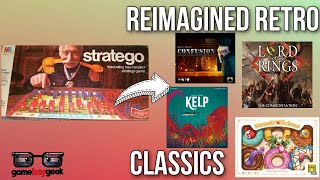
Stratego sits between perfect-information abstracts like chess and the hidden-information games that came later. It proves that strategy does not require full information; in fact, the fog of war forces different skills: deduction, memory, bluffing, and psychological reading. Many later titles, from The Lord of the Rings: Confrontation to hidden-movement games like Scotland Yard, owe a conceptual debt to Stratego's framework. It remains a pure expression of tactical play driven by hidden deployment rather than luck or narrative.
Potential Drawbacks
Setup and Early Pacing Can Test Patience
Players new to Stratego often cite the setup phase as a point of friction. Deciding piece placement requires genuine thought, and because there is no single correct arrangement, first-timers can feel paralyzed by options. The opening turns, when the board is too cramped for clever maneuvers, can feel procedural. Players accustomed to modern designs where engagement begins immediately may struggle with the reality that Stratego's most satisfying moments arrive only after many turns of grinding out information.
Memory Burden and Cognitive Load
Winning at Stratego demands sustained attention and memory. Tracking the positions and revealed values of pieces across a hundred-square board, then anticipating opponent moves based on past behavior, imposes real mental overhead. Unlike chess, where the board state is fully visible, Stratego requires constant reconstruction of the opponent's hidden army from memory. For some players this is exhausting; for others it is precisely the appeal. Younger players or those with weaker spatial memory may find themselves at a persistent disadvantage.
If You Enjoy Stratego
Players drawn to Stratego's deductive, hidden-information core will find a natural progression in The Lord of the Rings: Confrontation, which streamlines Stratego's mechanics and layers on asymmetric powers and a thematic lens. For a different flavor of hidden information paired with bluffing, Scotland Yard delivers hidden movement as detectives try to corner Mr. X, turning the asymmetry sideways. Fans of the psychological duel and misdirection should try Mr. Jack, where asymmetric roles and hidden identity create a comparable cat-and-mouse dance of deduction. And those who love the pure abstract battle will appreciate chess as the perfect-information counterpoint that Stratego so often invites comparison to.
What Reviewers Are Saying
"One of the few gaming moments as satisfying as convincing your opponent that your low-valued piece is actually a prize to be won, guarding it and moving it across the grid with your opponent's piece in pursuit, only to reveal that they were chasing a decoy."
— Adam in Wales
"Stratego is a capture-the-flag game, kind of like chess where you're trying to take the king. But pieces are only revealed when they're used, and then they go back to being hidden, so there's an element of misdirection and memorization. It's not as deep as chess, but it's just as easy to teach and I think a bit more fun."
— Grant Lyon
"You might move a particularly weak piece, but move it in a really confident way to imply that it's much stronger than it is, thereby drawing your opponent into a trap. It's not outright lying, but it's bluffing, and that's where the game comes alive."
— Adam in Wales