










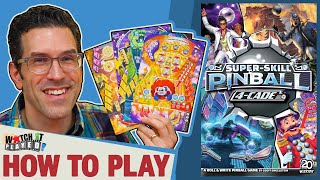





Super-Skill Pinball: Ramp it Up! Deep Dive
What the Community Thinks About Super-Skill Pinball: Ramp it Up!
Reviewers and tutorial creators tend to describe Super-Skill Pinball: Ramp it Up! as a roll-and-write game that works best for people who already enjoy the feel of a real pinball machine. It is a standalone sequel to Super-Skill Pinball: 4-Cade, and Board Games Unlocked put the relationship plainly: if you like the earlier game you will likely like this one, and if you do not, this one will not change your mind. That commentary treats the two as nearly identical in play, with the new release mainly adding four fresh tables.
Praise centers on how well the game captures the rhythm of pinball using dice and paper. Commentators say the beginner set makes it quick to start, that the rulebook is clean and straightforward, and that there is enough dice mitigation and multipliers that players do not feel stuck with whatever number they roll. Criticism is mostly about scope rather than quality. The game is seen as needing more content, and the separate boxes make the collection awkward to store.
Core Mechanics That Define Super-Skill Pinball: Ramp it Up!
Dice Choices That Move the Ball Down the Board
Each round, two dice are rolled and every player simultaneously chooses one of the values to use. The chosen number decides which open spot the ball can fill, and each turn the ball must drop to a lower section, with the start of a round as the exception. Filling a spot triggers its benefit, which might be points, a skill shot, or a bonus. When a player has no legal place to move, the ball falls out below the board and that player's round ends. The tutorial creator stresses that each choice involves a trade-off between a safe fill and a more ambitious route toward a valuable spot.
Flippers, Colored Spots, and Launching Back Up
The ball can only be sent back up from a flipper, and the background colors of the spots determine what a flipper can reach. A flipper can launch the ball to any spot in a matching color, and red ramps lead up into the upper areas, including the back glass portion of the machine. Players have to manage flipper use carefully, because each time a flipper is used the fewer options remain for launching back into the top of the board. Landing in an outlane can also score two points for every filled red flipper box, so the flippers are a source of points as well as movement.
Nudging and the Tilt Risk
Players can nudge a die to change its value, but nudges are limited to three uses across the whole game. The player records the difference between the original number and the new one on the board, and then uses the altered value. The next roll checks for a tilt. If the difference between the two dice is smaller than the nudge value, the round ends immediately. The risk is limited to that one turn, which makes nudging a deliberate gamble rather than a routine move. Board Games Unlocked describes the nudge as thematically cool, since it recreates the moment of pushing a physical machine and risking a tilt.
Multiball, Score Multipliers, and Skill Shots
Bonuses unlocked by completing spots add variety to scoring. A skill shot lets a player bank a die value to use later in the round. Multiball puts a second ball in play, and while two balls are active, the points earned are doubled. On the Gopher Gold table, the Flume Loop rewards consecutive passes with rising point values, and a score track runs all the way up to 600 points. The tutorial notes that scores can climb very high once these multipliers come into play.
The Super-Skill Pinball: Ramp it Up! Experience
A Real Pinball Feel in a Compact Box
The strongest sense of experience comes from how closely the game imitates pinball. Players roll dice, choose a number, move a small ball down the machine, and then flip it back up to chase combos before it drains. Board Games Unlocked notes that players who have experienced physical pinball machines tend to get more into the theme, while people who have never played one are often less interested. Foster the Meeple calls the game addicting, and says that the pinball framing is a big part of why players keep trying to beat their previous scores.
Quick Play With a Puzzle Rhythm
The game is described as quick and puzzle-like rather than heavy. Foster the Meeple says it plays quickly, although a very skilled player may find the game takes a little longer. The decisions on each turn feel like a small logic puzzle, with each die value pointing toward a different target on the board. Reviewers appreciate that the experience stays engaging across a session without requiring a large commitment of time or attention.
What Makes Super-Skill Pinball: Ramp it Up! Stand Out
Four Tables in One Box
The game includes four tables, Gopher Gold, Pin Pals, High Roller Heist, and Top Speed, and each one has its own theme and scoring twists. Gopher Gold is the table the tutorial walks through in detail, with spots for numbers, bumpers, flippers, and the Flume Loop. Pin Pals adds a teammate mode in which partners work together to earn bonuses. High Roller Heist is a casino caper in which a guard can send the ball to jail, and Top Speed adds a speedometer that raises the value of die results. Foster the Meeple notes that the sets play slightly differently from one another and that the box includes varying levels of difficulty.
An Easy Entry Point With a Clean Rulebook
Commentators single out the beginner set and the rulebook for making the game approachable. The quick setup lets newcomers follow a short set of simple rules and start playing right away. The full rulebook then covers the finer points, explaining each section of the board and how points are earned. Board Games Unlocked describes the rulebook as very clean, simple, and straightforward, and says the roll-and-write design lets players feel good about using their dice.
Potential Drawbacks
Limited Content and Overlap With the Predecessor
The most common criticism is that the game does not change much from Super-Skill Pinball: 4-Cade. Board Games Unlocked describes the new release as adding new machines without doing anything wholly different from the earlier game, and the commentary concludes that the line needs more content overall. The commentator also points out that the boxes are tiny and compact and cannot be combined, so anyone who owns both has to keep two separate boxes for what is essentially the same game. A larger box that could hold every table together would be a welcome improvement.
Dependence on Pinball Familiarity and Limited Options on Doubles
Enjoyment depends partly on the player's comfort with pinball, since players unfamiliar with real machines may not connect with the theme. In play, rolling doubles narrows the choices. The tutorial notes that there is no special effect when doubles are rolled, only fewer options to choose from. Once the flippers fill up, players can run short on ways to launch the ball back up, which can leave later turns with fewer high-value targets.
If You Enjoy Super-Skill Pinball: Ramp it Up!
Readers who enjoy quick roll-and-write games with a physical pinball flavor are the most likely audience for this one, especially if they have played a real pinball machine. Board Games Unlocked describes the design as a roll-and-write for a niche audience, which suits people who enjoy chasing high scores, planning flipper routes, and taking calculated risks with nudges. Players who already like the earlier 4-Cade game can step in directly, and anyone who wants more variety may want to look at the other tables in the series.
What Reviewers Are Saying
"But basically if you like this, you're going to like this. If you don't like this, you're not going to like this. They're pretty much the exact same game"
— Board Games Unlocked
"both are amazing with these games it's like you are playing a pinball machine but it is a rolling right"
— Foster the Meeple
"every single round of the game these dice are going to be rolled and everyone is going to move their pinball once and"
— Getting Games