/pic8805857.jpg)




























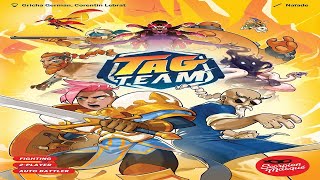




Tag Team Deep Dive
What the Community Thinks About Tag Team
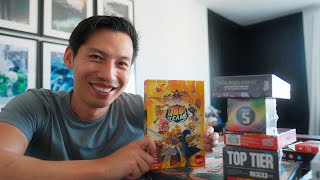
Tag Team, the two-player auto battler from Scorpion Mask, has earned wide enthusiasm from reviewers who see it as one of the standout two-player games of 2025. Board Stupid called it a "certified banger" and placed it among their top games of the year, with one host declaring it "the two-player game of the year." Adam in Wales (Board Game Design) placed it at number five on his annual list, citing the buzz and the inventiveness of its core mechanic. Going Analog described it as a game outside their usual wheelhouse that genuinely surprised them, and Our Family Plays Games recommended it as a holiday gift for anyone wanting a quick, accessible head-to-head experience.
The consensus is that Tag Team does something specific extremely well: it delivers the feel of a classic arcade fighting game in a tightly designed card package that plays in around 15 minutes. Reviewers consistently emphasize that "short" does not mean "shallow." Board Stupid put it plainly: "It's a popcorny game, but it's not a simple game. And it doesn't mean it's not deep." Tim Chuon played it five times in quick succession after Gen Con, calling it something genuinely new to him in board gaming. Board Game Hangover praised the characters as the game's best feature, noting the combinations between paired characters create what feels like "almost infinite options."
Where reviewers are more measured is on longevity. Board Stupid raised the question of how many legs the base box has once players have worked through their preferred character pairings, and Board Game Hangover flagged luck of the draw as a potential friction point. These are real concerns, but no reviewer treats them as dealbreakers.
Core Mechanics That Define Tag Team
Deck Building with Fixed Order
Tag Team was designed by Quartier Labraat and published by Scorpion Mask, the same publisher behind Sky Team. The game opens with two players combining the starting cards of their two chosen characters into a single small deck. Players reveal cards simultaneously and resolve their effects, but the defining rule is that the deck order is never reshuffled. When new cards are added after each round, the player inserts them at a chosen position in the existing sequence without disturbing the cards already there.
This constraint is the heart of the game. Because you add a card to the top, middle, or end of your growing deck without reordering it, both players gradually develop a working map of their opponent's likely sequence. Going Analog described recognizing that "my second card was an attack and his second card was always a shield," then inserting a card to shift that attack to a later position. Board Stupid called this the "interesting memory game that comes into it, where you're playing the player a little bit." Tim Chuon described it as an auto battler system unlike anything he had encountered: "You start off very simple. You know which two cards the other person has. And then you layer on this really interesting strategy that becomes so much more complex as the game goes on."
Asymmetric Character Decks and Smash Building
The second defining mechanic is the combination of two character decks into one, giving each player a team rather than a single fighter. Board Stupid coined the term "smash builder" for this approach, comparing it to the AEG game Smash Up. Each of the 12 characters comes with a unique set of cards, tokens, and sometimes special tracking components.
The characters are genuinely distinct. Board Stupid described Melody, who sets up delayed schemes that fire on future turns; a knight who buffs up through idle turns before a single devastating attack; and Bodvar, who has a rage tracker Tim Chuon described vividly: "A lot of his cards will increase his rage every single turn, so it's almost like a ticking time bomb. As soon as Bodvar reaches the very top, he switches over to his bear form and becomes an absolute monster." The synergy between two paired characters is where the game's replay value lives. Going Analog described pairing the bear character with a monk who heals: "If I could keep him alive, eventually he'll turn into the bear." A draft mode for experienced players adds another layer, letting players pick characters and eliminate combinations to deny opponents key synergies.
The Tag Team Experience
Confrontational and Intensely Interactive
Tag Team is built around direct conflict, and reviewers describe the experience as genuinely aggressive in the best possible way. Board Stupid put it directly: "It's a one versus one game. It's very back and forth. It's very aggro. The game is designed like that, but you can't get salty about it because it'll be done in 15 minutes." Every card either attacks the opponent, defends against their attacks, or sets up a chain for a future turn. There is nowhere to hide.
What elevates this beyond simple aggression is the mind-game layer. Because decks are never shuffled, both players accumulate real knowledge of each other's likely card sequence. Tim Chuon described the pleasure explicitly: "I love being able to read my opponent. If I know they're going to open up with an attack, boom, here I have a shield that completely blocks it." Board Stupid compared the loop to putting coins in an arcade machine: "You put another 50p in. You fight. You lose again. And you put another 50p in." The intensity is real, but the short game length makes it sustainable.
Quick, Satisfying, and Breezy
Reviewers consistently return to the pleasure of the card reveal. Board Game Hangover described flipping as one of the game's best qualities: "Just flip a card and see what happens. It is full of emotions. Will he defend against my attack that I just put into the deck? Will he do something else?" When the cards play out the way you planned, it rewards the thinking you put into deck construction. When they do not, the game is short enough that you immediately want to try again.
Board Stupid captured the breezy quality: "The game is done and dusted in 15 minutes. You can knock out a few of them. It's kind of a popcorn game. You want to keep playing more. You want to keep exploring the different combinations between the characters." Tim Chuon, after five plays in quick succession, said simply: "This game is so good and I can't wait to talk about it more."
What Makes Tag Team Stand Out
Character Depth and Diversity
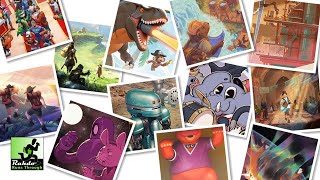
Reviewers consistently single out the characters as the game's standout achievement. Adam in Wales noted that "the character abilities are diverse and inventive," and cited the vibrant illustrations by Niad, the artist behind Tokaido and Seasons, as a key part of the appeal. Board Stupid emphasized that each character is fully defined with a distinct style and complexity rating, so players know at a glance whether a character is beginner-friendly or requires deeper knowledge. Board Game Hangover put the combination aspect well: "Each time you will play with two characters and take both of their decks, shuffle them together, and play these cards, which means you can build almost what feels like infinite options for yourself." With 12 characters in the box, most sessions present something players have not encountered before.
Accessibility Combined with Strategic Depth
Tag Team threads a genuine needle between accessibility and meaningful decision-making. Board Game Hangover described it as perfect for players who want a warm-up before something bigger, while also noting it works just as well for mobile phone gamers or anyone new to hobby games. Our Family Plays Games recommended it as a gift precisely because of this quality. Board Stupid placed it at the "top of intermediate" in complexity, noting that while a new player can get into it easily, the deck-building decisions and character-specific rules reward investment in learning the archetypes. Going Analog noted that the game taught them things about their own preferences: "This is not normally our wheelhouse," yet they found genuine engagement with the mind-game layer.
Potential Drawbacks
Luck in Card Draw
Board Game Hangover identified luck of the draw as the most significant potential dealbreaker. When a deck runs out and a player draws three new cards to choose from, the quality of those options is outside the player's control. "Sometimes you will get the damage you're looking for the whole game. And sometimes you won't. You might plan really carefully about where to place your card, remember all of your opponent's cards, and because of luck where the opponent placed a card without thinking, it might ruin everything you set up." Players who strongly dislike randomness in outcomes may find this frustrating, particularly in a game where the rest of the experience rewards careful planning and opponent reading.
Longevity With the Base Box
Board Stupid raised a clear-eyed concern about long-term staying power. With 12 characters, the number of possible two-character combinations is substantial but not unlimited. Once experienced players have worked through their preferred pairings, the novelty of discovering new interactions diminishes. "How many legs has it got?" was the question Board Stupid posed directly. They answered it partly by noting the Arthurian Legends expansion was already teased inside the box. For players who do not purchase expansions, the base box has real but finite combinatorial space.
If You Enjoy Tag Team
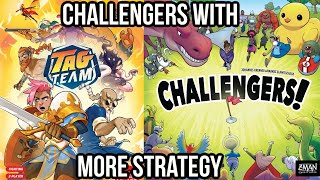
Board Stupid drew the clearest parallel to Dice Throne, describing Tag Team as delivering similar head-to-head asymmetric character combat in a shorter format: "It's like Dice Throne with less setup time. It gives me a lot of the Dice Throne vibes." Board Game Hangover recommended Challengers for players who want the same card-flipping energy with more people at the table. Adam in Wales compared the deck-merging approach to the AEG game Smash Up. Board Stupid also compared Tag Team to Sky Team, noting both games share a commitment to a focused, tight experience in a compact box from Scorpion Mask.
What Reviewers Are Saying
"It's such a fun combination of a little bit of deck building combined with an auto battler in this very interactive one versus one Street Fighter, Marvel vs. Capcom inspired arcade feeling game. You stick your 50 pence in the machine, you fight, and then you go again. It's really enjoyable. Lots of fun in the experience of smashing two different fighters together and seeing what sort of combos come out of it."
— Board Stupid
"I've really grown to love this auto battling system that I've never seen before in a game. It's so fun because I love being able to read my opponent. It makes me way more interested in this sort of system where you don't always have cards to draw and to play in whichever order you want, but instead putting them in a specific sequence and being able to read your opponent makes it extremely satisfying."
— Tim Chuon
"My favorite thing about this board game is the standoff. When the round ends and we have played all the cards, we flip them around and then try to figure out where to place a new card inside of our deck, because we cannot shuffle it. And this choice is freaking amazing."
— Board Game Hangover