











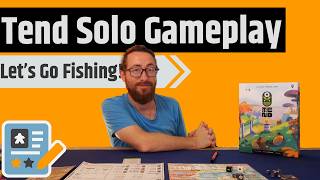










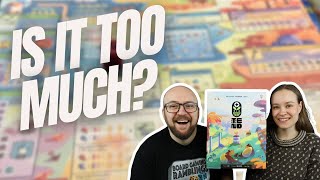






In Tend, players take on the role of a pioneer working for the Zenith corporation to start a homestead on a new alien world.
Tend is a "flip and write" game where players are each building up their own farm and collecting the greatest selection of goods to send back to Zenith HQ for study. All players will be using the same deck of action cards each round to simultaneously take actions on their own sheets.
As the game progresses new cards will be added to the shared deck, changing what actions are available for the whole table throughout the course of the game.
Players earn victory points for collecting badges, completing season objectives, being the best neighbor, and filling up their Cargo Manifest with goods to send back to Zenith HQ. In the end, the player with the most victory points wins!
—description from the designer
- strong strategic depth with multiple victory paths
- high replayability due to variable cargo manifests and seasonal bonuses
- premium production and tactile components
- high complexity and setup time; demanding commitment for longer sessions
- farming and long-term strategic planning with resource chaining
- alien planet colonized by an off-world agriculture corporation
- Euro-style puzzle with heavy planning and tactile stamping mechanics
- Stardew Valley
- Three Sisters
Mechanics (from transcript analysis)
- cargo manifest polyomino puzzle — Fitting shapes into a grid to score and unlock bonuses.
- end game bonuses — Seasonal bonuses modify available actions and trigger cascading effects.
- resource-to-upgrade progression — Resources convert into upgrades or stamps on cargo manifest.
- seasonal objectives and bonuses — Seasonal bonuses modify available actions and trigger cascading effects.
- Simultaneous action selection — Players choose actions from a shared deck each round.
- Simultaneous Actions — Players choose actions from a shared deck each round.
Video topics + discussion points
Quotes (from this video)
- Tend absolutely crushes the other two on mechanics alone.
- Theme integration in Stardew is genuinely strong if you care about that experience.
- Three Sisters is the best value proposition and the most universally enjoyable for casual groups.
References (from this video)
- Engaging solo mode with tactile stamping and scratching mechanics
- Stardew Valley-inspired feel for farming/mining loop, but with a distinct flip-and-write tempo
- Clear progression through upgrades and distinct seasonal scoring tracks
- Multiple viable scoring paths (cargo manifest, neighbor interactions, badges) that support replayability
- High price point noted as a potential barrier
- Learning curve and table presence may deter new players
- Possible longer play sessions for a thorough solo run
- Some players may find the iconography and setup complexity intimidating
- Resource management, farming, crafting, tool upgrades, and neighbor interaction
- Farming village with woodlands, rivers, and mines; seasonal progression
- Sandbox strategy with tactile, card-driven actions and growth milestones
- Stardew Valley
Mechanics (from transcript analysis)
- Action selection from five cards — Each turn you choose two actions from a pool of five available action cards.
- Badges and energy/resource tokens — Badges provide end-game bonuses; energy bars grant extra actions during a round.
- Cargo manifest scoring with color modifiers — Points are earned by filling cargo slots; certain colors yield bonus points or zero points depending on column.
- Dice rolling — Rolling to determine internal rewards or items found in geodes; adds an element of chance tied to exploration.
- Geode-like luck/dice mechanic (through dice for geodes and fishing rewards) — Rolling to determine internal rewards or items found in geodes; adds an element of chance tied to exploration.
- Neighbor gifting and card selection — Gifting items to neighbors grants rewards and can influence end-game scoring paths.
- Scratch card and growth phase — Scratch to reveal resources and trigger growth, affecting scoring and progress.
- Seasonal scoring tracks — Scoring happens across multiple seasons (Season 1, Season 2, Season 3) with round-based progression.
- Track advancement — Upgrades unlock more efficient actions and higher potential outputs; progress is tracked across different tracks.
- Upgrade tracks (mining, chopping, tending, and tool upgrades) — Upgrades unlock more efficient actions and higher potential outputs; progress is tracked across different tracks.
Video topics + discussion points
Quotes (from this video)
- Stardew Valley-esque. Absolutely wonderful.
- I'm really enjoying this game.
- it's a crunchy flip and write
- This is going to be exciting.
- Oh, and I forgot something.
References (from this video)
- Inclusion of a solo mode, appealing to solo players.
- High replayability through rotating decks, seasonal cards, and modular components.
- Strong thematic coherence with cozy farming vibes (crops, livestock, fishing, neighbors).
- Tactile, well-presented prototype components with clear organization for demonstration.
- Neighbor interaction adds dynamic player interaction and strategic depth.
- Clear potential for engaging campaign marketing and crowdfunding appeal.
- Complex rule set and multiple interlocking systems may present a steep learning curve.
- Prototype components are subject to change; final production may adjust balance and clarity.
- Estimated playtime of 90 minutes across 1-6 players could vary significantly with player count.
- Cargo manifest scoring and color adjacency rules may require careful tracking and planning.
- Potential for pacing issues mid-game due to simultaneous actions and deck evolution.
- Cozy farming simulation with emphasis on resource management, neighborhood relationships, and seasonal progression
- Cozy farming environment where players manage a farm, tending crops and animals, fishing, mining, and interacting with neighbors, all while building a cargo manifest for the Zenith Corporation.
- Emergent, player-driven storytelling through tile-placement, resource allocation, and score-chasing objectives across seasons
- Stardew Valley
- Animal Crossing
Mechanics (from transcript analysis)
- cargo manifest and resource conversion — Resources can be converted into coins or placed into a cargo manifest to earn victory points; placement depends on stamp shapes and colors.
- dice-based resource gathering — Crop and animal resources are represented by colored dice; harvesting and upgrading require managing dice faces and colors.
- flip-and-write — Each round presents five action cards; players simultaneously choose two to execute, with cards cycling and new ones entering the deck each round.
- Flip/Roll and Write — Each round presents five action cards; players simultaneously choose two to execute, with cards cycling and new ones entering the deck each round.
- neighbor gifting and social rewards — Gifting resources to neighboring players grants bonuses and end-game points, incentivizing interaction and strategy around who to help.
- Positive player interaction — Gifting resources to neighboring players grants bonuses and end-game points, incentivizing interaction and strategy around who to help.
- Resource management — Resources can be converted into coins or placed into a cargo manifest to earn victory points; placement depends on stamp shapes and colors.
- seasonal deck-building — Action cards are organized into seasons; new cards enter each round while some move toward a discard pile, altering future choices.
- upgrades, energy bars, and tools — Players can upgrade tending, fishing, and mining tools, plus energy bars that grant extra actions, adding a strategic upgrade path.
Video topics + discussion points
Quotes (from this video)
- I'm super excited to show off this game for you guys today.
- there is a solo mode so that is great for all of my solo players out there.
- this is going to be a flip and write
References (from this video)
Mechanics (from transcript analysis)
Video topics + discussion points
Quotes (from this video)
- you are somebody's reason to smile
- we are so close to 30,000 Garden members
- thank you all so much for watching and for your support
- I am leaving for Japan and I cannot wait to document it
References (from this video)
- lush, vibrant production and engaging thematic integration
- satisfying chaining of actions and upgrades
- strong solo mode with clear route to maximize scoring
- high replayability driven by evolving objectives and card flow
- engaging integration of crafting, mining, fishing, and farming tracks
- initial rule and iconography complexity can be intimidating
- managing multiple tracks and cards can feel fiddly during longer sessions
- some abstract scoring decisions may be non-intuitive at first
- solo mode requires careful internal bookkeeping since there are no real neighbors
- resource management, community-building logistics, and a garden/woodland economy
- A woodland-farm village with tendable crops, mining and fishing zones, and a growing infrastructure
- sandbox, objective-driven, with evolving seasons and built around a cargo-manifest economy
- Hadrian's Wall
- Draft & Write Records
- Void Fall
- Revenant
- Story Fold
- Wild Woods
- Mythwind
Mechanics (from transcript analysis)
- action selection — each round offers five actions; players choose two to perform, and new actions refill from a deck in subsequent rounds
- badges and exploration — completing badge rows grants end-game points; woods explorer, stones, and sap-related objectives influence planning
- cargo manifest and scoring grid — resources are placed on a central manifest/board, forming rows and shapes that score at season ends
- dice-driven scratch-off resources — progress is revealed by scratching boxes on action-dice tiles to yield resources
- energy bars and action economy — energy bars temporarily amplify action capability, enabling extra actions within a round
- seasonal objectives and end-game scoring — three seasons with escalating goals and scoring, plus long-term strategies around completing rows and badges
- tool and upgrade progression — players upgrade tools (e.g., pickaxe, fishing rod) to access more powerful actions and deeper levels
Video topics + discussion points
Quotes (from this video)
- Ivy games are so extra and Tend is no exception
- this game is absolutely gorgeous
- I am genuinely excited to jump into it right now
- I love this game and I think Tend is my new favorite from Ivy Games
- the overlay on this stream looks fantastic and I want to replicate it
- I think this is actually my best score so far in solo Tend
References (from this video)
- Instructional design that teaches mechanics through early, approachable puzzles
- Compact, travel-friendly packaging and format that fits in a bag or small box
- Strong visual design and thoughtful puzzle ergonomics that feel cohesive and premium
- Some puzzles can be quite challenging and may deter casual players
- No explicit on-video rating is provided, which can leave viewers unsure of relative value
- Advanced puzzles can require repeated attempts to master, potentially increasing barrier to entry
- Spatial reasoning and stacking puzzles themed around guiding shepherds and herds to gold goal spaces on a modular grid.
- A compact, book-style puzzle board with a grid, printed icons, and movable shepherd figures that interact with sheep-like stacks called herds.
- Tutorial-led exploration that gradually reveals mechanics through progressively challenging puzzles, with optional advanced challenges.
- Deck and Lock
Mechanics (from transcript analysis)
- grid movement — Players move shepherds on a grid; movement continues in a chosen direction until blocked by an edge or another piece.
- grid-based path movement — Players move shepherds on a grid; movement continues in a chosen direction until blocked by an edge or another piece.
- jumping over obstacles — Shepherds can jump over a single obstacle to land two spaces away, enabling selective bypassing of blocks.
- Layer building — Herds can be moved and stacked; their fixed shapes constrain movement and create new interaction possibilities.
- level progression with tutorials and stars — Puzzles increase in difficulty; some include optional challenges and star markers for advanced play.
- non-rotation and shape constraints — Certain pieces (herds) cannot be rotated, forcing players to respect specific movement patterns and alignments.
- Pattern Movement — Certain pieces (herds) cannot be rotated, forcing players to respect specific movement patterns and alignments.
- sliding and edge guidance — Puzzles emphasize sliding behavior where pieces repeatedly press toward the grid edge or obstacle, reinforcing forward planning.
- stacking and manipulating herds — Herds can be moved and stacked; their fixed shapes constrain movement and create new interaction possibilities.
Video topics + discussion points
Quotes (from this video)
- These puzzles are very simple because yes these are the tutorials. These like teach you the game, but believe me, the puzzles become a lot more complicated later on.
- This is a puzzle board game.
- I really enjoy it.
- This is a pretty small and nice box.
- I think this is like my favorite so far.
- It comes in a pretty small and nice box here, right? But essentially, you don't even need the box, right? This is a book. This is just a book.
- Puzzles get a lot more interesting as you progress, and the design really sells the whole experience.
- The art and components are very well executed; it feels premium despite the compact form.
References (from this video)
- Rich Euro-engine with multiple strategic directions and upgrade paths
- Engaging action-card tension and conditional bonuses
- Tactile components (stamps, scratch-offs) that reinforce theme and fun
- High production value and potential for varied replay
- Very expensive and physically bulky; scaling raises diminishing returns
- Iconography and UI can be dense, especially for new players
- Flow can be interrupted by the sheer quantity of resources and decisions
- Not ideal for large player counts; 4+ players feel bloated and slow
- Prescriptive scoring feel in a sandbox engine; sometimes lacks fluidity
- Corporate exploitation and resource management on an alien world
- Planet colonization overseen by the Zenith Corporation
- humorous, satirical take on corporate colonization
- A Feast for Odin
Mechanics (from transcript analysis)
- Action card selection with conditional bonuses — Each round you are dealt five action cards; you choose two and execute them; some cards unlock bonuses if conditions are met in future rounds
- Badge and cargo manifest scoring — Completing badge rows yields Zenith points; the cargo manifest provides additional scoring through resource placement and shapes
- Resource engine-building with upgrades — Invest in upgrading tools and infrastructure; upgrades increase efficiency and unlock new capabilities
- Scratch-off resource tracking and stamping — Two sheets dictate actions and rewards; you scratch off resources and stamp shapes that map to Tetris-like pieces for scoring
- Tetris-like placement with color adjacency constraints — Resources must be placed with color-specific adjacency rules; shapes must fit within a limited grid for points
Video topics + discussion points
Quotes (from this video)
- This is the size of a regular rolling right and this this is the result of an industry that's going through something.
- This is a really expensive game.
- Tend wants to subvert its genre.
- If you play this with anything more than four I dont want to do this but I will call the cops on you because there is just so much analysis paralysis.
- In my first games of Tend I was smitten. It was like playing an Uwe Rosenberg design but with the addition of fun activities like scratching off rewards and stamping things.
- The setup of the game is basically doing this and then setting up free decks of cards.
- If you want the full set for six players, it is £44 which then makes it significantly more expensive than a feast for Odin and Norwegians combined.
References (from this video)
- Cozy farming theme integrated with an alien planet setting
- Neighbor interaction adds meaningful social between players
- Tactile, randomized scratch-off sheets boost variability and fun
- Two-sheet flip-and-write structure is approachable yet offers depth
- Clear thematic integration with mechanics and scoring
- High replay potential due to randomized task cards and sheets
- Not all players will find it highly complex; it sits midweight
- Tracking resources can be challenging; no built-in tracker leads to memorization
- Luck-driven elements (dice and scratch-offs) can influence early progress
- Longer play time with 4-6 players; may require a timer to maintain pace
- Cascading conversions can be hard to manage without external aids
- Cozy, agricultural management with a light, resource-driven economy
- Alien planet; Zenith corporate farming operation tending flora, fauna, and resources
- Pragmatic, task-oriented farming in a modular, randomized environment
- Hadrian's Wall
- Hrien's Wall
- Rolling Realms
- Feast for Odin
Mechanics (from transcript analysis)
- action selection from randomized task cards — Each round you choose two actions from a pool of randomized task cards; more actions unlock over time
- Dice rolling — Dice rolls determine fishing and other actions, with upgrade options to improve outcomes
- dice-driven resource gathering — Dice rolls determine fishing and other actions, with upgrade options to improve outcomes
- flip-and-write — Players flip and write on dual sheets to mark fields, crops, and animals; mirrors Rosenberg-style farming games
- Flip/Roll and Write — Players flip and write on dual sheets to mark fields, crops, and animals; mirrors Rosenberg-style farming games
- neighbor interaction — You can give resources to a neighbor to gain neighbor rewards, driving positive player interaction
- neighbor interaction and rewards — You can give resources to a neighbor to gain neighbor rewards, driving positive player interaction
- Polyomino — Resources are converted into money and placed on a cargo manifest using tetraomino-like shapes for scoring
- polyomino/cargo manifest placement — Resources are converted into money and placed on a cargo manifest using tetraomino-like shapes for scoring
- randomized personal sheets with scratch-offs — Each player has a randomized sheet with scratch-off elements that reveal resources and opportunities
- resource cascades and multi-step conversions — Resources cascade through multiple conversions (coins → goods → symbols) with cascading effects
- Resource management — Resources cascade through multiple conversions (coins → goods → symbols) with cascading effects
- scoring via cargo and symbol columns — Points come from cargo manifest configurations and symbol-driven scoring on your sheet
Video topics + discussion points
Quotes (from this video)
- I give this game a 7.8 at 8 out of 10, which is exactly what this game averaged out to be
- For a quick game comparison, Hadrian's Wall is probably one that fits this the best
- I would play this again in a heartbeat
- Rolling Realms. That's like the competition and the bar for what I look for in a Roll and Write game
References (from this video)
- Deep, crunchy rolling-right with meaningful decisions
- High variability and replayability due to many objectives and upgrades
- Solo mode closely mirrors the multiplayer experience
- Compelling end-game scoring via cargo manifests and badges
- Highly thematic with a strong engine-building feel
- Hard to optimize everything; must focus on a few goals
- Steep learning curve and dense iconography
- Early luck in fishing and dice can hamper early progress
- Resource management, growth cycles, and spatial planning in a competitive/solo context.
- An alien-farm setting where players cultivate crops, raise animals, fish, and explore a modular field to score points.
- Abstract, procedural narrative driven by actions and tile placements rather than a linear story.
- Stardew Valley
Mechanics (from transcript analysis)
- badge_and_medal_scoring — Badges and medals reward players for completing patterns; these points contribute to final score.
- cargo_manifest_scoring — Players place resources into a cargo manifest; colors and shapes score at end-game with adjacency rules.
- Compound Scoring — Three scoring moments during the game (rounds 6, 10, end) tied to different objectives.
- Dice rolling — A dice-driven action system where players roll dice to determine available actions each round, selecting two tasks per round.
- income — A farming/mechanics matrix with tilled soil, crops, trellises, and animals that produce resources over time.
- neighbor_phase — Non-player neighbor reward system in multiplayer; in solo, neighbor phase is simulated by discarding a card for a neighbor bonus.
- resource_upgrade_and_action_tokens — Upgrades (hatchet, fishing rod, mining) provide more actions and enable deeper combos; energy bars grant extra actions.
- rolling_right — A dice-driven action system where players roll dice to determine available actions each round, selecting two tasks per round.
- seasonal_objectives_and_round_based_scoring — Three scoring moments during the game (rounds 6, 10, end) tied to different objectives.
- tile_and_field_growth — A farming/mechanics matrix with tilled soil, crops, trellises, and animals that produce resources over time.
Video topics + discussion points
Quotes (from this video)
- solo mode is almost identical to the regular game
- I love this game.
- This is the type of game where you have to like pick a couple things to focus on because if you focus on anything, you're definitely not going to do good.
- You can't focus on everything in this game.
References (from this video)
Mechanics (from transcript analysis)
Video topics + discussion points
Quotes (from this video)
- Stardew Valley the board game can be played solo.
- This is literally the cozy farming game you can find in a board game.
- I 1000% recommend this one.
References (from this video)
- Intuitive gameplay
- Excellent production quality
- Interesting combo mechanics
- Unique space farming theme
- Digital app integration
- Potential for analysis paralysis
- Difficulty tracking resources
- Space farming
- Alien planet
- Space exploration for Zenith Corporation
- Three Sisters
- A Feast for Odin
Mechanics (from transcript analysis)
- polyomino puzzle — Cargo manifest puzzle-solving
- Resource management — Collecting and spending resources for upgrades and cargo
- Roll and Write — Flip and write game with simultaneous action selection
Video topics + discussion points
Quotes (from this video)
- In space, no one can hear you moo
- They're not afraid to push the boundary of what a game can be and say 'why not more'
- It seems like everything stuck
References (from this video)
- Accessible to families and casuals
- Fast, quick, and replayable
- Less depth than heavier euro titles
- Rule looks may scare away some players
- Light, approachable drawing and route-like actions with a nature vibe
- Casual, light-hearted board game universe with fishing/mining/chopping themes
- Casual, family-friendly, with a touch of whimsy
- Adrian's Wall
Mechanics (from transcript analysis)
- Rolling rights/print-and-play style — Players fill out a small action set across a few rounds with rolling-like elements.
Video topics + discussion points
Quotes (from this video)
- Would you say that the main message behind this game is that only suckers take the bus?
- It's a masterpiece of a game.
- This is a big game actually. A roll and write, Tend.
- Aridia is a masterpiece of a game.
References (from this video)
- high tactile satisfaction
- strong planning and endgame scoring tension
- expensive and large component footprint
- industrial expansion and resource management
- Farm and mining frontier with Zenith headquarters
- tactile, scratch-card driven feedback loop
- Described as tactile, with direct comparison to other scratch-card games
Mechanics (from transcript analysis)
- Resource collection and end-of-round bonuses — round-based bonuses drive decisions and scoring
- Scratch cards / action-taking — players scratch and reveal actions, with combos and bonuses
Video topics + discussion points
Quotes (from this video)
- This is the kind of game you play when you want to feel smart.
- Everything feels like a good decision.
- The card play in this game is absolutely stellar.
- A lot of little things come together to feel cohesive and satisfying.
- You reap what you sew, you know, you need to be strategic and methodical about it.
References (from this video)
- deep engine-building with a clear upgrade ladder
- engaging interaction through shared action planning in a roll-and-write format
- thematic cohesion with a charming alien-farm vibe
- can be lengthy and dense for new players
- keeping track of multiple subsystems may be overwhelming
- farming, exploration, and resource automation
- alien farm with exploration, mining, and city-building vibes
- engine-building progression with a strong cause-and-effect arc
- Stardew Valley (video game) for vibe
- Terraforming Mars for engine-building scale
Mechanics (from transcript analysis)
- engine building — as you improve skills (mining, fishing, etc.), capabilities improve and unlock more actions.
- engine-building — as you improve skills (mining, fishing, etc.), capabilities improve and unlock more actions.
- Flip/Roll and Write — players roll and record results, then choose how to use outcomes to build their engine.
- progressive card-driven unlocks — cards that come out over time enable more powerful actions as you develop your farm.
- roll-and-write — players roll and record results, then choose how to use outcomes to build their engine.
Video topics + discussion points
Quotes (from this video)
- the map has all these different ways, and where they're located is very deduction-based
- this is a nice marriage of the two—cooperative play and deduction
- I love the pieces on this
- it's a good heavy euro where you have action bidding; you don't just place out a worker
- the interaction of the player spaces and the gears that you put out that allow you to basically pick from adjacent action spaces
- everything in this game is so logical and cohesive
References (from this video)
- cute visuals
- variety of activities (fishing, mining, tending)
- accessible for new players
- potentially punishing if you chase too many objectives
- tending crops/fish/mining in a festival-like setting
- garden-craft/draft-and-write themed tableau
- light, pastoral puzzle-driven
- Stardew Valley (vibe)
- Druid City (analogy)
Mechanics (from transcript analysis)
- draft and write — draft cards and write effects to grow your tableau
- multi-use actions — cards activate in multiple ways depending on your play
Video topics + discussion points
Quotes (from this video)
- I'm judging a little.
- I want a deluxe version of this game.
- This is a solo puzzle, and it's a five out of five for me.
- I would pay for a deluxe version.
- Skyrise is a crossover we both have in the same video.
- This is a fantastic set of games. This is a good set of games.
References (from this video)
- Thematic and production-forward with fun components
- Crowdfunding status could affect availability
- Sci-fi farm/colony management
- Planetary management with farming and mining
- Star-dominant with Zenith Corp. oversight
- Stardew Valley-inspired titles
- Planet-management games
Mechanics (from transcript analysis)
- deluxe components and theme integration — Stamp pens and color tokens emphasize production
- Resource collection and management — Crops, animals, mines, and cargo to fill a manifest.
Video topics + discussion points
Quotes (from this video)
- We rely on the generosity of all of us. And so if you like BG, please consider donating.
- Two great tastes taste great together.
- It's like war, but there's a million little knobs and levers.
References (from this video)
- amazing
- will be in top 50 next year
- prototype not ranked this year
- agriculture
- gardening
- Three Sisters
- Flip Town
Mechanics (from transcript analysis)
- Flip and Write — excellent flip and write game
Video topics + discussion points
Quotes (from this video)
- we're products of what we've played
- objectively most games are good
- the longer I'm in this hobby the more I have identified that I love very heavy strategic War based games
- people play games differently
- I just wish people would be a little bit more cognizant of what the people around the table are doing to the game
- every year there's a new card game that comes out that we just go head over heels for
- the odds that I'm going to get a chance to play this game are probably pretty limited
- I would argue none of them are like something I'm like itching to get out and play
- it's all about betting the right amount of hands and trying to screw other people over
- how do you compete with new content constantly being released
References (from this video)
- Cooperation; team-based play
- Cooperative game session promotion
- Event preview, not yet played
Mechanics (from transcript analysis)
- cooperative play — A game that will be played in the upcoming stream.
Video topics + discussion points
Quotes (from this video)
- IP and the mechanisms do match pretty well.
- The progression of your character, that sort of slow motion deck building aspect.
- The biggest strategy is to conserve those discard tokens.
- This is not the top 10, it's the top 10 worst Christmas gifts we've ever received.