/pic4583626.jpg)










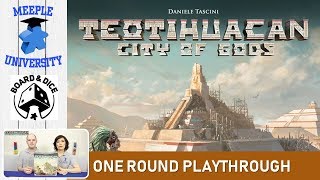















Teotihuacan: City of Gods Deep Dive
What the Community Thinks About Teotihuacan: City of Gods
Teotihuacan: City of Gods has generated substantial discussion within the board gaming community since its 2018 release. The game presents a fascinating paradox: reviewers consistently recognize its mechanical depth, thematic ambition, and impressive component design, yet reactions to the overall experience vary considerably. Some players find the interconnected systems rewarding and satisfying, while others view the abundance of rules and tracking as more taxing than engaging. The game clearly serves a specific audience of players who enjoy complexity and careful planning, though opinions on whether that complexity enhances or detracts from the experience remain divided.
Core Mechanics That Define Teotihuacan: City of Gods
Dice Placement and Worker Progression
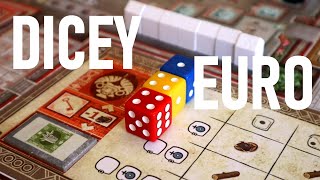
At Teotihuacan's mechanical heart lies an elegant dice placement system where players never roll their dice but instead use them to track worker strength. Each worker begins at value one and increases through repeated use, culminating in ascension when reaching six. This creates a distinctive tension between specialization and flexibility. Players must balance the desire to power up strong dice with the need to maintain flexibility in their available actions. As workers ascend, they return to value one while providing bonuses to the player, ensuring that the game maintains momentum even as workers cycle. The rondelle structure, where players move workers one to three spaces clockwise around the board's eight action locations, creates a spatial puzzle that rewards forward planning. The most experienced workers execute actions more efficiently due to their higher values, making the decision of which worker to use and when a central strategic consideration throughout the game.
Resource Economy and Cocoa Taxation
The game's resource management layer, centered on the currency cocoa, creates meaningful economic pressure. Taking the main action at any location requires payment of cocoa equal to the number of different colored workers already present at that space. This elegant cost mechanism incentivizes spreading workers across the board while naturally escalating the cost of popular actions. Players can always choose to simply collect cocoa instead of performing a space's main action, gaining cocoa plus one. This option prevents complete lockout from valuable spaces while rewarding efficiency in movement. Three resource types, wood, stone, and gold, fuel major scoring actions. The scarcity of resources relative to available actions creates constant pressure to prioritize, ensuring that even experienced players face difficult choices about which opportunities to pursue and which to defer or abandon.
The Teotihuacan: City of Gods Experience
The Pyramid Construction as Central Achievement
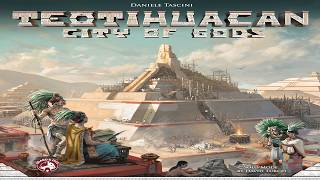
Building the Great Pyramid of the Sun forms the thematic and mechanical centerpiece of the game. Players contribute tiles to four pyramid levels at increasing resource costs, with the final level ending the game upon completion. Each pyramid tile placement provides victory points immediately, with decoration tiles offering bonus points based on symbol matching. The pyramid's visual presence on the table grows throughout play, creating tangible progress toward the shared endgame condition. Matched colored symbols on decorations trigger advances on corresponding temple tracks, creating an interlocking reward system where pyramid building indirectly fuels other scoring avenues. The satisfaction of seeing the structure rise across the three eclipse phases resonates with players on both mechanical and thematic levels.
Temple Advancement and Mask Collection as Scoring Engines
Three temple tracks run parallel to pyramid construction, each providing benefits for advancing along them and scoring for reaching specific milestones. The first player to reach the top of any temple track gains a powerful endgame bonus. Temple advancement occurs through worship actions at specific locations or from decoration symbol matches. Simultaneously, players collect masks through various means, gaining victory points during eclipse phases based on the quantity and variety of mask types accumulated. Multiple sets of different mask types yield exponentially increasing rewards, creating a compelling set collection subgame. The interaction between these scoring systems forces difficult decisions about whether to invest in immediate pyramid progress, long-term temple benefits, or flexible mask acquisition.
What Makes Teotihuacan: City of Gods Stand Out
Intricate Mechanical Interdependence
Teotihuacan distinguishes itself through deeply interconnected systems where actions in one area produce cascading effects elsewhere. Choosing which worker to activate affects not only current actions but ripples through future turns based on that worker's placement and value progression. The interaction between dice placement, cocoa costs, resource accumulation, and temple advancement creates numerous valid strategic approaches while ensuring that one optimal path does not dominate. Most spaces offer multiple action options, with different values of dice unlocking different outcome tiers. Players who invest time learning these connections discover surprising synergies, such as using specific discovery tiles to unlock powerful economy-building sequences or timing worker ascensions to maximize bonus collection. This depth rewards both mastery and creative problem-solving.
Three Scoring Phases Creating Evolving Priorities
The game's three eclipse phases, separated by major scoring rounds, structure play into distinct eras with shifting valuations. Pyramid progress scores the highest in early eclipses but decreases in value with each subsequent round, while avenue of the dead advancement maintains consistent value. This temporal twist on scoring encourages early pyramid investment but allows players who focused on slower-burning strategies to accelerate in later rounds. The changing point values force reevaluation of priorities and prevent the game from becoming decided by early play choices. Players who fall behind can mount comebacks by exploiting neglected tracks or discovering powerful late-game combinations, maintaining engagement throughout the entire experience.
Potential Drawbacks
Analysis Paralysis and Extended Downtime
The combination of open information, numerous decision points, and economic constraints creates substantial opportunity for analysis. With eight action spaces, multiple resource types, and intricate interactions between systems, a single turn can involve calculating several turns ahead to evaluate opportunity costs. Players attempting to maximize their turns through cocoa management and worker placement optimization naturally fall into extended thinking periods. Four-player games reported durations approaching three hours, with much of this time attributed to player deliberation rather than unavoidable game complexity. The planning aspect itself is not poorly designed, but rather represents a feature that certain players appreciate while others find unnecessarily burdensome for a single game session.
Mechanical Density and Accessibility Barriers
The game demands substantial rules comprehension and index-checking throughout play. Eight distinct action locations, each offering multiple decision branches, require either memorization or constant rules consultation, particularly on first plays. Discovery tiles introduce situational abilities that vary wildly in application and power level. The technology system, while elegant in principle, adds another layer of ongoing effects to track. New players require extended teaching periods and frequently need clarification on interactions. The rulebook, while functional, demands careful reading to resolve edge cases. Some players view this abundance of moving parts as engaging interconnected design, while others perceive it as unnecessary complexity layered atop a simpler core system. The game clearly rewards repeated plays as players internalize systems and reduce consultation overhead, but the teaching burden and initial play confusion deter casual audiences.
If You Enjoy Teotihuacan: City of Gods
Players drawn to Teotihuacan likely appreciate heavy economic strategy games with multiple victory paths and interconnected systems. Comparable games like Airship City, Eclipse, Underwater Cities, and Imperial share similar design philosophies of dense mechanical interaction and competitive resource management. The Rondelle structure appears in other designs like Imperial and Ticking Clock, though Teotihuacan's implementation through worker dice offers a distinctive twist. Those who love engine-building satisfaction will appreciate the growing efficiency of powered-up workers executing chained actions across the board. Players seeking accessible euros with moderate complexity might explore Meeple University's assessment that the game ranks as medium-weight, though most observers concur that this assessment underestimates the planning commitment required. The game finds its audience among dedicated hobby gamers comfortable with 90-120 minute sessions involving deliberate decision-making and forward planning across multiple interconnected systems.
What Reviewers Are Saying
"The way this game works is you activate a worker and you move them around the board and you can easily and you probably should plan out multiple turns in the future like I'm gonna put a worker there and then move this one there and then join them up together to do a more powerful action, but the thing is that almost everything you do is going to cost resources in general cocoa and there is this feeling of getting nickel and dimed as you are playing this game."
— Getting Games
"Every single turn you're gonna take one of your three workers and you're gonna move it one two or three spaces clockwise around the rondall by up to three spaces taking the action at the destination groups of workers can take more powerful actions than individual workers and so players who specialize and keep their workers grouped together we'll have better actions but less flexibility in their strategy."
— Meeple University
"I want to like teotihuacan a lot um the base idea of that game with the rondelle that's different and the dice that upgrade as you play through them I love all of that stuff but teotihuacan has too many other things on top of it uh just too many other layers there's so many different tracks that you're going up uh every single spot has a couple different ways that you can activate."
— Getting Games