













The Breach Deep Dive
What the Community Thinks About The Breach
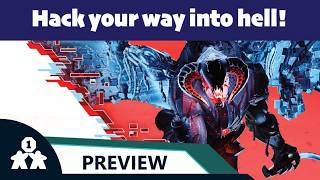
The Breach is a competitive net crawler for one to four players, published by Ludus Magnus Studio. Players take on the role of hackers who infiltrate a digital mainframe to steal secret information while evading the defensive monsters that guard it. Community coverage is thin, and the available discussions differ sharply in depth. The most substantial review comes from Board Stupid, whose hosts Wayne and Matt call it one of their favorite cyberpunk games and recommend it to fans of heavily thematic games who still want a measure of control. They describe it as a hybrid of American-style thematic play and a Euro-style cube puzzle, and they note that the game rewards close study of its rulebook.
Other coverage is brief. Tom Vasel, The Dice Tower covered the game in a list episode and said the channel had previewed it but did not believe it had played the final version. Tom described it as looking interesting and as having miniatures. Tim Chuon discussed it in a collection tour, reporting that they had played the base game twice and had not yet played its expansions. Because the dedicated review is the only full treatment, most of the perspective on the game's systems comes from that single source.
Core Mechanics That Define The Breach
Modular Board
The mainframe is assembled from tiles that are placed face down, so no player knows which room will sit next to theirs until it is explored. Board Stupid describe this as creating a different labyrinth in each game. Each tile carries special effects, such as bonuses, rerolls, or passages that are harder to move through. Rooms have entry and exit points, and when a player discovers a room, they can position those connections. The reviewers also highlight the bridge, a power represented by a card that replaces a wall so a hacker can pass through it. The bridge closes after a couple of moves, and the room is then sealed again. The board scales with the number of players, growing or shrinking and holding more or fewer information points depending on the table size.
Resource Management
Each player's desk holds cubes that represent movement, combat, shields and defense, and a cache action. On their turn, players spend clicks, which are their action points, to move cubes from one section of their board to another. Moving a cube strengthens one area while weakening another, so every allocation forecloses another option. Reviewers frame this as an action selection puzzle in which the cubes are the resources that pay for actions. Players plan ahead by shifting cubes so that they will have more movement next turn or more defense when enemies are expected to attack. Board Stupid stress that this part of the game is fully deterministic. The only dice roll is tied to the effects of placing a virus, and the outcome of the cube puzzle depends entirely on the player's own input, although an opponent can still disconnect a hacker from the mainframe and undo that planning.
The Breach Experience
A Cyberpunk Hacking Fantasy
Reviewers say the theme shapes nearly every system. When a hacker is overwhelmed, they are not eliminated. They are disconnected from the mainframe and must spend an action to return. Antivirus shields absorb incoming damage, and the monsters that defend the network embody the ICE of cyberpunk fiction. The artwork across the tiles, cards, and player boards reinforces the setting. Board Stupid say the cube movement feels like typing code, and they describe the overall feel as highly thematic and well balanced between its theme and its mechanics.
Tense, Deterministic Pressure
Board Stupid describe the game as consistently tense and dynamic, with few quiet moments. The mainframe fights back through an event deck. Each player on the mainframe draws an event card that acts as the AI for the monsters, moving them or attacking hackers. Because a player's own choices fully determine their cube puzzle, the danger comes from the other hackers and the mainframe's responses rather than from chance. The reviewers say that uncertainty grows as the mainframe becomes more dangerous over the course of play, which pushes hackers to upgrade their avatar and hacker programs.
What Makes The Breach Stand Out
Theme and Mechanics That Reinforce Each Other
The most frequent praise is for how the cube puzzle and the cyberpunk theme support one another. Board Stupid say the hybrid of thematic and Euro-style elements is executed as well as they have seen, and they highlight the way the hacker programs slot into the player's board to unlock cheats such as moving between tiles without spending movement. Each hacker is paired with an avatar that has its own abilities, and the reviewers note that drafting these combinations at the start of the game adds considerable replayability.
Production Quality
The hosts describe the production as top tier. The miniatures are made from a plastic and acrylic jewel-like material that gives them a striking appearance that suits the cyberpunk setting. The player boards are unique, each carrying a small hacker-personality detail and Easter egg. Board Stupid point out references to Overwatch on several of these boards, which they read as a sign that the designer enjoyed that game. They also say the bundle as a whole, from the box to the smallest card, feels premium. The review copy was supplied by the publisher, and the hosts state that the review is not paid.
Potential Drawbacks
Rules Density and Learning Curve
Board Stupid place The Breach in the advanced to expert range. The rules themselves are straightforward once learned, but the cards contain a great deal of text and many interactions, and the end-of-turn sequence has to be followed step by step, at least in the first game. The reviewers recommend reading the full rulebook without skipping sections, and they say that the rulebook answered every question they had during play.
Length and Player Count Trade-offs
The reviewers say two-player games are excellent, while three and four players add more interaction and a livelier, more chaotic mainframe. The trade-off is time. Board Stupid estimate about 75 to 80 minutes for a two-player game, with additional time for each extra player, and they say experienced groups at higher player counts may need closer to two hours. That runs longer than the 90-minute playtime listed in the game's metadata at the upper end of the player range. Their estimates also rest on the first game being slower while players learn the rules.
If You Enjoy The Breach
Board Stupid draw one explicit comparison in their review. They note that the player boards contain a lot of Overwatch references, and that one of the avatars copies the abilities of other avatars in a way that recalls an Overwatch character. Readers who enjoy that style of asymmetric hero design and playful references may find it a natural companion.
What Reviewers Are Saying
"When you die, you don't really die. You just get disconnected from the main thing because it's you're still an avatar and then you can reconnect again."
— Board Stupid
"Did anyone at The Dice Tower review this one? We previewed it, but I don't think we ever played the final game of it."
— Tom Vasel, The Dice Tower
"I have played every game except a few expansions. One of them was Marvel Champions: Sinister Motives, and the other one are expansions from The Breach, but I have played the base game twice already."
— Tim Chuon