A card game for 2 players in which players take turns controlling the Byzantine Empire. On a player’s off-turn he represents the many foes of the Byzantines. The game is divided into 3 ages - the first 4 turns are the Early Age, turns 5-8 are the Middle Age, turns 9-12 are the Late Age. Each player will get to be the Byzantines for 6 out of the 12 turns.
Each player starts with 10 Legacy Tokens. The Byzantine Empire starts with 10 Territory Tokens (TT). The most TT it can have is 20. If at any time the Byzantine Empire is reduced to zero or less Territory Tokens the game ends immediately and the current Byzantine player loses 3 Legacy Tokens.
There are 2 decks: The Byzantine Deck and the Foes Deck. Cards are of certain types and have a force value. Some cards are only useable during specific Ages. At the start of the game all Middle and Late Age cards are removed from the decks and set aside. When the Middle Age starts the Middle Age cards are shuffled into the decks. When the Late Age starts the Late Age cards are shuffled into the deck.
Each turn has 6 Phases:
1. Draw Phase
- The Foe player fills their hand to 8 cards.
- The Byzantine player fills his hand to 9 cards in the Early Age, 8 cards in the Middle Age, or 7 cards in the Late Age.
2. Age Phase
- Discard any cards in your hand that are not useable in the current Age and draw replacements. If the discarded cards are from an earlier age, remove them from the game.
3. Redraw Phase
- Each player may discard up to 4 cards and draw replacements.
4. Meld Phase
- Each player makes a Meld.
- A Byzantine meld may have up to 1 leader card, 2 recovery cards, 4 troop cards, 1 negotiation card and 2 legacy cards
- A Foe meld may have up to 1 Northern foe card, 1 Southern foe card, 2 disaster cards (Max 1 Natural Disaster) and 4 troop cards
- If a negotiation card is played, the Byzantine player may discard 1 target Foe card. The Foe player may replace it immediately with another Foe card if he has one in hand.
- Each player totals the force of the cards in his meld. The side with the higher force total wins. If tied the Foe player wins.
- The Byzantine Empire gains or loses Territory Tokens equal to the difference in the Force Point Totals.
- All Meld cards are discarded. Unique Meld cards are removed from play.
5. Legacy Phase
- The Byzantine Player (BP) potentially earns Legacy Tokens (LT). If the Empire lost TT this turn the BP loses 1 LT. If the Empire gained TT this turn the BP gains 1 LT.
- The BP gains LT equal to the legacy value of the legacy cards he played in Meld Phase.
6. End Phase
- If you have cards left in your hand, discard down to 1 card and pass it to your opponent.
- Players switch control of the Emperor Token.
The game ends after 12 turns. The player with the most Legacy Tokens at the end of the game wins.

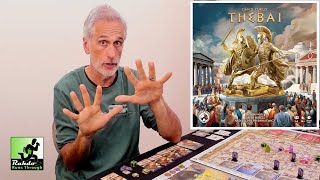
- Each turn is 'big and rich' with many possibilities.
- The game allows for both short-term and long-term planning.
- The dice aging/retirement mechanic is well-loved and unique.
- The worker movement and modular board create interesting strategic choices.
- Positive player interaction where helping an opponent can also benefit oneself.
- Satisfying and crunchy decisions throughout the game.
- The game can be quite long, especially for slow players (2-3 hours for the host).
- The 'Herald cards' in the two-player game introduce swingy luck-based upgrades that are not revealed in advance, which the host dislikes.
- The board does not expand as quickly in a two-player game compared to higher player counts, limiting opportunities for movement and interaction.
- Rebuilding a fallen city and improving its economy
- Late Bronze Age city of Thebes
- A game by Andre Novak (NSKN) set in ancient Rome with dice aging and retirement.
Mechanics (from transcript analysis)
- Dice Aging / Retirement — Dice (citizens and soldiers) can be upgraded and eventually 'ascend' when they reach a certain level, becoming generals or unlocking special powers. The host compares this to a 'dice aging' mechanic.
- Modular Board — The game board's layout and available actions can be customized with randomly drawn tiles, and the board can be flipped for different player counts.
- Set Collection — Players collect different types of contract icons to score bonus points at the end of the game.
- solo mode — The game includes a solo mode where an automated opponent (Antiggony) emulates human player functionality.
- Variable player powers — Upon achieving certain milestones like creating generals, players gain unique commander powers that provide ongoing benefits.
- worker movement — Players move an 'Archon' pawn around a modular board to activate additional actions and interact with dice.
- Worker Placement — Players place citizen dice on action spots to perform actions, with higher-level workers potentially activating multiple actions or gaining better benefits.
Video topics + discussion points
Quotes (from this video)
- The fact that, okay, I desperately need two grapes and then I can finish this objective. What do you know? It actually has two grapes on it. Okay, I'll spend one coin to go across the blank space. This is a free action me because of a bonus I got earlier. And then thanks to your die, I had the last passage I need to get where I'm going. Great. I get my two grapes. I finished my contract. But what did you get? Oh, I just made your die age.