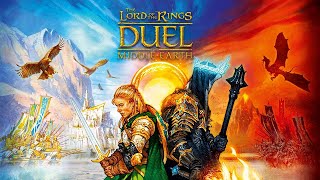
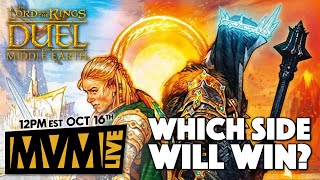
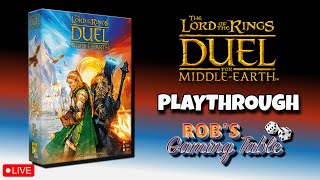
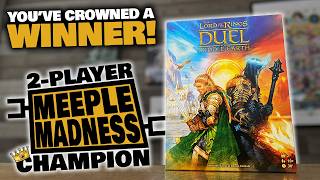
A dark rumour rises from Mordor. The Eye turns to Middle-earth. The hour has come. The Fellowship is reunited. The Heroes prepare for battle. Will you play as the Fellowship of the Ring to defend the free races and destroy the One Ring? Or will you play as Sauron and pursue Frodo and Sam while deploying your hordes to the gates of the enemy cities? The destiny of Middle-earth is in your hands!
A game plays over 3 successive chapters that unfold similarly.
On your turn, strengthen your Skills, hoard your treasure, stretch your presence across Middle-earth, rally Races to your cause, or advance the Quest of the Ring.
Turn OverviewIn each chapter players take cards from a display of face-down and face-up cards arranged at the start of a round. A player can take a card only if it's available, that is not partially covered by any other cards. Players can either play the card, paying its cost and placing it in their play area, obtaining its benefit, or discard the card and take as many coins from the reserve as the current chapter.
Players can also take a Landmark tile from one of the faceup tiles, paying its cost placing it in their play area. They will be able to immediately place a Fortress pawn on the corresponding region of the central board and benefit from its other effects.
Victory ConditionsImmediately win the game by fulfilling one of the 3 victory conditions:
Quest of the Ring
For the Fellowship: If Frodo and Sam reach Mount Doom, they destroy the One Ring and you immediately win the game.
For Sauron: If the Nazgûl catch Frodo and Sam, they seize the One Ring and you immediately win the game.
Support of the RacesIf any player gathers 6 different Race symbols on their Green cards, they rally the support of the Races of Middle-earth and immediately win the game
Conquering Middle-earthIf a player is present in all 7 regions (with a Fortress and/or at least 1 Unit), they dominate Middle-earth and immediately win the game.
If none of these three victory conditions are achieved by the end of chapter 3, the player who is present in the most regions of Middle-earth (with a Fortress and/or at least 1 Unit) wins the game. In case of tie, share the victory.
- Thematic exploration in a compact two-player format
- Older title; may be outpaced by newer LOTR releases
Mechanics (from transcript analysis)
- Combat: Deck/Hand — Head-to-head combat/competition inspired by Tolkien's universe.
- Two-player duel — Head-to-head combat/competition inspired by Tolkien's universe.
Video topics + discussion points
Quotes (from this video)
- Mental health is something that is really important to us and ever since then it's kind of been a big proponent of our channel and of our community.
- This allows us more opportunities to do topics like that on the podcast.
- bi-weekly podcast every other Friday.
- Carcasson being my true love in my wife's wedding vows.
- Seven Wonders Duel showed how you don't need to play a three-hour game to be completely enraptured by a board game.
- Gloomhaven opened doors to ongoing legacy and campaign experiences for us.
- There is now an entire audience that might not have found us because they don't consume YouTube or watch video content; podcast opens that door.
References (from this video)
- Excellent mechanics that interlock well for a tight two-player experience
- High accessibility for new players while offering meaningful strategic depth
- Three clear, distinct paths to victory encourage varied playstyles
- Pyramid drafting provides a tactile and engaging drafting experience
- Ties can be common due to symmetrical play and multiple scoring tracks
- Some players may desire more thematic flavor or narrative storytelling beyond mechanical play
- Fantasy epic surrounding the Fellowship of the Ring, focusing on strategic competition, alliance-building, and territorial influence within a mythic Middle-earth backdrop.
- A compact, two-player duel set in the world of Middle-earth where players vie for control and complete the epic journey of the Fellowship. The action unfolds across a stylized map divided into seven regions, with a pyramid-style card drafting mechanic driving resource generation, ally recruitment, and ability acquisition.
- mythic_epic
Mechanics (from transcript analysis)
- Area Control — A map-based mechanic where players attempt to assert and maintain control over seven regions to influence victory possibilities and scoring opportunities.
- card drafting — Players draft cards from a pyramid structure to gain resources, allies, and special abilities that influence board state and combat potential.
- hidden victory points — Three distinct paths to victory: guide the fellowship to Mount Doom, dominate all regions on the map, or assemble an alliance of all six race tokens.
- Multiple victory conditions — Three distinct paths to victory: guide the fellowship to Mount Doom, dominate all regions on the map, or assemble an alliance of all six race tokens.
- Race-token alliance system — A token-based mechanic where different fantasy races contribute to victory via alliances, adding a layer of strategic depth and potential for comebacks.
- Resource management — Resources generated by drafted cards are spent to activate powers, recruit allies, and execute strategic plays.
- Two-player restriction — Designed explicitly for two players, emphasizing head-to-head strategic planning and quick game cycles.
Video topics + discussion points
Quotes (from this video)
- I give this a seven out of 10.
- Excellent mechanics. Very approachable for anyone to pick up.
- Give it a checkout.
References (from this video)
- clever, tactile ring track mechanic
- strong thematic integration with Lord of the Rings
- shared landmark tiles add strategic tension
- three distinct paths to victory increase variance
- card stock is a bit thinner than ideal
- the insert is not great and may frustrate organizers
- ring quest vs. dark pursuit; artifacts and regional control drive outcomes
- Middle-earth map with a progressing track toward Mount Doom and opposing Nazgul progress
- lore-inspired, integrated into card play and map progression
- Seven Wonders Duel
- Seven Wonders Duel: Pantheon
Mechanics (from transcript analysis)
- Artifact collection — Six artifacts (green cards) are pursued; collecting them yields powerful bonuses and advances a win condition.
- changing tableau / card drafting — On your turn you pick a card from a visible subset; taking it reveals new options underneath, creating strategic tension about what to leave open for your opponent.
- economy tweaks from Seven Wonders Duel — Coins are tight and the cost mechanics are streamlined; resource costs and incentives differ from the original Seven Wonders Duel.
- multi-win conditions — Victory can be achieved by advancing on the ring track, delivering or stealing the ring, or collecting six artifacts.
- Ring track movement — A physical map-based track replaces abstract point scoring, representing progress toward completing the ring saga and moving figures (Fellowship vs Nazgul).
- shared landmarks — Landmark tiles can be built by either player, introducing race dynamics and shared objectives that can disrupt or accelerate a plan.
Video topics + discussion points
Quotes (from this video)
- everything is a race
- the ring track is really clever
- it's basically the Crew Lord of the Rings edition
- the art is Vincent Drait
- money is tight
- we've had a few games where one person was one move away
References (from this video)
- Seven Wonders Duel
Mechanics (from transcript analysis)
- dice drafting — Choose cards to deny or enable options for your opponent; map-based track element replaces blue cards.
- shared tier and map placement — Tracks and map placement create a race to Mount Doom.
- two-player drafting — Choose cards to deny or enable options for your opponent; map-based track element replaces blue cards.
Video topics + discussion points
Quotes (from this video)
- this is really interconnected worker placementish game.
- it's surprisingly smooth for how many moving parts there are.
- it's a game of inches where every space matters.
- there's way too many moving parts to explain here, but it is very very satisfying.
- you can definitely not just follow one thing and focus on one thing.
References (from this video)
- Strong integration of the Lord of the Rings IP into a mechanically robust two-player experience
- Fresh take on Seven Wonders Duel mechanics with a thematic rebuild rather than a mere reskin
- High production quality: compelling artwork, components, and durable tokens
- Accessible and fast-paced 30-minute sessions that still offer depth and meaningful decisions
- Clear path for future home tinkering or expansions if desired
- Not a radical departure from Seven Wonders Duel in terms of core drafting and resource mechanics
- Some players who love classic victory points may miss the old win conditions
- Limited expansion footprint out of the box; the design leans on the IP to carry theme rather than new core mechanics
- epic fantasy, quest-driven conflict, alliance-building vs. strategic conquest
- Middle-earth; Frodo and Sam's quest to destroy the One Ring, pitting Sauron against the Fellowship in a two-player skirmish
- high fantasy, lore-inspired, thematic reinterpretation of a classic IP
- Seven Wonders Duel
- Inis
- Grande
- Enish
Mechanics (from transcript analysis)
- area majority — Players place troops and towers to contest control of map regions; majority yields presence and strategic advantages.
- area majority control — Players place troops and towers to contest control of map regions; majority yields presence and strategic advantages.
- Combat: Deterministic — Troop conflicts resolve without dice; outcomes are determined by card choices and placement, producing a fast, decisive resolution.
- Deterministic combat — Troop conflicts resolve without dice; outcomes are determined by card choices and placement, producing a fast, decisive resolution.
- open drafting — Players draft cards from an open market each turn, determining access to resources, military power, and location options.
- Resource management — Players use money and resource cards to purchase other cards and to fundtroops, towers, and special effects.
- resource management via market and treasury — Players use money and resource cards to purchase other cards and to fundtroops, towers, and special effects.
- ring/goal progression (Golem and Ring symbols) — Golem cards and ring symbols advance Frodo/Sam toward Mount Doom or, conversely, push Sauron closer to them, creating a chase dynamic and an alternate path to victory.
- set collection — Green cards provide symbols; collecting a complete set or diverse symbols yields bonuses and potentially wins via alliances.
- set collection and symbol matching — Green cards provide symbols; collecting a complete set or diverse symbols yields bonuses and potentially wins via alliances.
- three-era structure with alternative win conditions — The game unfolds across three eras with multiple victory routes (territory presence, alliances via green-card sets, or the Ring chase).
- tower placement and map expansion — Locational cards introduce towers and new zones, enabling deeper territorial strategy and defense bonuses.
Video topics + discussion points
Quotes (from this video)
- "this is Seven Wonders Duel, the famous amazing two-player game"
- "it's not a reskin; it's a reimagining"
- "the game is absolutely amazing"
- "this is my favorite Seven Wonders Duel at this point"
- "the production and artwork are fantastic"
- "the territory control system is fantastic and a great addition to what is already an amazing game"
References (from this video)
- Flexible discount paths (free cards, discounted cards, and coin-pay options)
- Distinct tag-based free-gain opportunities add strategic depth
- Complexity and multi-layer decision space can be intimidating
- LOTR-inspired strategic card acquisition and discount optimization
- Middle-earth with a focus on card-based discounts and roster/tag interactions.
- Thematic, story-driven within a familiar fantasy IP
- Seven Wonders
- Seven Wonders Duel
Mechanics (from transcript analysis)
- Cost discounts via cards and tags — Any time you see a cost, you can sometimes gain the card for free using specific icons or tags; coins can substitute to swap icons.
- Order-of-operations tension — You must decide when to pay now or wait to gain future discounts, making opponent choices influential.
Video topics + discussion points
Quotes (from this video)
- Skyler: My favorite game featuring ongoing discounts is Flamecraft.
- Dylan: This is my favorite of the West Kingdom trilogy, and managing ongoing discounts is a major key to success in the game.
- Aaron: Space the final frontier. These are the voyages of whatever you name your ship.
- Caitlyn: In Ark Nova, you can claim partner zoos in four of the five continents. And whenever you play an animal into your zoo that matches one of your partner zoos, you get a three credit discount on the animals cost.
- Skyler: This creates a very low conflict environment where everyone helps to improve the town, making it awesome for families.
- Jamie: Lord of the Rings Duel for Middle-earth really got me thinking about the decision space of do I spend money on a card now or wait to get the resource that a card provides so I don't have to pay it in the future.
References (from this video)
- Strong thematic integration with The Lord of the Rings IP
- Distillation of Seven Wonders Duel mechanics into a tight two-player experience
- Beautiful artwork and a compelling ring track visually tying theme to gameplay
- Easy to teach and quick to play (roughly 30 minutes)
- Good replayability via landscape tiles and card drafting choices
- Limited to two players, reducing group play options
- Less modular variability than Seven Wonders Duel expansions
- Compared to War of the Ring: The Card Game, depth and duration can feel lighter for some players
- No points-based endgame; ends by meeting specific victory conditions which may feel abrupt to some
- Lord of the Rings lore, alliance-building, struggle across regions, ring track tension
- Middle-earth, two-player strategy on a centralized Middle-earth map with regional presence and combat dynamics
- thematic storytelling embedded in card effects and map interactions rather than direct linear narration
- Seven Wonders Duel
- War of the Ring the Card Game
Mechanics (from transcript analysis)
- ally collection and set bonuses — Collect six different ally icons to trigger an immediate win, with additional sets granting draw bonuses or extra draws
- card drafting — Draft and place cards to build a personal tableau that advances your position on the central map and toward victory conditions
- card drafting / tableau building — Draft and place cards to build a personal tableau that advances your position on the central map and toward victory conditions
- centralized map with landscape tiles — Landscape tiles populate the map, replacing the Wonders from Seven Wonders Duel, and offer big bonuses with varying costs
- Combat: Deterministic — Combat occurs in territories with opposing units; resolution is a one-for-one removal until a stalemate or a win condition is reached
- endgame conditions without point scoring — Instead of end scoring points, players win by meeting Mount Doom or presence across all regions; if no one meets a condition, the one with most presence wins
- landscape tile economy — Landscape tiles provide powerful effects but are expensive; they influence resource generation and endgame potential
- military/combat resolution — Combat occurs in territories with opposing units; resolution is a one-for-one removal until a stalemate or a win condition is reached
- resource engine with simplified currency — Cards provide resources; currency is simplified to a single coin-type mechanic for ease of play
- Resource management — Cards provide resources; currency is simplified to a single coin-type mechanic for ease of play
- ring track and specific win conditions — A ring track mechanic representing Sauron/Nazgul pressure; victory can be achieved by meeting certain conditions along this track
- set collection — Collect six different ally icons to trigger an immediate win, with additional sets granting draw bonuses or extra draws
- three-stage card reveal and discard — At the start of each round, a subset of cards is revealed and drafted in staggered fashion, with some cards discarded each round
Video topics + discussion points
Quotes (from this video)
- I think this game is a great distillation of Seven Wonders
- it's a very thematic integration
- the weight of this game is about the same as Seven Wonders duel
- I would play this game over War of the Ring the card game
References (from this video)
- Juicy drafting decisions; you must weigh which card to take and how to use it.
- Theme support from the Lord of the Rings IP enhances immersion.
- Fast-paced, elegant two-player duel experience with clear rounds.
- First-time setup is approachable and quick to learn.
- IP-based licensing can affect future expansions or variations.
- Two-player focus means limited group play potential.
- tight card drafting and duel mechanics with an iconic IP backdrop.
- Lord of the Rings universe, in a tactical two-player duel setting.
- competitive and thematic, with meaningful choice at the moment of card selection.
- Seven Wonders Duel
Mechanics (from transcript analysis)
Video topics + discussion points
Quotes (from this video)
- I love Ark Nova.
- Bees in space best theme ever.
- This game is just always buzzing in my ear.
- The actions are distilled down to such a great system.
References (from this video)
- strong Lord of the Rings flavor
- solid design if you’re a fan of the theme
- tight two-player engagement
- fans of other Seven Wonders Duel-style systems may compare
- epic fantasy quest with thematic ties to Tolkien's world
- The Lord of the Rings universe, with Sam and Frodo striving to reach Mount Doom under Sauron’s pressure.
- duel-driven, two-player strategic confrontation
- Seven Wonders Duel
Mechanics (from transcript analysis)
- card drafting — Players select cards to build a strategic hand each round.
- set collection — Gathers resources and deploys actions to gain advantage across a duel.
- set collection / resource tension — Gathers resources and deploys actions to gain advantage across a duel.
Video topics + discussion points
Quotes (from this video)
- This is Spooktacular. Definitely check it out.
- It's so asymmetric and the fact these monsters also have different difficulty.
- Origin Story really is one of the more thematic trick-taking games that I've ever played.
- This is a fantastic deck building game.
- There’s so many captains that you play in it feel so distinct. It really nails the Star Trek theme.
- Pandora's box. Oh, so fun.
References (from this video)
- Expansion adds depth, tension, and multiple viable win paths that increase strategic diversity
- Thematic immersion is strengthened by recognizable LOTR factions and lore nods
- Towers and landmarks create lasting map influence and encourage forward planning
- Opposition and interaction via disruptive cards raise tension and strategic decision points
- Symbol-based and eagle-based win conditions add interesting strategic tension and timing
- Some cards are perceived as weak or boring in practice (e.g., Leadership)
- Spider (She-lob) disruption can feel oppressive and swingy in certain lines of play
- Overall complexity increases setup time and learning curve; may steepen entry for new players
- Balancing issues can emerge if one player controls key symbols or tokens early, potentially skewing outcomes
- Good vs Evil alliance mechanics; influence and territory control; epic quest motif anchored by iconic LOTR moments
- Midde-earth across multiple regions (Gondor, Rohan, Mordor, Enidwaif/Roanian-like regions, etc.) during an escalating conflict; factions vying for control
- fantasy epic with paper-thin but flavorful cards and lore nods; lively in-game banter and dramatic moments
Mechanics (from transcript analysis)
- Card economy and choice — On a turn you can claim a card for free, pay its cost to play, or discard it to gain coins; card costs scale with age to shape planning windows.
- Deck building — Card pools and strategies shift between ages; setup and card availability evolve as the game progresses.
- Deck structure by age — Card pools and strategies shift between ages; setup and card availability evolve as the game progresses.
- Disruption and control tools — Cards like Griema and She-lob offer disruptive effects that force opponents to take or discard cards or block access to tokens.
- Eagle symbol integration — An additional symbol (the eagle) adds a secondary path to victory and interacts with the overall symbol economy.
- Enter/exit effects on cards — Some cards grant a 'come into play' (enter) effect and a stronger 'exit' effect; the latter is more expensive but more powerful.
- Landmarks and towers — Landmark tiles provide access to special abilities; towers remain on the map and influence strategic placement and presence.
- Multi-use cards — On a turn you can claim a card for free, pay its cost to play, or discard it to gain coins; card costs scale with age to shape planning windows.
- Power tokens and age-based costs — Power tokens are spent to activate card abilities; costs rise as you progress through the three ages, creating pacing pressure and decision tension.
- Presence and map control — Victory can be achieved by controlling presence in strategic regions; presence can be augmented via towers and the placement of units.
- Symbol collection as a win condition — Collect symbols representing various peoples (elves, dwarves, hobbits, humans, wizards, ants, etc.); reaching a threshold triggers a win.
- Symbol synergy and chaining — Symbol types unlock further effects and can chain with other symbols to enable powerful plays or turn-limiting options.
- tile placement — Landmark tiles provide access to special abilities; towers remain on the map and influence strategic placement and presence.
- Troop placement and 1v1 combat — Troops occupy regions; troops in the same region fight and eliminate one-for-one; towers do not engage in combat but persist.
Video topics + discussion points
Quotes (from this video)
- This expansion includes seven cards per side and the tokens come into play to activate abilities.
- The spiders are a beast; She-lob here says when she comes into play, you cannot look at those tokens anymore.
- Bruno Catala, I love you. Antoine Bowser, you too.
- If you’re present in all seven regions with a fortress and at least one unit, you dominate Middle Earth and immediately win the game.
- These cards are really powerful. The new expansion here, it’s powerful.
- Leadership is a boring card... nobody likes that card.
- Griema time. It’s the tongue, the worm tongue, the tongue of the king.
- Mama said knock you out.
- The eagles are fire, baby. This is crazy good in the long game.
- That is trash. That’s with one baby. And then if I want her exit power is I discard one of yours.
References (from this video)
- Smooth play experience with high tension throughout
- Three distinct victory conditions keep decisions interesting
- Thematic familiarity required to fully appreciate the stakes
- Adventure combat with three victory conditions
- Middle-earth, Tolkien-inspired conflict and pursuit
Mechanics (from transcript analysis)
- closed drafting — Three victory conditions create multi-path tension (combat, race to Mordor, and pursuit of hobbits).
- Drafting with hidden/face-up mix — Three victory conditions create multi-path tension (combat, race to Mordor, and pursuit of hobbits).
- Face-up and face-down card interaction — Face-up vs. face-down reveals create suspense and strategic ambiguity.
- Hybrid combat and race mechanics — A blend of tactical combat and route/race to key objectives.
Video topics + discussion points
Quotes (from this video)
- "Planet Unknown is my number one favorite game of all time as of right now."
- "I am in awe of this design. It is a truly inspirational card design."
- "This is Planet Unknown... a great spatial puzzle and a great simultaneous puzzle."
- "Duel for Middle-earth is a delight. The tension is high throughout the game."
- "The Gang is my number two favorite game of all time. I love its cooperative poker aspect."
- "I love the pacing of Skull King—ramping up the number of cards each hand creates escalation."
- "Ark Nova is the heaviest game on this list, and I love every minute of it when it's on the table."
References (from this video)
- Strong Tolkien theme and artwork
- Multiple win conditions keep it tense
- Two-player focus may limit group play
- two-player combat with Tolkien theme
- Middle-earth duel
- epic, thematic
- Seven Wonders Duel
Mechanics (from transcript analysis)
- Combat: Deck/Hand — duel with multiple win conditions
- Ring track relevance — Track affects win condition and tension
- Two-player duel — duel with multiple win conditions
Video topics + discussion points
Quotes (from this video)
- Nobody expects the Spanish Inquisition.
- The only thing you can count on in this game is chaos.
- If you've got a rowdy and loud family, Hot Streak is going to be for you.
- Beige box belies its depth.
- This is a no-brainer for any Lord of the Rings fans.
References (from this video)
- Looks tremendous and feels tense
- Not merely a license badge; redesigned to fit a duel experience
- May feel derivative of Seven Wonders Duel to some players
- tense, multi-angle dueling with license-aligned flavor
- The Lord of the Rings universe adapted to a duel-style experience
- fantasy epic collaboration
- Seven Wonders Duel
Mechanics (from transcript analysis)
- card drafting — Draft cards and manage actions toward endgame objectives
- card drafting / hand management — Draft cards and manage actions toward endgame objectives
- set collection — Endings hinge on strategic card choices and board state
- Set-collection / conflict resolution — Endings hinge on strategic card choices and board state
Video topics + discussion points
Quotes (from this video)
- This is a two-player only trick-T game that is really clever.
- It seems to be the MO—the cleanest, most straightforward way possible.
- Castle Combo is a killer design that manages to in 20-25 minutes tops give me so many fun little moments.
References (from this video)
- Beautiful IP integration and artwork
- Aesthetically pleasing with thematic weight
- Niche appeal limited to LOTR fans
- Rules can be dense for a quick play
- Duel/combat with iconic characters
- Middle-earth, The Lord of the Rings IP
- IP-driven, cinematic
Mechanics (from transcript analysis)
- Card-driven combat — Character-specific abilities small-batch card play dictates combat outcomes.
- two-player head-to-head — Focused duel experience between two players.
Video topics + discussion points
Quotes (from this video)
- That's my number 10.
- It's just a game that hits the table at our house.
- The Crew will always be in my repertoire of games to play.
- Vincent Dutrait's artwork on the table is a real draw.
- "It's a great two-player game and it's one that we can pull out and play and enjoy."
- "This might be my favorite Euro game. Not No, there's a couple others in there."