/pic7565506.jpg)
In The Princes of Florence, players attract artists and scholars to their palace while trying to become the most prestigious family in Florence.
Over seven rounds, players attempt to score points in various ways, with most points being earned by playing profession cards to generate "work points", which can be exchanged for money or victory points. The game includes a variety of professions, such astronomers, organists, and architects; each profession is attracted to a particular combination of building, landscape feature, and social freedom, and players acquire these items via auctions. The more that a player can match these preferences, the more work points they earn — but the minimum requirement of work points increases each round, and you must meet that threshold in order to convert the work points.



- Clever design in scoring and money management
- Interesting decisions
- Highly interactive
- Dated appearance of the older version
- Impressing nobility
- Florence
Mechanics (from transcript analysis)
- Auction — Players auction off various tiles, and winning an auction removes that type of tile from being auctioned again that round.
- Engine Building — Players can convert points into money for future rounds, creating an economic engine.
- Set Collection — Profession cards provide hidden scoring goals based on acquired tiles.
- Tile Placement — Players acquire tiles and place them on their player board to fulfill hidden goals.
Video topics + discussion points
Quotes (from this video)
- So today we have a list of 10 older games that were released 2017 and earlier.
- This is not really ranked, just so you know.
- The decision space is really interesting.
- The look of the game and like just the overall pitch sounds like it's going to be this is going to be light, but it's brain burning.
- The theme and the art on all of these cards are very silly, super thematic.
- There are just so many games that come out, so many games you play, it's almost impossible for you to like formulate like a true top 50.
References (from this video)

- Stands the test of time, feeling modern despite its age.
- The auction phase is a highlight, adding player interaction.
- Solid resource management and scoring conversion.
- Low downtime due to quick turns.
- Enjoyable for players who like polyomino games.
- Excellent for larger player counts.
- Can feel too short, leaving players wanting more turns.
- Two-player bidding can be less engaging than with more players.
- Attracting artists and building a district with parks and buildings.
- Renaissance Florence
- Siliconia
Mechanics (from transcript analysis)
- auction/bidding — Players bid on items like workers, building placements, and 'gestures' (artist appeal) which influence scoring.
- Set Collection — Artists require certain elements in their district (e.g., a park) to be completed, scoring points and money.
- Tile Placement — Players place polyomino tiles on their player boards to build out districts.
- Variable round structure — The game spans seven rounds, with increasing demands for completing artist jobs each round.
- Worker Placement — Players can acquire additional workers through bidding, which affect costs and actions.
Video topics + discussion points
Quotes (from this video)
- Hey y'all it's time for Rolling Dice and taking names.
- The community is going to be friendly I don't think our community was any more friendly than the fighting game Community I mean everybody was super nice there and very polite.
- If you like economic games this is an excellent economic game and that's what's so misleading about you look at it and it's like how is this an economic game and it strictly is.
- So straightforward easy fast playing little war game very strategic is it something new something different not really but it is quick it's easy to play and I think the asymmetry of the two sides is what really makes this a good game.
- If the whole thing about ethnos was the shifting of the area control or area majority and being able to battle for that is what made that game for you then this is not going to be archus society is not going to be a game for you.
References (from this video)

- never really liked
Mechanics (from transcript analysis)
Video topics + discussion points
Quotes (from this video)
- I'm genuinely curious about your origin story and sort of how you got more involved in whatever hobby it is.
- Exposing a child to games is probably a really important thing.
- It's like baseball cards but you play a game with that seems stupid.
- I really loved it and got into that
- I just got sucked back into board game geek because I had you know been on it like in 2005
- I just got like sucked in
- I never really liked Puerto Rico or Princess of Florence but I really like Power Grid
- The DM sucked and I didn't really like it at all
- He's just like the worst, you know pictured like the worst kind of DM RPG type of personality that was that guy
References (from this video)

Mechanics (from transcript analysis)
Video topics + discussion points
Quotes (from this video)
- this is easily my game of the month and right now it's one of the best games I've played in the last year to uh maybe a couple of years
- Randomness uh chaos nightmare essentially
- it's a historical simulation
- the tiebreaker is the number of Windows you have in your Mansions
- the rulebook literally says get comfy you know Brew yourself a cup of coffee it's going to take you a little while to read through this rulebook
- I was not expecting to like this game so much in general
References (from this video)

Mechanics (from transcript analysis)
Video topics + discussion points
Quotes (from this video)
- I have a monstrous shifting shelf
- nine games leaving the collection
- there are 19 new games that arrived this month
- I backed it on Kickstarter and apparently I backed it for a level that also got me Deep Dive
- Founders is a Thailand game
- bone race essentially
- this is going to be four videos coming out that week
References (from this video)

- strong euro design lineage
- simple, meaningful choices that drive competition
- patronage and prestige
- Renaissance Florence
- For Sale
Mechanics (from transcript analysis)
- profession_cards — Profession cards generate work points that translate into money or victory points.
- round_progression — Seven rounds with increasing scoring thresholds.
- Track Advancement — Seven rounds with increasing scoring thresholds.
Video topics + discussion points
Quotes (from this video)
- the Temptation may be to make the simplest path possible but there in lies the strategy of foolishness
- it's a really good game you can play with a bunch of people and you it's like a light war game but of civilization building war game
- a zombie game a survival horror board game
- the game that most other games taste like if you want a yachi like experience but in a way that's just like got a theme it's lovely to look at
References (from this video)

- Polyomino aspect is present
- Builds in complexity and satisfaction
- Great engine building
- Late game combo potential
- Engaging auction and building phases
- Hidden money adds strategic depth
- Fun at all player counts, especially two-player.
- Starts slow
- Can be difficult, especially at two players
- Time commitment required
- Principality
Mechanics (from transcript analysis)
- auction/bidding — there's an auction phase for what you want.
- Engine Building — it's great for like that engine buildy feel.
- Tile Placement — building up on your board.
- Worker Placement — grabbing other players workers and then placing them back down.
Video topics + discussion points
Quotes (from this video)
- Hello everybody my name is Ilia and my name is Tyler together we make up C a couple that loves to play board games
- so every year what we do is we do a themed month where we dive into to content and try to really understand a genre of games
- Out of the 46 that we have played 46 46
- if you're wanting a sneak peek feel free to support us by checking out our patreon page down in the links below
- Baron Park just a heaps of Joy hitting it out of the baron Park
- Lookout makes very good polyomino games
- I genuinely have no complaints about this game
- It is heavy and it's amazing
- this game will always have a really really special place in my heart because of how fast it plays because of how fun it is and because of the memories we were able to build with this game
- Congratulations to all of our winners we will be in touch to get you those games
- if there's any other ways that people reach out to you it's not real it's fake news it's a scam be careful around those
- what is your favorite polyomino game yes
- what theme should we do next year
References (from this video)

- Liked how points and money worked
- Enjoyable game mechanics
- Requires 3 players, which was difficult to achieve
- No longer in their collection due to lack of play
- Renaissance patrons funding projects.
Mechanics (from transcript analysis)
- bidding — The game mechanics involve bidding for certain elements or actions.
- Drafting — Similar to bidding, players draft elements to use.
- Set Collection — Players collect sets of cards or resources to fulfill project requirements.
- Worker Placement — Implied by the need to acquire elements and fund projects.
Video topics + discussion points
Quotes (from this video)
- if we reach 3,000 subscribers we would do our top 100 games of all time
- it's like how do you pick out the best ones and then on top of that how do you rank the best ones
- if my mind is able to be fully present which game do I prefer
- we're going through this 10 games at a time so today's video we're going through 100 through 91
- this is such a fun pretty game and it's so mean like you don't realize how mean this game is until you play it
- the game playay itself is so unbelievably chill this is super relaxing experience
- the system the gameplay of this game is so strong and so good
- I don't care if I win or lose it doesn't matter what matters is how good of a story did I create at the end of the game
- Ticket to Ride what a classic uh game
- Ticket to Ride Legacy garbage it doesn't count for this
- it is incredibly adorable it is aggressively adorable
- absolutely a brain burner thinky experience as well
References (from this video)

- Unique and strange game.
- Some like having the 'oddball' included.
- The auction is described as super restricted.
- The set collection aspect is not typical.
- One speaker does not love it.
Mechanics (from transcript analysis)
- Auction — Described as a pure auction but with restrictions.
- Set Collection — Described as a set collection thing, but not exactly set collection.
Video topics + discussion points
Quotes (from this video)
- it's Dominoes Ah
- based on reviewing the Wikipedia for dominoes um that doesn't that seem that year seems wrong. That seems way late.
- but anything that is like a Domino's game we would recognize doesn't occur until the very end of the 18th or beginning of the 19th century.
- and tomorrow night at 7:00 p.m., we're finishing up with Antiquity, which is pictured behind Ken's head over there.
- Of our 402 games, only 13 are published before 1990.
- So you got Spirit Island, you got Lizboa, you got Quest for Elorado, and 22 other games that are on one person's list.
- 2019, PAX Premiere, Crystal Palace, and 24 other games.
- 2015, Gallerist, Trickarion, Food Chain Magnate, 16 other games.
- Brass, Birmingham, Obsession, Root.
- John Company, sure. Weather Machine, Carnegi, 19 other games from 2022.
- Age of steam. Age of steam, right? Yeah. Yeah. Obviously, right. Yeah.
- Like trying to narrow it down is a hard thing when you when you have maybe the newer you are, the less hard that is.
- there's going to be another one tomorrow where we go through tutorial number four of Atlantic Chase.
- I might have a latest greatest version of Crossrox. I'm so excited about this game after hearing you guys talk about it.
- Every game that you guys play, you're playing. It's oath.
References (from this video)

- groundbreaking game
- very good
Mechanics (from transcript analysis)
Video topics + discussion points
Quotes (from this video)
- Movie Tricks is really good. Movie Tricks is from Chitty Fox Games. It's a trick taker, but it's got a bit of a kick and I really like that.
- Severton is a game from Vlades Shaattle. You may have heard of Vlad Shaattle, but he's got a new game this year called Severton. It's the first time he's had a new game published for about 10 years. And a little bit like Dutch Resistance: Orange Shall Overcome, it's a cooperative game where you're trying to complete missions. And it's really, really good. And not many people are talking about it.
- The new version for me is an improved version of the game. So, if you like Ingenious or Genal, whatever you want to call it, then have a look at the 3D version. That was really good.
- we played this game called drop alter and I absolutely blitzed it. I mean I think I won I think I won six of five of the six rounds that we played or something like that.
- In general, I don't play abstract games. But there are certain ones which I do play and I do like.
- Project L is another really really good game and I really like Project L and uh and that is a completely abstract game.
- I dread the day when I have to play on Mars again because I don't have the time, mental energy, everything else to go back and relearn on Mars.
- Talisman. 34 year gap between playing it.
- as much as A Trespass Odyssey was the most complicated game that I've ever played and some of the rules were extremely confusing and we weren't sure of some of the rules after 25 games, that game had things in it which I have never had that experience from any other game ever.
- And I've heard that Kingdoms for Lawn offers a similar experience.
- But when I'm playing it solo, if I'm not live streaming it, my brain because of the weird memory issues that I have, literally gets to a point and I go up and it just stops and my short-term memory disappears and I'm like, I have no idea not only what I was doing, but where we are, what phase we're on, or anything like that.
- live streaming it and talking to the audience and keeping things going is the only way that I can actually get my brain to, you know, work and be able to cope with playing the actual game itself.
References (from this video)

- great classic game
- interesting mechanism
- fallen a little bit
- renaissance city-building
- renaissance city-building
Mechanics (from transcript analysis)
- Auction — it's a game where you start by doing an auction for different elements of the game
- Money Conversion to Points — when you get money you have to choose do I want to how much of this money do I want to convert into points
- Set Collection — and then you're trying to build these buildings and get these other tiles so that you have artists that want to come and work in your little city
Video topics + discussion points
Quotes (from this video)
- This is not science. This is a snapshot of feelings.
- It's tight but it's tight in a nice way.
- it's an exploration game you will be exploring.
- It's wonderfully thematically. It's funny.
- Role Player Adventures, it was a great storydriven game.
- it's fun and fast and simple and easy to teach and uh it's just like a lot of laughs.
- Hard to get is like um mix between similar and code names I usually say.
- Prince of Florence is a great classic uh game that I will always enjoy.
- And this also is one that I really appreciate because it's so easy to get it played.
- It's one of the best games I've played.
- We still have the original and I don't think we're going to let it go.
References (from this video)

Mechanics (from transcript analysis)
Video topics + discussion points
Quotes (from this video)
- Nippon originally came out in 2015 and it's had a new version.
- I love the original game. So, I'm more happy the fact that it's come back.
- Nippon is basically back; it's mostly the same as the old one.
- Concordia is the very definition of elegant.
- Princess of Florence was an absolutely classic game that I absolutely loved when it first came out.
- Endeavor Deep Sea is amazing and I've loved it.
- Millennium Blades is the game that I was thinking.
- it's a fantastic game.
References (from this video)

- Simple rules, a lot of interaction, and a lot of fun.
- Great interaction and auction.
- Interesting balance between taking cash and points.
- Can be difficult to choose between cash and points early on.
- Building up an estate to attract workers
Mechanics (from transcript analysis)
- Auction — How do you get those things? Yes, by auctions. And the beginning of each round there is an auction.
- Resource Management — And then you have to choose how much of that money do you want as actual cash because that's what you bid on and make the rest of the game continue to work.
- Set Collection — Also it's a little bit of set collection also in this game because you want like professions that work well together.
- Worker Placement — You are basically building up your estate to make it so that people want to come and work there.
Video topics + discussion points
Quotes (from this video)
- And you are watching Board Gaming Rambling.
- So today, we are taking a look at 10 games that are great with five players.
- The reason is because we wanted to. Yeah, just because it we did it was fun this time to do it.
- And this is a bit unusual because usually when we make top 10 list, we make each list we make that's not a sentence. We make our own list. And this time somebody else made a list. It's someone It's Bob. Bob made a list. No, we have a joint top 10 this time.
- I feel like the pool of games I would put into this list is way smaller than for example if we did top 10 heavy games or top 10 worker placement games.
- Because if we play three players, I don't care if it's a multiplayer solitaire game. But if you're five people, I need to be also more engaged in when the other players have their turn, which then interaction is a big part of that.
- And there is like a tendency from newer Eurogames to have less interaction than older Eurogames. That that be a topic that would be interesting to talk about in the future.
References (from this video)

- Deep strategic gameplay
- Unique scoring system
- High player interaction
- Strong thematic integration
- Can be overwhelming for new players
- Scoring can be complex to track
- Medieval
- Renaissance
Mechanics (from transcript analysis)
- action selection — Players choose from a limited set of actions on their turn.
- Card Drafting — Players select cards from a common pool.
- Set Collection — Players collect different types of cards representing resources and actions.
- Variable player powers — Each player has a unique character with special abilities.
Video topics + discussion points
Quotes (from this video)
- The scoring in The Princess of Florence is really unique and it's one of the main draws for me.
- Pax Pamir is just such a masterclass in creating a really tense and dynamic political game.
- Catacombs is such a fun dexterity game. The flicking mechanic is just so satisfying.
- Root is a prime example of an asymmetric game done right. Every faction feels so different.
References (from this video)

- Really fun.
Mechanics (from transcript analysis)
Video topics + discussion points
Quotes (from this video)
- I think Castle Combo has been a game this year in particular. off castle.
- It's a simple draft game where you have to spend resources to play cards and you're building a nine card tableau. Super easy, super simple.
- I think it's definitely on the lighter side when it comes to hobby games as well.
- I feel like every time we play that game, you see people's faces light up and we want to come back to it again and again.
- What cult of the old game, so like 10 years old, have you discovered just this year?
- Last Will.
- Oh, it's so good.
- But the last will is hilarious because your whole goal is you got to spend money and you got to spend all of it
- Oracles of Delelfie.
- I played this game I think two or three years ago at a convention and I loved every minute of it and I have just not been able to find it.
- I'm really intrigued because I love Sweetland so much. I want to try Rosalie.
- I will shout out another store uh local to us called Pomemetto Games run by the owner of David. He is a phenomenal human being.
- A shout out I have is a Instagram creator named Dana from Better Mood Board Games.
- Dana is one of the most talented creators out there.
- What is your personal favorite piece of content we've created this year?
- Most recently, I think the UKG video we did, the tend to demo, tend to buy.
- I think my favorite video I like the one we did in the park.
- That'd be a long video.
- What game right now can you teach from heart? Setup and everything. You just take out the box, you teach the game.
References (from this video)
- Wealthy Italian families attracting artists to improve their principality and gain Prestige Points.
- Renaissance Italy
Mechanics (from transcript analysis)
- Auction — The game involves winning items at auction.
- Tile Placement — The game is described as a tile placement game.
Video topics + discussion points
Quotes (from this video)
- It's Ryan from Nights Around a-Table, and this is The Princes of Florence, a tile placement auction game for 3-5 players.
- If you'd like to know more about how to play, click the link at the end of this video or in the description below to watch my complete How to Play video, which includes the setup segment you just watched.
References (from this video)
Mechanics (from transcript analysis)
- Auction — Mentioned as part of the setup: 'Stick the auction items here'.
- Money management — Players receive 'buckazoids' and the rest forms the bank, with cash supply being secret.
- Set Collection — Players are dealt profession cards and keep some, implying collection.
Video topics + discussion points
Quotes (from this video)
- It's Ryan from Nights Around a-Table.
- Here's how to set up The Princes of Florence.
- Well, does it sound interesting?
- If you want to learn more about the rules of the game, click the link at the end of this video or in the description below to watch my complete How to Play video, which includes the overview segment you just watched.
- And if you like what i’m doing, click the badge to subscribe, and the bell to get notifications.
- And now, we dance!
References (from this video)
- Completing a work is the big show and a way to rack up PP.
- Buying a building gets you 3 Prestige Points right away.
- Bonus cards increase Work Value points and don't count as an extra action.
- Recruiting cards can be played on your turn without counting as an action.
- The game is divided into two phases: Auction and Action, and whoever named them that should be shot.
- Players who pass in the auction won't get a chance to bid again on that item.
- If you're strapped for cash, you can move your figure backwards on the score track.
- Buildings cannot touch any other building, including your built-in Palazzo structure, except at its corners.
- You can only have one of any type of building.
- Once a building or landscape is laid, it cannot be moved or gotten rid of.
- Opponents can grind down Prestige card points if they unknowingly match the conditions.
- If any other player beats you at a Prestige card goal, you don't earn any of the card's points.
- Patronage system, wealthy Italian families during the Renaissance competing to attract artists and create great works
- Renaissance Italy
Mechanics (from transcript analysis)
- auction/bidding — Players bid on various items like landscape pieces, jesters, builders, and cards, with a starting bid of 200 Florins and increments of 100.
- Card Drafting — Players draw Profession cards, Bonus cards, and Prestige cards from decks, keeping one and returning others.
- Set Collection — Collecting certain buildings, freedoms, or professionals can increase work value or grant Prestige Points.
- Tile Placement — Players place buildings and landscape tiles in their principality, with specific adjacency and placement rules.
- Worker Placement — Players use actions to perform tasks like completing works, buying buildings, or acquiring new cards.
Video topics + discussion points
Quotes (from this video)
- The game is divided into two phases: Auction and Action, and whoever named them that... should be shot.
- It's do or die: the money, or the prestige.
References (from this video)

- Well-balanced auction mechanism
- Strategic action selection with variety
- Motivating constraints add depth
- High strategic replayability
- Auctions are not for everyone, but this game makes it accessible.
- Building a Principality, Gaining Prestige
- Renaissance Italy
Mechanics (from transcript analysis)
- action selection — take two main actions
- Auction — you'll auction various tiles cards or Little Builders or gestur
- Set Collection — based on the buildings the freedoms the Landscapes and the cards that you've played
- Worker Placement — putting your players to work
Video topics + discussion points
Quotes (from this video)
- I feel like even though this is a not it's not an old game it's a like the last five four five years it feels like a classic to me
- this is almost some more fun multiplayer Patchwork
- emptying the cooler emptying the cooler
- this is one of the fastest Legacy games I think we finished
- my favorite Parts is you have bullets and when you shoot the Banis they become tombstones
- the mechanics in this game blew me away
- I love seeing the world wonders on the board the they're just so pretty and they're so vibrant
- auction games are not really my thing this is like a nice little like push into the auction space where it is very important to get your stuff but you don't get left in an unfortunate space of not being able to do anything
References (from this video)
- Clear step-by-step setup and rules explanation
- Comprehensive coverage of auction, tile placement, and scoring mechanics
- Rule-heavy with many details may be overwhelming for new players
- art patronage and estate building for prestige
- Florence, Italy
- instructional tutorial with demonstration
Mechanics (from transcript analysis)
- Acquire bonus/profession cards — Pay 300 Florin to draw five cards, choose one; can take a profession as one of two actions.
- Auction / Bidding — Up to seven stacks are auctioned in each round; players bid 200 Florin starting price; increases of 100 Florin; winner pays final amount and takes item.
- auction bidding — Up to seven stacks are auctioned in each round; players bid 200 Florin starting price; increases of 100 Florin; winner pays final amount and takes item.
- Building action — Buildings cost Florins; builders can reduce costs and unlock adjacency advantages.
- Completing a work — Choose a profession, compute work value based on landscapes, buildings, gestures, recruiting cards, etc.; earn money and possibly prestige; place pawn on track.
- end-of-round scoring — After all players complete works, compare pawns; highest earn 3 Prestige; ties split; moves proceed to next round.
- Freedom tiles — Pay 300 Florin to gain a freedom tile; limit one of each type; provides actions/benefits.
- prestige track — Prestige points move on a track; moving earns Florin; 50 and 100 point disks track progress.
- Recruiting cards — Use recruiting cards to gain professions or reuse cards to complete works later; used as part of the work action.
- Tile Placement — Landscape, building, and other tiles are placed in the principality according to placement rules; duplicates yield prestige points.
- Track Advancement — Prestige points move on a track; moving earns Florin; 50 and 100 point disks track progress.
- two-player variant — Rules differ: start wealth and available freedoms; auction starting bid and landscape group rule changes.
Video topics + discussion points
Quotes (from this video)
- "The game is played over seven rounds and each round is broken into two phases starting with the auction phase"
- "you can bid more money than you currently have but only if you can pay the difference in Prestige points"
References (from this video)
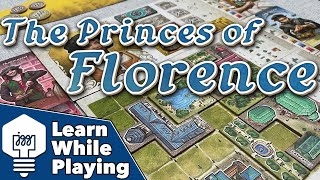
- Gestures add significant work value (two per gesture).
- Jester is highlighted as a powerful asset with strong potential impact.
- Expansion included in this edition (The Muse and Princess).
- Recruiting cards provide strategic flexibility by swapping profession cards while boosting work for both players.
- Cooperative variant offers an alternative mode of play.
- Placement rules can create awkward layouts due to restrictions (no orthogonal touching; diagonals allowed).
- Auction bidding can be expensive, requiring large sums of Florence to secure valuable items.
- Rules are complex with multiple card types and expansions, which can be challenging for new players.
- Italian aristocratic dynasties seeking prestige by completing works
- Golden Age of the Renaissance
Mechanics (from transcript analysis)
- Actions and options during the action phase — In each round, players may perform up to two actions from five options (construct building, complete a work, buy a card, buy a bonus card, or gain a freedom); multiple actions of the same type are sometimes allowed with restrictions.
- Auction / Bidding — Players bid to win objects; starting bid is 200 Florence; bids can be increased by 100 Florence or players may pass; winner pays the bid amount and takes the object.
- auction bidding — Players bid to win objects; starting bid is 200 Florence; bids can be increased by 100 Florence or players may pass; winner pays the bid amount and takes the object.
- Bonus cards and gestures — Bonus cards provide work-related buffs; gestures add work per completed works; recruiting cards swap with profession cards and affect work values for both players.
- Builders and end-of-round effects — In the second round, Builders are auctioned to grant discounts; up to three Builders can be acquired, with effects including discounted costs and adjacency benefits.
- building construction and discounts — Constructing buildings costs 700 Florence (subject to discounts from Builders); first Builder reduces cost to 300, second Builder allows adjacent placement, and a third Builder can make future builds free.
- Complete works — Choose a profession card to play and accumulate a work value from the card (plus other sources) to meet the minimum for the round; sufficient work completes a Work and yields Prestige and money.
- Cooperative principality variant — A cooperative variant flips principality boards and allows overlap of buildings across principalities only if players can negotiate an agreement; otherwise builds stay on individual boards.
- Expansion: The Muse and the Princess — This edition includes The Muse and Princess expansion; the host explains how these expansions introduce new character cards and related auction phases and effects.
- Prestige and money management — Money can be spent to gain Prestige; Prestige can be reduced to gain more money; end-of-game scoring favors the highest Prestige, with tie-breakers based on money and then shared victory.
- Recruiting cards — Recruiting cards can be taken to either immediately use or place in hand; when used, they swap with a profession card on the table, giving the recruited card to your hand and placing the Recruiting card in its previous spot, while the replaced card continues to grant work (including for the other player).
- Tile Placement — Placed tiles must fit within the estate perimeter and cannot overlap existing tiles or pre-printed buildings; tiles can be rotated or flipped; certain placement restrictions apply.
- Tile/landscape placement — Placed tiles must fit within the estate perimeter and cannot overlap existing tiles or pre-printed buildings; tiles can be rotated or flipped; certain placement restrictions apply.
Video topics + discussion points
Quotes (from this video)
- the goal of the game is to gain the most prestige possible over the course of seven rounds
- the initial bid must be 200 Florence you cannot go higher and then we're going to go clockwise around the table with each player either increasing the bid by exactly 100 Florence OR passing
- Winning a Jester is a very good thing for reasons that you'll see later on
- money is very important because we have to spend it to construct buildings as well as for those very important auctions
- for every gesture that we have we add two work
- this edition of the game comes with The Muse and Princess expansion
- Cooperative principality variant now it is a competitive way to play the game you just cooperate when it comes to these principality boards
- you can rotate and even flip it over if you want
- when you take recruiting cards you swap this card with a profession card that's on the table and that means you take that profession card and put it into your own hand and then you put this recruiting card in its place
References (from this video)
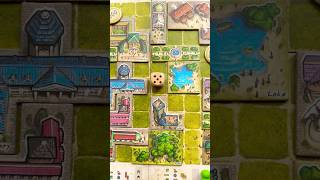
- interactive, puzzly feel
- engaging auction and card/tiles synergy
- strong thematic integration with estate-building
- economic development, family strategy, patronage
- Renaissance Florence, aristocratic estate building
- competitive, negotiation-driven engine-building
- Princes of Florence
Mechanics (from transcript analysis)
- Auction — players bid money to acquire builders and profession cards
- Auction / Bidding — players bid money to acquire builders and profession cards
- Tile Placement — spend money to buy tiles and place them into your estate
- Worker Placement — specialists are assigned to tasks to generate income
- worker placement / specialists — specialists are assigned to tasks to generate income
Video topics + discussion points
Quotes (from this video)
- I'm always particularly drawn to Old School Euros this particular one has had
- it's got a highly interactive puzzly feel
References (from this video)

- engaging auction tension
- tight action economy
- auction-first may feel brittle for some
- auction and building with artist cards
- Renaissance Florence
- Medici
- Splendor
Mechanics (from transcript analysis)
- Auction / Bidding — auction at round start to acquire assets, then building with artist cards.
- auction / hand management — auction at round start to acquire assets, then building with artist cards.
Video topics + discussion points
Quotes (from this video)
- it's so simple but it's so clever
- one of the best experiences
- go check it out on Kickstarter
- it's a fantastic experience sadly like the other things that came after it hasn't been that good
- I would love to play it more
- this is a game that can have an abrupt ending if you do poorly
References (from this video)
- urgent auctions and breadth of scoring
- classic euro feel with depth
- age may require tweaks for modern audiences
- luck of draw can affect contracts
- auction and polyomino-building
- Coliseum
Mechanics (from transcript analysis)
- Auction / Bidding — bidding for contracts and actions with urgency
- auction_bidding — bidding for contracts and actions with urgency
- Polyomino — placing tiles to fulfill contracts and build structures
- polyomino_construction — placing tiles to fulfill contracts and build structures
Video topics + discussion points
Quotes (from this video)
- "This is a deck deconstruction game where you want to be the first player to abandon all of your artichokes"
- "hidden movement games are a strange one for me"
- "it's a very light game it's very quick bit of silly fun"
- "the more weird a theme is the heavier the game is"
- "Revive is such a great card driven Euro"
- "best game from 2022 No Doubt"
References (from this video)

- Engaging bidding dynamics
- Strategic planning for city-building and scoring
- Auction-driven decisions can feel punishing
- Complex scoring may be opaque to new players
- Stratego
- Sheriff of Nottingham
Mechanics (from transcript analysis)
- auction/bidding — Players bid to gain buildings and resources for scores.
- set collection/engine-building — Acquiring buildings to attract artisans who score points.
Video topics + discussion points
Quotes (from this video)
- lying is a subset of bluffing
- it's not outright lying but it features bluffing
- the only social deduction game that I can think of that doesn't feature outright lying it features bluffing
- hate drafting in another form
References (from this video)
- Elegant fusion of auction and tile-laying mechanics
- Tense, tiered scoring that punishes lazy play and rewards sharp planning
- Feels like a classic Euro with fresh twists
- Rules are dense for new players
- Can be lengthy in longer player counts
- auction-driven tile-laying and city-building
- Renaissance Italy
- historical Euro flavor with classic prestige
Mechanics (from transcript analysis)
- Auction — multiple auction types, winner cannot win more in the same round; bidding starts at a fixed minimum and escalates by set increments
- resource/money management — money can be used to bid; money/tokens can influence scoring and auctions
- set_collection / scoring cards — works (scoring objectives) require meeting specific building types; thresholds rise over rounds
- tile_laying / tile_placement — players place tiles to build their personal city card matrix (libraries, lakes, museums, universities, etc.)
Video topics + discussion points
Quotes (from this video)
- it's basically it's an auction tiling game
- it's a classic Euro but with fresh mechanics that you don't really see in newer games
- the best scoring that you can get is one building amongst all these things is is four points
- I really liked it I think the very first uh work that I scored I took it all as money and I thought like this is great I'm gonna have so much money for the rest of the game but I think that hurt me in the end
- it's mean that it was comical
- it's a very silly game
- it's a strong mix of chaos and strategy
- it's better with higher player counts
- it's one of those games where there's very limited communication; it's fully cooperative
References (from this video)

- fantastic end-of-round scoring mechanic
- tight auction with meaningful decisions
- engine building through buildings, discounts, and contracts
- lucky card draws can ruin your plans and feel game-breaking
- board can feel restrictive; the game can be tight and unforgiving
- older design may feel dated to some players; it isn’t as accessible as newer euros
- building projects, contracts, and artistic patronage
- Renaissance Florence; patronage and architecture
- auction/contract-driven engine with careful risk management
- Coliseum
- Tennis Trail
Mechanics (from transcript analysis)
- architect contracts and bonuses — architect cards give conditions and scoring opportunities; completing sets yields points
- Auction / Bidding — auction for tiles/buildings that you place on your board
- auction bidding — auction for tiles/buildings that you place on your board
- discount and rule-bending economy — building tokens grant discounts; you balance risk and reward to plan future auctions
- end-of-round scoring and cashing — players cash in money/points strategically each round
- Tile Placement — tiles become buildings, gardens, lakes that unlock points and bonuses
- tile placement on a personal board — tiles become buildings, gardens, lakes that unlock points and bonuses
Video topics + discussion points
Quotes (from this video)
- I cannot recommend this one
- the box here is way too big
- the components are very small like all the different tokens and wooden bits are a mini skill and they're quite fiddly to handle
- this game shines for me is the deck building and the Hand management part
- the strongest example of a game that I've played that has been completely debilitated by the length
- this is one of the old school Euros dating back to the year 2000
- I would rate this like a six and a half out of ten
- I actually think I prefer Coliseum to the Princes of Florence
References (from this video)

- Thematic integration of Renaissance Florence is appealing
- Kramer’s involvement adds credibility and interest
- Typically heavier/busy rules
- Potentially long playtime
- Prestige and patronage at the Florentine court
- Florence, Italy during the Renaissance
- Aeolian, aspirational; players seek prestige through patronage
Mechanics (from transcript analysis)
- area scoring / prestige tracking — Prestige is earned through placement and patronage choices.
- Auction / Bidding — Players bid to attract patrons and artists to their palace.
- Tile Placement — Artwork and patron tiles decorate a palace and contribute to prestige.
Video topics + discussion points
Quotes (from this video)
- "we are going back in time to before Y2K"
- "starting with games from 2000 the year 2000 and before we call those the before times"
- "I am obsessed with that theme like making movies"
- "I just think it looks really really neat"