/pic3584095.jpg)










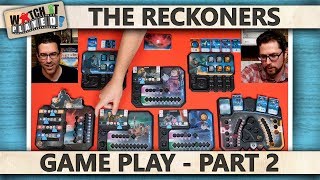



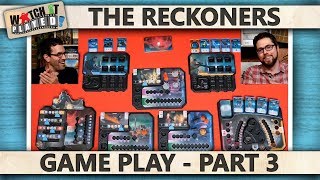


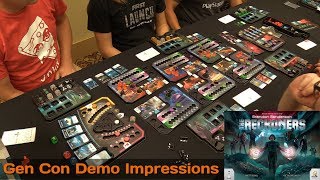

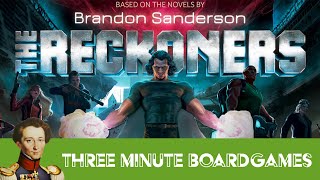










The Reckoners Deep Dive
What the Community Thinks About The Reckoners
The Reckoners has earned respect from reviewers as a solidly executed cooperative experience that succeeds precisely where many IP-driven board games falter. Reviewers consistently highlight the game's thematic coherence: the mechanics serve the narrative of ordinary humans using limited resources to combat overwhelming supernatural tyranny. The consensus is clear that this is not a game resting on Brandon Sanderson's novels for credibility, but rather one that captures the spirit of those books through its core systems. Some reviewers note the game was initially seen as overproduced when it arrived, its tower of plastic components and multiple trays feeling excessive by traditional standards. That perception has softened as other heavy games have followed similar production paths. The primary divide is practical rather than qualitative: players love the game itself, but acknowledge its physical footprint and price point limit its audience. For fans of the source material, reviewers universally recommend diving in. For cooperative dice rolling fans, the simultaneous action system sets it apart from the typical turn-based cooperative template.
Core Mechanics That Define The Reckoners
Simultaneous Dice Rolling and Action Resolution
All players roll their dice at the same time, then work together to decide the order in which they spend them. Unlike sequential cooperative games where one player takes a full turn before the next player acts, The Reckoners creates a continuous flow of interleaved actions. Players can mix and match their dice spending: one player takes two actions, another jumps in to combine efforts, then a third player acts. This system eliminates downtime and keeps everyone constantly engaged. Reviewers emphasize that this removes the "waiting for my turn" frustration common in longer cooperative games. More importantly, the mechanic demands real communication and teamwork. A successful round requires players to constantly ask, "What do you need? What can I do?" rather than execute predetermined individual turns. The system is prone to alpha gaming with domineering players, but with a cooperative group mindset, it produces the tightest sense of collective action.
Dice Rolling with Rerolls and Risk Management
Each player starts with six dice: three standard dice and three character-specific dice that show double symbols on one face. Players must keep at least one die after each roll but can choose to reroll the others up to three times total. This Yahtzee-like mechanism creates meaningful tension. Reviewers point out that players must constantly evaluate: do they keep what they have and accept the result, or push their luck for better outcomes? The character-specific abilities tie directly into this tension. One character rolls double research, another rolls double attacks, but the dice still stubbornly refuse to cooperate. The limitation of exactly three dice rerolls forces strategic decisions. Do you conserve rerolls early for a guaranteed later round, or spend them desperately now? The mechanic creates emergent stories where players recall desperate final attempts to research a weakness or finish an Epic before Steelheart's next activation.
The The Reckoners Experience
Gritty and Confrontational
The Reckoners captures the bleak tone of a city under occupation by supervillain tyranny. Every mechanic reinforces this oppressive atmosphere. Players constantly make impossible choices: do they research Steelheart's weakness, or contain the Epics to prevent population loss this round? The game never lets players feel secure. Steelheart and his minions are always advancing, always threatening to tear the city apart. Watching the population tracker decrease and the enforcers multiply creates palpable dread. The theme is not celebratory victory fantasy but rather desperate resistance. When reviewers discuss memorable moments, they often involve narrow escapes or brutal rounds where the team barely survived to the next turn. One gameplay session showed a team needing exactly the right dice rolls to finish the game before the city fell apart. When the final roll succeeded, the victory felt earned and desperate rather than inevitable. This gritty tone permeates the entire experience, making the game feel like a battle for survival rather than a puzzle to solve.
Epic in Scale and Challenge
Despite its relatively quick 75-minute play time, The Reckoners delivers a sense of epic struggle against overwhelming opposition. Reviewers emphasize that the game escalates tension throughout a session. Early rounds feel manageable, but as more Epics enter the board and Steelheart's power grows, the situation feels genuinely dire. The production values reinforce this: chunky translucent dice, detailed plastic miniatures for each character, and 3D barricades all contribute to a sense of cinematic consequence. Every design choice serves function. The color-coded dice directly map to special abilities, the sliding brackets prevent confusion on chaos-filled turns, and the custom player boards for each character make roles immediately clear. The game's scope expands gradually: you start fighting individual Epics, then must manage Steelheart's growing threat, then balance research progress against city population loss. By the final rounds, players are juggling multiple crises simultaneously. Reviewers describe this escalation as thrilling rather than overwhelming, with the game's structures making crisis management feel heroic rather than fiddly.
What Makes The Reckoners Stand Out
Thematic Alignment Between Mechanics and Narrative
The Reckoners does not simply drape Brandon Sanderson's Reckoners novels over generic cooperative mechanics. Instead, the dice system embodies the novels' central conceit: ordinary people with no superpowers must rely on preparation, intelligence, and teamwork to overcome enemies with extraordinary abilities. Each character directly maps to their role in the books with matching abilities. The research mechanic mirrors the novels' focus on uncovering villain weaknesses before confrontation. The mandatory reroll limitations reflect the characters' human constraints. The game avoids flavor text bloat or rules that only make sense in story context. Instead, the streamlined design allows mechanics and theme to reinforce each other elegantly. The equipment cards provide character-specific upgrades that feel drawn from the books without requiring novel knowledge. Designers Brett Sobel and Seth Van Orden treated the IP with respect, creating a game that serves the property without being consumed by it. The result is accessible to people unfamiliar with the novels while feeling authentic to fans.
Dynamic Teamwork Without Kingmaking
The simultaneous action resolution system creates genuine shared agency, which reviewers identify as rare in cooperative games. Many cooperatives suffer from a dominant player (alpha gamer) controlling the table by directing others' moves. The Reckoners mitigates this through structural design. Players see their own dice results simultaneously, creating information symmetry. No single player can perfectly plan the round because everyone discovers their resources at the same moment. Communication becomes collaborative negotiation rather than hierarchical direction. The mechanic forces this not as flavor but as mechanical necessity. With all dice available simultaneously, the team must work out which dice serve which purposes in real time. Reviewers describe the resulting conversations as energetic and inclusive. Players experience genuine moments of surprise and celebration when unexpected dice rolls open new possibilities. The game structure actively rewards cooperation over domination, making it mechanically friendlier to diverse play groups than traditional sequential cooperative games.
Potential Drawbacks
Physical Footprint and Storage Challenges
The Reckoners is enormous. Reviewers describe it as a table hog that requires significant real estate. The box contains multiple custom trays for each character, district trays for Epics, Steelheart's massive tray, a central resource tray, and component trays for equipment and tokens. While reviewers acknowledge that the trays serve function (sliding brackets and health trackers prevent knocking pieces, custom dice pools stay organized), the sheer physical presence remains a barrier. Some players with limited space cannot accommodate it. For casual players or those with small game collections, the spatial commitment is a real drawback. Reviewers universally recommend trying it before purchasing, as the physical reality of ownership is non-trivial.
Group Dynamics and Alpha Gaming Vulnerability
Despite mechanical safeguards, The Reckoners can suffer from alpha gaming with the wrong group. Reviewers acknowledge the simultaneous action system does not entirely prevent domineering players from controlling decisions. A player can argue loudly for specific action sequences, push others toward their preferred strategy, or use the shared dice pool to override more cautious voices. The cooperative nature, while generally productive, can devolve into frustration if a dominant personality treats the game as a puzzle to solve for everyone else. Group composition matters significantly. With people who embrace collaborative problem-solving, the game sings. With competitive personalities or experienced players who cannot resist directing others, it becomes unpleasant. This is less a game flaw than a player-fit issue, but reviewers identify it as a real obstacle.
If You Enjoy The Reckoners
Players seeking similar experiences should explore Elder Sign, which shares cooperative dice management and escalating pressure. Pandemic offers comparable tension and resource scarcity for those drawn to the core cooperative challenge. Project Elite provides simultaneous action intensity and chaotic planning in a real-time format, though with faster pacing. For Sanderson fans specifically, Red Rising brings thematic adaptation of another novel series with its deck-building mechanics and faction interplay. Dune Imperium offers asymmetric powers and area control with strong thematic grounding. Marvel United appeals to players who enjoy managing shared resources and competing crises in a cooperative framework.
What Reviewers Are Saying
"The best thing about this game is that you can chain actions between players in a turn, truly working as a collaborative effort."
— 3 Minute Board Games
"It's a streamlined dice game that evokes its theme in the coordination you need to survive the insurmountable threat of endless Epics and the excitement of the dice rolling. It's a breath of fresh air, a game based on an IP that isn't consumed by the weight of it."
— Actualol
"Everyone's turns happen at the same time. With a great group you get this buzz going of teamwork and collective action that I've never played in another cooperative game. The Reckoners does it really, really well."
— 3 Minute Board Games