/pic2486726.jpg)
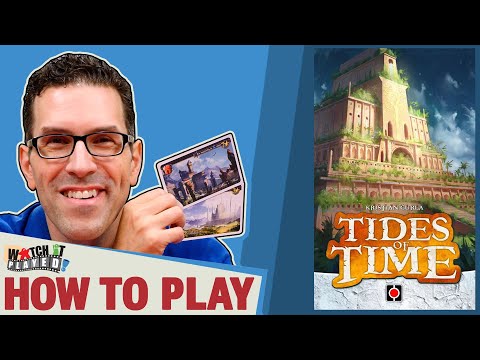
Play as an ancient civilization as they prosper and collapse through time. Build gigantic monuments, raise impenetrable fortifications, and amass vast knowledge as the ages pass. The greatest civilizations will leave their mark long after their collapse. From times long forgotten to times recently lost, civilizations will rise and fall as the tide of time carries them.
Tides of Time is a drafting game for two players. Each game consists of three rounds in which players draft cards from their hands to build their kingdom. Each card is one of five suits and also has a scoring objective. After all cards have been drafted for the round, players total their points based on the suits of cards they collected and the scoring objectives on each card, then they record their score. Each round, the players each select one card to leave in their kingdom as a "relic of the past" to help them in later rounds. After three rounds, the player with the the most prosperous kingdom wins.

- Excellent as a two-player game
- Game of denying other players cards
- A lot of avenues for winning
- Easy rules to pick up
- Set collection and card drafting to create combos
Mechanics (from transcript analysis)
- Card Drafting — Players select cards, keep one, and pass the rest around until a tableau is established.
- Set Collection — Players try to create suits and combos for points.
Video topics + discussion points
Quotes (from this video)
- Magic the Gathering number one what I love about magic the Gathering it is the ultimate toplayer living card game that has been around for almost an eternity and there is so much going on and so much to love about the game that you often find yourself spending all your money on it
- it is such an immersively fun game that even if you know this much or even if you know that much you'll still have a lot of fun
- it's one that is living so it's constantly being updated it's constantly being evolving and you don't have to be up to date with you know the highest level competition plays at the moment it's just a simple fun game with lots of layers as I've mentioned multiple times at this video but it's one that you can play and play and it's one of those things where once you've created a deck it's it's yours and you can keep it and you can change you can modify you can take it to your friends place and try and battle them with it and what you find is that you make a lot of friends along the way and this is one of the ultimate reasons why I really put this at my number one of my two-player board game list
- there's one game that always pops into my mind when we talk about two-player games and this game deserves some special recognition it is is Twilight Struggle
- it's definitely not a game for everyone it's very heavy but it is well worth having played it a couple of times and realizing sometimes it can go on for 3 days where you play a little bit and then come back to it and play another little bit and play another little bit
- but boy this is one game that has really stuck in my memory as an amazing two-player game and even though the theme is not the most enjoyable one it just really gives you that taste of a slice of History I think you come out learning more than actually enjoying it
References (from this video)
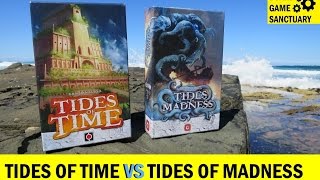
- Beautiful box cover art.
- Cards evoke a sense of grandeur.
- Incredibly detailed and immersive art.
- Cards have a protective white border.
- Well printed and highly durable tokens.
- Clear and easy to understand iconography.
- Rules are well-written and immersive.
- Easy to learn and teach.
- The Kings Nest card is slightly overpowered and can skew the game.
- Building fortifications and kingdoms that will last the test of time.
- Tides of Madness
Mechanics (from transcript analysis)
- Card Drafting — Pure card drafting games where players pick cards to keep and pass the rest on.
- Set Collection — Games are set collecting card drafting games.
Video topics + discussion points
Quotes (from this video)
- Hands down both of them are equally as impressive so they both get my thumbs up
- I will have to choose Tides of Madness
- So Tides of Time and Tides of Madness are pure card drafting games.
- The Kings Nest is in here this is a really good card because if you're tying with another player you actually win the tying get the point
- Using it in a very strategic way can make the game feel a bit in balance
- Tides of madness comes up on top in terms of gameplay
- Especially because those madness tokens really level out the gameplay a little bit more and add a little bit of complexity
- So is more about collecting the actual sets of different suits and maximizing the scores that way
- The games so similar that you only really need one and not the other
- If you're asking for my preference I would say that probably Tides of Madness
- There's a bit of a rarity it's supposed to be a face book but this is melding the two together is if you have four players that's really interesting to try and combine the two sets of cards together
References (from this video)
Mechanics (from transcript analysis)
Video topics + discussion points
Quotes (from this video)
- I'm not talking about the strategy of the gameplay I'm talking about the way the game feels the way the game pulls you in and transports you to another world
- because in this video we are going to talk about seven weird things that board gamers really like
- durable cards are so important if they've got a linen finish on it they've kind of got this cross-hatched nature on it where when you Shuffle and pick up the cards the cards don't stick together it's easy to manipulate and also repels a little dirty grimy oily and greasy fingertips
- when it comes to packing up or setting up a board game sometimes it feels like you're putting together a 1000 piece puzzle you really want to organize all of your different components and bits so nothing gets lost
- the idea that those games fit together well it's like putting that final piece in a 1000 piece puzzle and standing back and going wow I love my game collection
- there's something satisfying about playing a Euro and seeing your colored cube move up a technology track race against another player up a temple and that sense of tension that you get when it comes to playing with cubes
- there's something really special and expressive about a wooden component in a game that has screen printing on it
- board gamers really appreciate it when everything stays in the one place and stays in a place where you last left it
- So what did you think of my top seven lists Are there specific things that you look for to help elevate your board game experience
References (from this video)

- Very quick to learn and play.
- Strategic depth emerges as the game progresses.
- High replayability due to card memorization and strategic interplay.
- Engaging 'thinky game' with constant decisions.
- Strategy might not be immediately apparent.
- Can lead to 'analysis paralysis' (AP).
- Building an empire through ages
- Card-driven
Mechanics (from transcript analysis)
- Card Drafting — Players draft one card at a time from a hand, then choose one to keep, one to discard, and pass the rest.
- Engine Building — Players build an empire by drafting cards with suits and scoring goals over three ages.
- Hand Management — Players manage their hand of cards to optimize scoring and deny opponents.
- Set Collection — Cards of the same suit provide points, encouraging players to draft them.
Video topics + discussion points
Quotes (from this video)
- It's Sunday night Origins is over what I decided to do was take some of the videos I shot from the past two days and combine them together for the video for days four and five.
- The highlight of the night was when they played it did like a game show type thing.
- So finally after talking about it a lot on our show I was able to sit with Chevy D from who is the US Representative of Portal Games to try out rattle battle grab the loop.
- This is a dice game so there is luck involved and uh Chevy just showed me paragraph to the end of the rule book saying this is a dice game and there is luck it's meant for fun.
- It was very cerebral you're really thinking I found myself really think I got crushed my first game you guys are a really close game but you can see the more you would play the more it would reward re beated understandings of the cards and what they do.
- The idea with epic is is to create a ccgs type game without the ccgs type problems of booster packs.
- Every card in the game you can play starting from turn one so you're playing big awesome things starting from the first turn of the game.
- All the cards are big all the cards are powerful so you're going to be able to play Big Stuff in the beginning of the game but in the late game when you're drawing cards you're drawing powerful cards that are going to matter in the late game.
- I think overall Origins was a wonderful success I had a great time.
- The worst thing about every convention though is is having to say goodbye to all the friends the friends that you are reconnecting with or new ones that you're making.
References (from this video)

- adventure/ Madness lineage
- see Tides of Madness; part of the same line
- similar compact play experience
- Tides of Madness
Mechanics (from transcript analysis)
Video topics + discussion points
Quotes (from this video)
- balance is really important and having other interests is really important
- she's my best friend she's my favorite person and best friend
- thanks everyone I really appreciate it
References (from this video)
- Good expansion with seals of endorsement.
- Not essential and not groundbreaking.
Mechanics (from transcript analysis)
Video topics + discussion points
Quotes (from this video)
- This is just a bolt-on bit at the end for diehard fanatics of the game.
- There is literally no point to the solo play of this Moon Saga expansion.
- The scoring at the end is downright diabolically difficult.
References (from this video)

- Challenging decisions regarding which cards to take benefit oneself or deny the opponent.
- The deck is fully utilized each game, allowing for anticipation of upcoming cards.
- The game encourages strategic thinking about compatible buildings for scoring.
- Ancient civilizations will rise and fall
Mechanics (from transcript analysis)
- Area Majority — Some structures give points for having a majority of suits with only one card each.
- Card Drafting — Players choose one card to keep and place face down, then exchange unchosen cards, repeating until five cards are in play.
- End game scoring — Points are scored based on the constructions in the kingdom at the end of each round.
- Hand Management — Players choose cards from their hand to build their kingdom and decide which ones to discard.
- Majority — Some structures give points for having a majority in a certain type of building.
- Set Collection — Buildings provide points based on other buildings found within their kingdom, specifically types like gardens, strongholds, palaces, temples, and libraries.
- Variable player powers — Relic tokens are placed on kept buildings, indicating their ability and type will remain with the player for the rest of the game.
Video topics + discussion points
Quotes (from this video)
- this is not the pencil that comes with the game because I lost that pencil this is a replacement
- when both players are ready they then reveal their chosen structure and it's not a bad idea to read out the effect to the other player so they know what you've chosen
- remember only the player controlling the building gains points for it so even if my opponent had a majority they wouldn't gain anything they just continue to prevent me from getting points
- at the start of a round when you're first building your kingdom you're going to want to collect other buildings that are compatible and will help you gain more points
- those are the challenging sorts of decisions that you're going to have to make when you're playing
- these symbols that represent the different building types are also known as suits
- if you have any questions at all don't hesitate to put them in the comments below and I'll gladly answer them as soon as I get a chance
References (from this video)
- solid two-player drafting experience
- short enough to replay in a session
- not groundbreaking in the two-player space
- a bit forgettable compared to heavier two-player titles
- Cosmic Encounter Duel
Mechanics (from transcript analysis)
- Dice Drafting — Compete by drafting action cards and building a tableau with limited pieces.
- two-player drafting — Compete by drafting action cards and building a tableau with limited pieces.
Video topics + discussion points
Quotes (from this video)
- it's so tight like if you play this with five players it would be probably horrible so three or four players is the best
- this week we played 22 games and three of those were not for the talents we played and then 19 games for this challenge
- i'm having fun so far
- this is basically the same designer so it has a lot of the same element
- the weirdest thing that has ever happened in a board game
References (from this video)
- Fast, accessible, and suitable for lunch-break play
- Beautiful, compact components and clear visual design
- Low barrier to entry but with meaningful strategic depth
- Limited player count (only two players)
- Some players may desire more thematic narrative and less abstract mechanics
- Time pressure, rapid decision-making in a compact two-player format
- Abstract time-focused duel
- Non-narrative abstraction emphasizing elegant, minimal components and quick rounds
- Imperial Settlers
- 51st State Master Collection
- Empires of the North
Mechanics (from transcript analysis)
- deck-building — Each player builds a small, evolving deck of actions to perform on their turns, optimizing for tempo and timing
- two-player drafting/accumulation — Players draft or select actions to outpace the opponent, with limited interaction beyond tempo control
Video topics + discussion points
Quotes (from this video)
- number five tides of time two player game
- number four on my list and this was very tough for me because i was torn between these two
- number two we actually combine two games together, nirōshima hex and monolith arena
- number one stronghold, what else could there be right
- it's a game you can pull off the shelf and play without a heavy rulebook in hand
- the art is amazing and the components are gorgeous, it makes you want to play again just to look at them
References (from this video)
- Fun
- Tides of Madness
Mechanics (from transcript analysis)
Video topics + discussion points
Quotes (from this video)
- Shelf 16 is kind of a an odd mix here
- This shelf has twice as many games as most shelves
- one of my favorite two-player games, but it's very difficult to learn and play
- Fantastic abstract strategy game
- Such a classic game and I like it a lot
- I don't know why I like it so much, but I do
- one of the most beautiful dexterity/party games there are
- There are so many games on the shelf
References (from this video)

- fast, compact two-player abstract with deep planning
- clear rules and accessible concepts
- high interaction as players anticipate each other's moves
- replay potential within a short playtime
- high level of early planning required; some cards are very powerful
- final scoring can revolve around specific cards that are hard to achieve in early rounds
- limited synergy might lead to repetitive plays over time
- set collection and drafting
- Medieval fantasy city districts with five suits: Castles, Palaces, Temples, Gardens, Libraries
- abstract with flavorful flavor
Mechanics (from transcript analysis)
- Card Drafting — each round players select one card from a dealt set and then reveal/keep to build their hand for scoring
- perfect information after drafting — by knowing all cards in the deck after a few rounds, players can predict outcomes and optimize moves
- point-based scoring — points are awarded for various set completions and majority holdings; some cards yield points for specific conditions
- round-based drafting with replacement — after each round, players discard and draw new cards, while five cards stay preconstructed for the endgame emphasis
- Set Collection — scoring is based on collecting cards that form sets and thematic clusters (Castle, Palace, Temple, Garden, Library)
Video topics + discussion points
Quotes (from this video)
- this is a two-player micro game drafting game
- after first round of drafting we know I know all cars
- we know all the cars in the game
- we will open so you will show me what you chose
- I will choose one card that is danger for me and I want to discard it
- the game consists of 18 cards all cards will get into the game
- it's like thinking for the game
- knowing the game is like getting this another level of having fun with the game
- drafting right into your face
- one of us will win it's just simple
- perfect thanks I I love it
- we will draw two new cards
- we score the first round
- we like build our own strategy for the final round