

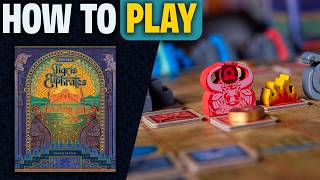









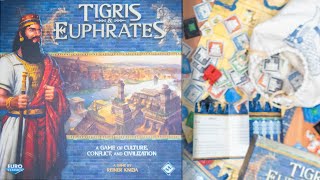































Regarded by many as Reiner Knizia's masterpiece, Tigris & Euphrates is set in the ancient fertile crescent with players building civilizations through tile placement. Players are given four different leaders: farming, trading, religion, and government. The leaders are used to collect victory points in these same categories. However, your score at the end of the game is the number of points in your weakest category, which encourages players not to get overly specialized. Conflict arises when civilizations connect on the board, i.e., external conflicts, with only one leader of each type surviving such a conflict. Leaders can also be replaced within a civilization through internal conflicts.
Starting in the Mayfair edition from 2008, Tigris & Euphrates included a double-sided game board and extra components for playing an advanced version of the game. This "ziggurat expansion", initially released as a separate item in Germany for those who already owned the base game, is a special monument that extends across five spaces of the board. The monument can be built if a player has a cross of five civilization tokens of the same color by discarding those five tokens and replacing them with the ziggurat markers, placing a ziggurat tower upon the middle tile. The five ziggurat markers cannot be destroyed. All rules regarding monuments apply to the ziggurat monument as well. If your king is inside the kingdom of the ziggurat, you will get one victory point in a color of your choice at the end of your turn.
Some versions of Tigris & Euphrates are listed as being for 2-4 players, while others incorrectly state that they're for 3-4 players. Tigris & Euphrates is part of what is sometimes called Reiner Knizia's tile-laying trilogy.
- deep strategic depth
- varied paths to victory
- replayability with different factions
- steep learning curve for newcomers
- Array
- Ancient Mesopotamia
- elevated in-game tension as civilizations grow
Mechanics (from transcript analysis)
- Area Control — players vie for control of four civilizations via tiles and leaders
- area control / influence — players vie for control of four civilizations via tiles and leaders
- Compound Scoring — final score equals the total points in your weakest category
- Scoring by Weakest Category — final score equals the total points in your weakest category
- tile placement — tiles are placed to form civilizations and regions
Video topics + discussion points
Quotes (from this video)
- Chaos just has this fun balancing act of each demon trying to do what's right for them but also keeping an eye on the other demons to make sure they don't get too strong in what they want to do
- the human skin board just gets increasingly tighter
- the score at the end of the game is the number of points in your weakest category
- this is such a cool game and look at this box art
References (from this video)
- Rich strategic depth
- Timer can intensify critical decision moments
- Complex rules can be challenging under timer pressure
- Array
- Ancient Mesopotamia
- Great Western Trail
- Coup
Mechanics (from transcript analysis)
- Area Control — control key regions for scoring
- tile placement — placing settlement tiles to shape civilization
Video topics + discussion points
Quotes (from this video)
- I love playing with the chess timer
- it's addicting
- my final say is to at least try using a chest timer for one of your two player games
- we could finish brass Birmingham under 75 minutes
- this chest timer is My Little Secret Weapon to use with a handful of friends to get through our favorite games faster
- I definitely think we could do it more games less time
References (from this video)
- deep strategic depth
- elegant abstract-in-theme design
- heavy for casual players
- can be less forgiving for newcomers
- Azul
- Patchwork
Mechanics (from transcript analysis)
Video topics + discussion points
Quotes (from this video)
- Number one ranked game is of course Azul.
- Number one is Dead of Winter, a crossroads game. I get 27 points.
- The Crew Mission Deep Sea is the number one trick taking game on board gamegeek.
- Number one is Root.
- Calico.
- Thunderbirds.
References (from this video)
- Elegant minimalism with deep strategic depth
- Widely regarded as a foundational Knizia title with lasting influence
- Clear core loop that remains accessible despite depth
- Can be unforgiving for newcomers
- Older printings have iconography and balancing quirks later addressed in reissues
- civilization growth, interlocking domains, and strategic conflict
- Ancient Mesopotamian civilization-building and empire management
- mythic/historic framing through scoring and board state
- Raw
- Modern Art
Mechanics (from transcript analysis)
- conflict and interaction — Conflicts and interactions between neighboring domains drive tension and bidding-like decisions.
- tile placement — Players place tiles to form and contest color-coded civilizations, creating territories and strategic leverage.
- Tile placement / area control — Players place tiles to form and contest color-coded civilizations, creating territories and strategic leverage.
- Weighted scoring across four domains — Victory points accumulate through control of diverse domains, with inter-domain interactions shaping endgame.
Video topics + discussion points
Quotes (from this video)
- I'm invoking RAW
- There are climactic bids and surprise upsets, all with minimal rules overhead.
- It's extremely welcoming to new players while also being really satisfying to uber dorks who have been slinging cardboard for decades like myself.
- The drama really is driven by the heart being in conflict with itself.
- RAW is the best the game has ever looked, with tight flourishes like some marvelous graphic design and UI.
- The ubiquity of so much output getting repackaged means you got to be really selective.
References (from this video)
- Layered depth and strategic tension
- Elegant, vicious yet purposeful interaction
- Yellow and Yangtze
Mechanics (from transcript analysis)
- Points by color pools — End-game score is determined by the lowest of four color-based point pools.
- tile placement — Place tiles to build civilizations and unlock points.
Video topics + discussion points
Quotes (from this video)
- I love how streamlined this game is.
- it's a drafting style game as you're trying to build up the civilization of cards
- one world worthy of all the hype
- this engine builder
- it's the crunchiness
- this is widely considered to be one of the best if not the best economic style board game of all time
- it's a joy to play
- you are destined to love it
References (from this video)
- dynamic board changes create constant opportunities
- strong conflict mechanics that feel intuitive
- timeless design that remains influential
- can be complex to teach
- confrontational play may not suit all groups
- four scoring colors with strategic conflict
- ancient Mesopotamia
- thematic but abstract
- Yellow and Yanxi
Mechanics (from transcript analysis)
- Compound Scoring — control temples to unlock strategic bonuses
- dynamic temple-based scoring and conflicts — control temples to unlock strategic bonuses
- loss/gain of tiles via battles — attacking cities reduces opponent tiles and shifts scores
- tile laying and color-based scoring — claim city tiles and build color-specific scoring chains
Video topics + discussion points
Quotes (from this video)
- this is a really interesting game
- one of the best examples of that mechanism being used correctly
- infinite replayability
- timeless, evergreen status
- flows wonderfully and rewards careful planning
References (from this video)
- Unique and chaotic but deeply strategic gameplay
- Rewards daring plays and bold timing
- High interaction that keeps players engaged
- Solid production values with weighty leaders and quality tiles
- Players can re-enter and potentially steal kingdoms after losses
- Not ideal for players who want peaceful, slow empire-building
- High volatility can lead to intense, sometimes brutal negotiations and outcomes
- Requires strong emotional resilience and tolerance for losing streaks
- Civilization conflict and resource management
- Ancient Mesopotamia, between the Tigris and Euphrates rivers
- Abstract historical flavor with symbolic leaders and temples
- Small World
- Power Grid
Mechanics (from transcript analysis)
- Calamity, revolt, and war mechanics — Calamity tokens disrupt spaces; revolts and wars resolve conflicts between kingdoms, affecting VP and control.
- end game bonuses — The game ends when the tile bag is emptied or the second-to-last treasure is claimed; final scoring depends on VP from kingdoms and monuments.
- End-game scoring dynamics — The game ends when the tile bag is emptied or the second-to-last treasure is claimed; final scoring depends on VP from kingdoms and monuments.
- hidden victory points — Treasures and certain tokens influence scoring; connecting tokens can grant VP, and monuments provide ongoing scoring effects.
- Kingdoms and monuments — Kingdoms are connected groups of tiles; placing four tiles of the same color can create a monument, which yields VP.
- Leader placement and faction management — Each player has four leaders of different types; placement rules influence scoring and control of kingdoms.
- tile placement — Players place tiles to create connected kingdoms and form structures like temples, markets, farms, and monuments.
- Treasure tokens and victory points — Treasures and certain tokens influence scoring; connecting tokens can grant VP, and monuments provide ongoing scoring effects.
Video topics + discussion points
Quotes (from this video)
- Tigris and Euphrates is a unique game there's nothing quite like it
- the best thing about this game is you never feel like you're out of it even if you lose a lot in one turn
- if you thrive in chaos or confusion this is a game you should really check out
- this one will not be for you everything you build can be smashed or stolen from you
References (from this video)
- tight, elegant design
- deep strategic planning with multiple win conditions
- replayability via asymmetric score tracks
- can be heavy to teach to new players
- some players may find interaction too direct
- civilization building, resource management, and tough conflict
- Ancient Mesopotamia; cradle of civilization
- abstracted civilization conflict with tangible thematic flavor
- Shadows Over Camelot
- Ra
Mechanics (from transcript analysis)
- Conflict resolution — Direct competition with others for tile and resource control, with scoring consequences.
- hand management — Managing a hand of leaders and actions across four civilizations.
- Tile placement / area control — Players place tiles to create civilizations and control regions.
Video topics + discussion points
Quotes (from this video)
- there's no fun game for everybody there are different approaches and people can pick what they like
- we didn't have the trouble of getting all the approvals from the movie side
- read Mickey Mouse and Donald Duck as a kid and suddenly I'm doing games about it
- the best thing is to give your best every day you don't know how many days you have left
- you've only one life
- Steve Jobs changed our world in our times probably like nobody else
References (from this video)
- Simple core actions with deep strategic depth
- Very interactive and dynamic scoring through wars and revolts
- Balanced, tense scoring requiring attention to all colors
- High production value in latest edition
- Clear, yet rich map of regions and temples
- Steep learning curve due to complex combat interactions
- Rule terminology can confuse players (battle vs revolt, walls vs colors)
- Not thematically strong (abstract feel) for some players
- Empire-building, resource balance, and tactical conflict among rival civilizations.
- Ancient Mesopotamia-inspired empire-building on a modular board with rivers and temples.
- Abstract/Deterministic with historical flavor
- Yellow and Yangtze
Mechanics (from transcript analysis)
- Area Control — Compete for control of regions through color tokens; strongest color in a kingdom gains points.
- Area control / kingdom building — Compete for control of regions through color tokens; strongest color in a kingdom gains points.
- Compound Scoring — Final score is determined by the lowest color across the four color sets.
- Conflict resolution (revolts and wars) — Resolve fights when opposing colors meet; involve strength based on tiles and optional tile boosts.
- Cube tower — Resolve fights when opposing colors meet; involve strength based on tiles and optional tile boosts.
- End-game scoring based on the lowest color — Final score is determined by the lowest color across the four color sets.
- hand management — Maintain up to six tiles, drawing to replace used ones; discard to speed up.
- Hand management / draw mechanics — Maintain up to six tiles, drawing to replace used ones; discard to speed up.
- Temple/castle scoring — Temples generate points for colors in control; additional castles boost points in rows.
- tile placement — Place tiles to extend kingdoms, connect temples, and claim color tokens.
Video topics + discussion points
Quotes (from this video)
- this is the most involved and the most complex game of his I've ever played
- player interaction is everything in this game
- it's a timeless design
- the dynamic balance of war and revolt is really interesting
- it's fantastic, it's a wonderful design
- this is a real niche product here
References (from this video)
- deep yet accessible abstract design
- pronounced strategic depth and balance
- can feel punishing when plans are disrupted
- takes time to teach and grasp to optimal play
- civilization-building and conflict
- ancient Mesopotamia
- abstract strategic
Mechanics (from transcript analysis)
- area majority — kick out or combine kingdoms via conflict mechanics
- area majority and war-type resolution — kick out or combine kingdoms via conflict mechanics
- tile placement — develop a connected civilization network with color-specific scoring
- tile placement and network building — develop a connected civilization network with color-specific scoring
Video topics + discussion points
Quotes (from this video)
- I absolutely adore this one
- I think it is an absolute blast
- this game is fantastic
- an evergreen to me
- it's stripped back and still a blast
References (from this video)
- classic, deeply strategic with iconic components
- reliable reprint/edition appeal
- age of the game shows in some mechanics
- complexity may be intimidating for new players
- area control with rival civilizations and terraforming-like tile placement
- ancient Mesopotamia between the Tigris and Euphrates rivers
- strategic, ancient-civilization thematic
- Gaia Project
Mechanics (from transcript analysis)
- Area Control — Score points for controlling regions and forming interconnected strategies
- area_control — Score points for controlling regions and forming interconnected strategies
- diary_of_tiles_and_kings — Secret boards and tile interactions affect scoring and play
- tile placement — Place tiles to establish areas and score with kings and river control
- tile_placement — Place tiles to establish areas and score with kings and river control
Video topics + discussion points
Quotes (from this video)
- The coldest hot board game out there right now is Ory. So, Orly is actually a quite heavy Euro game from the looks of it alone, right?
- Decorus is the new cooperative and hot board game from Pegasus.
- The looks are not that great. Yeah, it it looks unique, but it's a really tough and heavy cooperative board game about hacking.
- The Hobbit? Then you know what's coming.
- This is a deck building game.
- The board is actually very clean, yet at the same time detailed.
- The pieces pop. I love the contrast of black and white background and then having colorful pieces.
- First and hottest game this month is Vampire Lords, which is right now on Game Found.
- Second hottest board game out there right now is The Old King's Crown.
- Number three in our hotness list is Tigris and Euphrates.
- Fourth hottest board game right now is Covenant.
- Fifth hottest game on our list is Terramystica.
- Number seven on the hottest games of the month is Tag Team.
References (from this video)
- Unique ruleset unlike any other game
- Strategic depth with push-your-luck elements
- Simple rules despite complex gameplay
- Beautiful execution of game design
- Still holds up extremely well 20+ years later
- Interesting balance of strategy and luck
- Tricky to initially understand the ruleset
- Takes time to fully appreciate the design
- Civilization Building
- Ancient Mesopotamia
- Abstract
- Yellow and Yangtze
Mechanics (from transcript analysis)
- Area Control — Compete for regions with potential conflicts between leaders
- Area Control/Conflict — Compete for regions with potential conflicts between leaders
- Compound Scoring — Score based on the resource type you have the least of
- Leader Placement — Place leader tokens that generate resources
- Resource Scoring — Score based on the resource type you have the least of
- tile laying — Place tiles to build civilizations on the board
- tile placement — Place tiles to build civilizations on the board
- worker placement — Place leader tokens that generate resources
Video topics + discussion points
Quotes (from this video)
- these are the games that connect with me that I have a real emotional reaction to
- I've had really great experiences with although I could highly recommend any of the games on this top 10 for anybody to pick up and purchase
- dominion was one that was really pivotal in me getting into the hobby
- I'm just amazed at how well Alan Moon has managed to create such a simple rule set and yet such a substantial experience
- it's a bunch of mechanisms that mesh together just work for me so well
- I think I'll be playing it for a long time to come
- if you're looking for something that's a little bit more substantial got a bit more going on you can get your teeth stuck into then agricola is a great next step