




















Tiletum Deep Dive
What the Community Thinks About Tiletum
Tiletum has earned genuine enthusiasm from the board game review community. Reviewers consistently highlight its approachability within the heavy euro space and its capacity to deliver substantial accomplishment across just twelve player turns. Chairman of the Board calls it one of their favorite games of modern years and absolutely outstanding, while Stonemaier Games ranked it highly on a list of games that pack significant accomplishment into very few turns. Meeple University considers it the most enjoyable of the designers' dice-drafting games. The game's carefully balanced mechanics create competition that feels natural rather than punitive, and its replayability keeps bringing players back.
Core Mechanics That Define Tiletum
The Inverse Dice System
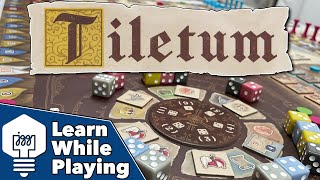
Designed by Simone Luciani and Daniele Tascini, creators of Grand Austria Hotel and other acclaimed euros, Tiletum's core mechanism creates a constant resource-versus-power dilemma. Each turn, you select a die and gain resources equal to its number, but then take an action whose power is inversely proportional to that die value. Take a high-value die for more resources, and your action weakens; take a low die and act powerfully, but gather little. This single elegant choice forces meaningful decisions every turn and ensures no option is universally superior. Published by Board & Dice, the game rotates its action wheel each round, keeping the puzzle fresh throughout play.
Contracts, Cathedrals, and Layer Building
Beyond resource management, Tiletum weaves together multiple victory paths through contracts, cathedral construction, and house completion. You stack pillars to build cathedrals across the board, house notable characters on your player board to gain bonuses, and pursue contracts that reward fulfilling sets of goods. These systems interlock: placing your merchant in the right city at round's end nets bonus points, while filling your houses unlocks trading abilities and character powers. Building these layered engines rewards both long-term planning and tactical pivoting as the dice fall each round, and a King track offers an additional strategic lever with a large potential point swing.
The Tiletum Experience
Satisfying Depth Without Rules Overhead
Reviewers praise Tiletum as a deep and rich game that somehow avoids many rules ambiguities or complexities. The elegance lies in how the game communicates itself: action spaces are well-labeled, player boards exceptionally laid out, and iconography crystal clear. This clarity means you spend mental energy on meaningful decisions rather than rule lookups. Turns can build explosive chains of bonus actions as you trigger cascading effects from contracts, characters, and free spending actions. These moments feel rewarding precisely because they emerge organically from the engine you have constructed.
Tense, Interactive Economic Drama
The end-of-round fairs create organic player interaction. Each round reveals a different scoring objective, perhaps crests, characters, or architects. If several rounds reward the same target, the game becomes a race for limited slots. This variability shapes every play uniquely, and your merchant placement matters intensely because missing a round's objective means zero points. With limited house spots at higher player counts, competition for key positions stays tight. Whether you face two opponents or four, the scarcity of actions and spaces forces tough choices without resorting to direct conflict, producing the intense, interactive tension reviewers prize.
What Makes Tiletum Stand Out
A Return to Throwback Euro Elegance
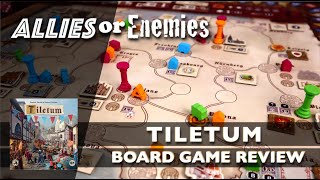
In an era of sprawling complexity, Tiletum feels like a celebration of classic euro design principles. The game trusts its mechanics rather than burying them under layers. There are no feed-your-people mandates and no hidden information, just a tight puzzle where every resource type has a clear function and every action matters. Reviewers note that because everything you do produces some benefit, unlike euros where a turn can accomplish nothing, the game stays forgiving while remaining analytically demanding. Allies or Enemies highlighted how accessible it feels relative to the designers' heavier titles.
Twelve Turns of Spectacular Accomplishment
With exactly three turns per player across four rounds, you take just twelve turns total, yet reviewers emphasize that this count is misleading. You do a great deal each turn because the inverse dice system lets you chain multiple actions, trigger bonus tiles, and leverage character abilities. The game does not waste your turns; it maximizes them. Stonemaier Games specifically noted that despite the substantial decisions and combo opportunities, the game moves at a good pace with little downtime. This efficiency is rare in heavy euros and makes Tiletum accessible to tables with mixed experience levels.
Potential Drawbacks
Aesthetic Minimalism and Color Confusion
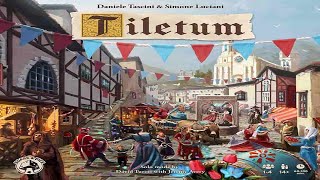
Tiletum is unabashedly euro, which means its visual presentation prioritizes function over thematic immersion. The game features significant beige tones, and the dice palette includes shades of gray that can be hard to distinguish at a glance. One reviewer characterized the color choices harshly, and others noted the Renaissance-era character artwork feels slightly disconnected from the medieval setting. These are not structural problems, since once you have played a round you know your colors, but they do not inspire the aesthetic delight some modern games offer.
Action Bloat at Higher Player Counts
While the game scales from one to four players, one reviewer noted that turns can sometimes get silly with a lot of extra actions, occasionally making the game feel like it meanders despite being designed as a tight euro. A player might take a base die action, trigger a bonus tile, gain a character ability, chain a free spending bonus, and unlock another action all in one turn. For experienced euro players this is exhilarating, but for newer players or those seeking quick turns, the ballooning action economy can lead to analysis paralysis at higher counts.
If You Enjoy Tiletum
Try Grand Austria Hotel, also by Luciani and Tascini, which shares the clever dice-drafting framework. For another rich euro in a similar vein, explore Praga Caput Regni, and for tight simultaneous dice management, Troyes pairs dice with spatial puzzles. If you appreciate Tiletum's throwback sensibility, Terracotta Army from the same design partnership sits squarely in the same lineage.
What Reviewers Are Saying
"I would go as far as to say that out of all of their dice-drafting games, I've enjoyed this one the most. There were a lot of really interesting decisions to be made."
— Meeple University
"It feels a little bit more accessible. Not that it's a game for new or casual gamers, but it doesn't feel as heavy as some of the other T games. There are also a lot of paths to combos and points in just about everything that you do."
— Allies or Enemies
"One of my favorite games of modern years. It's absolutely outstanding. This is like the sweet spot for me, deep and rich but without many rules ambiguities or complexities."
— Chairman of the Board