









Tiny Epic Vikings Deep Dive
What the Community Thinks About Tiny Epic Vikings
Reviewers generally place Tiny Epic Vikings among the strongest entries in the Tiny Epic line from Gamelyn Games, and the praise centers on how much design fits into a small box. Allies or Enemies calls it a full game with "one of the best developed systems of any tiny epic game." That review argues that the variability comes from using only three of the six gods in each match, from a limited 15 turns that never feels like enough time, and from cards whose rune requirements keep reshaping the best line of play. It also describes the gameplay, more than the components, as the real leap forward, suggesting it may be "the smoothest and most interesting tiny epic game since galaxies."
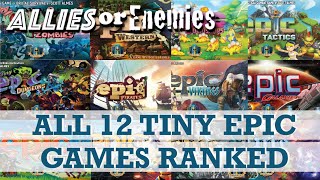
Enthusiasm is tempered by a clear sense of who the game suits. Meeple University recommends it to fans of the series who like the sound of Tiny Epic Blood Rage but want a gentler battle system and a shorter session. Allies or Enemies ranks it fourth in its ranking of the series, behind Tiny Epic Galaxies, Tiny Epic Dinosaurs, and Tiny Epic Dungeons, and calls the art "a huge step forward" for the line. Watch It Played introduced the game as a fast-paced strategy game for one to four players that combines drafting, area control, and set collection.
Core Mechanics That Define Tiny Epic Vikings
Area Control
Island control drives nearly every decision. A player needs at least one figure on an island and more influence than any opponent to claim its rune token. Getting Games explains the tally: each settler contributes one influence, each docked ship two, and each temple four. Control changes hands as rivals send more settlers ashore, and every change also raises the fury of the matching god. One Stop Co-op Shop describes the same tug of war from the solo side, where troops must establish majorities on each island to claim its tokens. Allies or Enemies notes that the system holds up at two players, which the reviewers consider a rarity for area control games.
Card Drafting and Multi-Use Cards
Each era opens with a draft. According to Getting Games, players are dealt four cards in the first era, five in the second, and six in the third, keep one face down, and pass the rest along the direction shown on the board. The cards then fuel the action phase. Meeple University highlights the multi-use card, which can serve as an action or as a battle entry, and notes that a card played into a losing battle can still deliver its benefit. The draft therefore does more than build a hand: it determines which runes will be available for the actions to come. One Stop Co-op Shop adapts the same idea for solo play, dealing piles of cards and passing the unwanted cards to the bot.
The Tiny Epic Vikings Experience
Mythology
The Norse setting does real work in the design. Getting Games notes that the gods Odin, Thor, and Sif each carry a fury track, and the god with the most fury makes the runes of its color worth the most at the end of the game. Fallen warriors travel to Valhalla, and their matching god gains fury and grants a benefit. Meeple University observes that this turns defeat into a resource, noting that losing can be "really good and almost like you want to lose sometimes." Allies or Enemies adds that the gods appear in a more traditional, less idealized style than the rest of the series, which reinforces the mythological tone.
Sandbox Strategy
Reviewers repeatedly describe several viable lines of play. Allies or Enemies argues that because only three gods appear in each game and every card differs, players will take different paths every time. One Stop Co-op Shop reports a solo win built on a spread-out strategy. After the bot's card knocked its settlers off several islands, the reviewer found that stacking runes in multiple places was stronger than chasing a single god in isolation. The reviewer also characterizes the bot as active opposition that competes directly for territory rather than playing a high score variant.
What Makes Tiny Epic Vikings Stand Out
Nuanced Action Ordering in a Small Box
Allies or Enemies argues that the rules are simple, drafting cards, playing them, and taking one of four-ish actions, but that the order of those actions creates real depth. Players line up rune bonuses, contest area control, and decide when to join a fight or throw one. Meeple University adds that timing matters, because playing the right card at the right moment yields runes that later actions can exploit. Getting Games shows that the battle system rewards some losses, citing a case where a defeat still earned four resources that paid for a temple.
Artwork and a Foldable Board
Presentation draws consistent praise. Watch It Played notes that Tiny Epic Vikings is the first game in the series to feature a foldable game board. Allies or Enemies describes the board as a traditional game board that still fits the signature Tiny box, and says the card art is the best in the series. The same review praises the silk screened wooden tokens for suiting the theme.
Potential Drawbacks
Fiddly Components and a Crowded Box
The physical complaints concern handling. Allies or Enemies says the wooden bits are fiddly and easily knocked, that the board is hard to lay perfectly flat, and that returning everything to the box is a challenge, although the reviewers frame that last issue as "a good problem to have." The same review also suggests the Ragnarok expansion may be needed to reach the full experience, since it adds an alternate board, more gods, and Valkyries to the base game.
Solo Bookkeeping and a Demanding Learning Curve
The solo mode draws the strongest reservations. One Stop Co-op Shop notes that the bot's doubled pieces, extra actions, and chained effects make the game hard to track, and describes it as "actually really fun" only "if you can handle it." Allies or Enemies describes the solo game as deep, with four AI opponents that play under largely different rules, but warns that players must be willing to learn "basically a second version of the game," likely needing several run-throughs with the rulebook before the rules feel comfortable.
If You Enjoy Tiny Epic Vikings
- Tiny Epic Galaxies: Allies or Enemies ranks Tiny Epic Galaxies first in its ranking of the series. Reviewers who call Vikings the smoothest release since Galaxies will likely appreciate the same tight design.
- Tiny Epic Kingdoms: One Stop Co-op Shop describes Tiny Epic Kingdoms as the early experiment that Vikings has "graduated" from, making it a good comparison for players who enjoy the series' ambitious 4X feel in a small box. Allies or Enemies also highlights its two-player version and the meeples that create natural conflict.
- Tiny Epic Blood Rage, Blood Rage, and Inis: Meeple University frames Vikings as the gentler, shorter cousin of Tiny Epic Blood Rage, while Allies or Enemies notes shades of Blood Rage and Inis in its battles and area control, although it considers Vikings "mostly its own thing."
What Reviewers Are Saying
"If you are a fan of the Tiny Epic games and like the sound of Tiny Epic Blood Rage with a gentler battle and shorter gameplay, then Tiny Epic Vikings is the one for you."
— Meeple University
"This may be the smoothest and most interesting tiny epic game since galaxies. The bones are fairly simple, draft cards, play cards, take one of four-ish actions, but there is a surprising amount of nuance in the order that you take those actions."
— Allies or Enemies
"There's an argument to be made that maybe it was better that they lost that battle versus winning it, considering they got those four resources that let them construct that temple on this turn."
— Getting Games