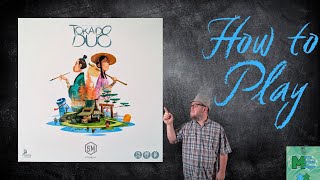
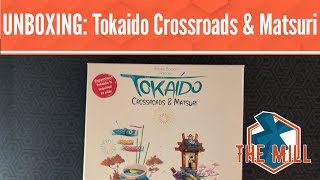
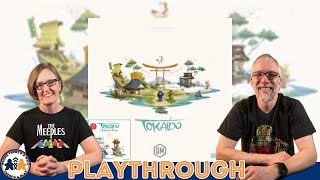
In Tokaido, each player is a traveler crossing the "East sea road", one of the most magnificent roads of Japan. While traveling, you will meet people, taste fine meals, collect beautiful items, discover great panoramas, and visit temples and wild places but at the end of the day, when everyone has arrived at the end of the road you'll have to be the most initiated traveler – which means that you'll have to be the one who discovered the most interesting and varied things.
The potential action spaces in Tokaido are laid out on a linear track, with players advancing down this track to take actions. The player who is currently last on the track takes a turn by advancing forward on the track to their desired action and taking that action, so players must choose whether to advance slowly in order to get more turns, or to travel more rapidly to beat other players to their desired action spaces.
The action spaces allow a variety of actions that will score in different, but roughly equal, ways. Some action spaces allow players to collect money, while others offer players a way to spend that money to acquire points. Other action spaces allow players to engage in various set collections that score points for assembling those sets. Some action spaces simply award players points for stopping on them, or give the player a randomly determined action from all of the other types.
All of the actions in Tokaido are very simple, and combined with a unique graphic design, Tokaido offers players a peaceful zen mood in its play.
Tokaido in about 3 minutes
Top 10 Mechanisms: Dice Games
Mechanics (from transcript analysis)

Video topics + discussion points
Quotes (from this video)
- I'm so excited about I played it for the first time this week my youngest son who's eight was begging to play it again tonight and I was just thinking this is such a chill game I would love a solo mode
- we're going to get solo mode which I'm so excited about
- Wings span's my most played Stone Mar game at this point
- Let's go to Jaan also a great family game I have learned this week
- they are not making any more of that deluxe Kickstarter
References (from this video)
- Numiji
Mechanics (from transcript analysis)
Video topics + discussion points
Quotes (from this video)
- What has wings but cannot fly? It was Finsspan
- Apiary
- Wingspan expansion 4
- Wingspan fan promo cards. We've had so much fun playing with them.
References (from this video)
Mechanics (from transcript analysis)
Video topics + discussion points
Quotes (from this video)
- and just sounded like a really cool way to show off the game.
- And we are going to get fan design bird pack for wingspan.
- Tokido duo is also in components.
- Terrammystica, a non Stonemire game, is finally going to get their kind of fan-made or designer made factions out
- Very exciting.
- be nice, be kind, help each other out, and play some board games because it's nice to escape into those sometimes.
- they should fit in the box.
- You just might get a little lid lift.
References (from this video)
Mechanics (from transcript analysis)
Video topics + discussion points
Quotes (from this video)
- Their goal is joy is always their goal.
- In 2025, my goals are to welcome both new and experienced gamers into the gaming community and bring joy to their tabletops, to support my amazing co-workers, and to lead with kindness, compassion, and empathy.
- What's the balance of randomness and luck versus control and agency advantage?
- The core hook advantage is that you are far away from your crew mates, yet you're still connected to each other through the skills, impact dice, slots, information about the world, the shared challenge dice, a variety of actions geared towards assisting other players, puzzles, and accomplishing your mission and destiny.
- It's supposed to be more intuitive, not straight up guessing.
- There really isn't much worry about spoiling something from going and looking at like a like going through the story books because there's so much in there.
- I would put it at like 90% control agency and 10% luck.
- you have to choose from the six different location choices what you are going to do.
- the heart of Vantage is exploration, discovery, and that freedom.
- there isn't an app for Vantage because it's meant to be an escape.
References (from this video)
Mechanics (from transcript analysis)
Video topics + discussion points
Quotes (from this video)
References (from this video)
- Serene, peaceful theme and aesthetic; trip-like experience.
- Beautiful finished panoramas and satisfying completion visual.
- Balanced starting options and a variety of viable strategies.
- No harsh punishments; maintains conversation and casual play.
- Tension exists in decisions without being overly heavy.
- Two-player AI feels underdeveloped and less competitive.
- Linearity can lead to diminishing depth after multiple plays.
- Limited strategic depth for players seeking a heavier game.
- tranquility, travel, personal enjoyment, collecting souvenirs
- Feudal Japan along the Tokaido road, a serene journey
- travelogue on a peaceful walk with scenic progression
Mechanics (from transcript analysis)
- card drafting — Panoramas are represented by multiple cards per motif; players collect cards to complete panoramas for increasing point value, with higher tier cards offering more points.
- Encounter cards — Drawing encounter cards at certain spots provides various benefits or opportunities, serving as a source of wild options.
- end game bonuses — Several side tracks and end-game bonuses reward players for specific achievements (e.g., who completed panoramas first, most visits, etc.).
- End-game bonuses and track-based scoring — Several side tracks and end-game bonuses reward players for specific achievements (e.g., who completed panoramas first, most visits, etc.).
- Inn/market/shop resource management — Stops like inns or shops provide meals or souvenirs; money is required for actions, and collecting symbol sets increases scoring.
- Panorama card drafting — Panoramas are represented by multiple cards per motif; players collect cards to complete panoramas for increasing point value, with higher tier cards offering more points.
- Resource management — Stops like inns or shops provide meals or souvenirs; money is required for actions, and collecting symbol sets increases scoring.
- Temple donation and bonuses — Donating money at the temple yields points and potential end-game bonuses for leading in donations.
- worker placement — Players move along a fixed path; the player furthest behind takes their turn and can choose any open spot ahead of them.
- Worker placement on a linear track — Players move along a fixed path; the player furthest behind takes their turn and can choose any open spot ahead of them.
Video topics + discussion points
Quotes (from this video)
- this is a very Serene very peaceful game you're kind of going on this this lovely walk you are painting pictures you're painting these panoramas you're stopping and getting delicious foods resting at hotels
- the nice thing about this game is that every spot is good like there's no bad spot
- it's not super strategic and there's not a lot to just discover and dive into here but that being said there's still some fun and relaxation to be had
- seeing that finished product when you're all done
References (from this video)
- clean, easy to learn and play
- asymmetric powers add variety
- beautiful production and art
- cozy, approachable feel
- fast play and quick to table
- tableau card edges are sharp; production quibble
- dots on the board are small; lots of white space
- two-player with a dummy bot is not ideal; best with three or more
- Array
- Array
- experience the journey and scenery, collecting tableau cards and meals
- Array
- Traveler journey along the Tokaido road in feudal Japan
- Array
- Array
- Array
- positive
Mechanics (from transcript analysis)
- end game bonuses — End-game scoring includes multiple bonuses and end-game tallies across several categories.
- end-game and bonus scoring — End-game scoring includes multiple bonuses and end-game tallies across several categories.
- set collection — Players collect items (meals, souvenirs, etc.) to build sets for incremental points.
- tableau building — At stops, players draw and acquire cards that contribute to their personal tableau for scoring.
- tableau building / card drafting — At stops, players draw and acquire cards that contribute to their personal tableau for scoring.
- Unique player powers — Travelers have unique abilities that influence decisions and strategy.
- Variable player powers — Travelers have unique abilities that influence decisions and strategy.
- worker placement — Each player places a traveler to take actions along the Tokaido road, determining access to tableau cards and bonuses.
Video topics + discussion points
Quotes (from this video)
- it's really clean. And I don't mean that because it's all white. It looks like it's clean. I mean mechanically, it's a very clean game.
- It's not heavy. There's not a ton going on. You have your worker placement and set collection and a little bit of push your luck as you're seeing if people are going to, you know, take something from you.
- Cozy, quick game that you can get a bunch of players to the table easily with.
References (from this video)
Mechanics (from transcript analysis)
Video topics + discussion points
Quotes (from this video)
- this game is so creative because you get to play kind of each of your favorite games in it.
- the box is organized in such a way that each of the cards are separated by color.
- it's very fun to try and beat the courses and see how many um, attempts it takes you to do it.
References (from this video)
- Beautiful art and components with a clean, accessible board
- Strong gateway game appeal suitable for families and new players
- Repeated playability via asymmetric character powers and multiple routes
- Exciting endgame scoring through panoramas, meals, and souvenir sets
- Interesting blocking dynamics and pacing choices, especially in multi-player
- Solid solo mode with Autotoma that feels like a cooperative-feel against bots
- Initial confusion about where to stop on the board; one may instinctively stand on icons rather than the interstitial dots
- Some panoramas have icons that require close inspection to interpret
- Blocking can backfire and sometimes hurts your own plan as you impede others
- traveling pilgrimage along a culturally rich route, balancing economy, encounters, and endgame scoring
- Kyoto to Edo (historical Japan) along the Tokaido road, collecting memories and experiences
- pictorial, experiential journey with emphasis on atmosphere and aesthetics
- Parks
- First Rat
- Ticket to Ride
- Lords of Waterdeep
- Carcassonne
Mechanics (from transcript analysis)
- Asymmetric powers — each player’s character grants unique bonuses or starting money, affecting strategy and routes.
- Blocking interactions — players’ choices can block or influence others’ access to spaces; the two-player variant adds a blocking pawn mechanic.
- Endgame scoring — points come from temples, panorama cards, meals, souvenirs, and most shop items; additional bonuses for completing certain sets.
- Goal-oriented routes and panoramas — players chase specific panorama sets and route destinations, influencing tension and competition.
- Movement — on your turn you may move any number of spaces up to the next inn, then perform the action of the space you stopped on.
- Resource management — collect coins, buy items, and assemble sets to trigger points and endgame bonuses.
- Solo mode (Autotoma) — a deck-driven bot system (Autotoma) provides a solo experience and approximates 4-player pacing with bots.
Video topics + discussion points
Quotes (from this video)
- gateway game. This is very much for people who are relatively new to board games.
- it's really simple.
- The two-player game almost feels like the meanest version of this game when you block spaces.
- The art and components are really nice and the look of Tokaido invites people to play.
- it's a nice casual kind of chill game.
- you can block someone from this and then they've got to change the thing they're doing.
References (from this video)
- Array
- Array
- Travel and tourism in Japan; collecting souvenirs and enjoying meals and scenery
- Array
- Touring Japan, traveling along a route to visit towns, shops, and experiences
- Array
- Array
- Array
- positive
Mechanics (from transcript analysis)
Video topics + discussion points
Quotes (from this video)
- I absolutely love all of the artwork in this game.
- the artwork on this thing is amazing.
- Wow. Looks fantastic. This artwork is amazing.
- this artwork is amazing. Absolutely love it.
- THIS IS THE BEST GAME EVER. I MEAN, I LOVE THIS.
References (from this video)
- Relaxing, comforting to play
- Longstanding favorite with fond memories
- Might be too light for some players
- As a lighter title, depth is limited
- experience travel, scenery, and personal enjoyment
- feudal Japan-inspired journey along a scenic route
- relaxed, contemplative journey
- Guess Who
Mechanics (from transcript analysis)
- movement on a route — players progress along a linear path, making choices to optimize scoring
- set collection — players collect scenic cards along a chosen route to maximize points
- set collection / route optimization — players collect scenic cards along a chosen route to maximize points
- Track advancement — players progress along a linear path, making choices to optimize scoring
Video topics + discussion points
Quotes (from this video)
- welcome to the board game garden
- i am the rose in the board game garden
- we plant this garden and hopefully it will grow
- thank you so much for joining the board game garden
- i would absolutely love to see your answers to these questions
- the board game community is so engaging and passionate
References (from this video)
- Beautiful artwork and components that reinforce the calming travel theme
- Meditative pacing that emphasizes experience and atmosphere over direct conflict
- Accessible entry point for players seeking a serene Euro-style experience with strategy under the hood
- Higher price point relative to some midweight Euros
- Playtime estimates can feel optimistic in practice for new players or solo sessions
- Some players who crave heavy interaction may find the experience too peaceful or low-conflict
- journey, exploration, and reflective travel through a picturesque landscape; experiential immersion over direct competition.
- Edo-period Japan along the Tokaido road, spanning the journey from Tokyo to Kyoto, emphasizing a serene travel vignette with cultural sites and encounters.
- experiential, contemplative, low-conflict, atmosphere-driven
Mechanics (from transcript analysis)
- choice-driven action selection — Players select actions or options from a hand of cards or encounter slots that influence their path and site outcomes.
- route progression — Players advance along a fixed route, stopping at selected sites to gain benefits and points while balancing choices.
- set collection — Points (or their stand-ins) are earned by collecting items or visiting distinct sites (e.g., souvenirs, experiences) along the route.
Video topics + discussion points
Quotes (from this video)
- to visit the most sites or the most valuable sites in order to gain points
- this is one I would be interested in
- this is $49.99 plays in 45 minutes
- that is never accurate
- we have been seeing more and more of these meditative type of games not nature games but where you are not necessarily going for points but you are going for calming experience
References (from this video)
- chill, journey-focused experience
- pleasant travel theme
- easy-to-understand core loop
- Leisure travel and scenic journey
- Tourists traveling in Japan
- Relaxed, exploratory
Mechanics (from transcript analysis)
- worker placement — players place a single meeple to trigger actions from available options; actions are taken one at a time in turn order with limits and later rounds reset options
Video topics + discussion points
Quotes (from this video)
- I absolutely love just the journey you go on
- this is such a fantastic work replacement game
- you are tourists going on a little adventure
- remember you're somebody's reason to smile
- I promise I won't bug you too much we just upload every Wednesday and Saturday
References (from this video)
- Beautiful art and evocative Japan-inspired setting
- Relaxing, cozy vibe that still offers strategic choices
- Solid solo variant with ramping AI
- Engaging panorama and souvenir systems with clear incentives
- May feel light to heavier gamers
- Some shopping/resource mechanics can be fiddly
- Temple/food balance can require careful planning late game
- Strolling through Japan, collecting experiences, panoramas, and souvenirs.
- A journey along the Tokaido road in Japan, visiting inns and landscapes as a traveler.
- Array
- Tokaido Duo
- Namiji
- Wingspan
Mechanics (from transcript analysis)
Video topics + discussion points
Quotes (from this video)
- BGG for life.
- This is the game that got Francis and I into gaming.
- I think the art style is absolutely stunning.
- Temple is huge.
- The solo variant has different rules for the AI.
References (from this video)
- beautiful production, intuitive travel theme
- late change to score track caused production confusion; misprint risk
- experience, travel, and mood-building
- Japanese travel along a scenic road
- quotidian travel narrative with path progression
Mechanics (from transcript analysis)
- Path-based movement — players move along a track collecting actions and points.
- score track redesign — the score track was changed from a staggered path to a wrap-around track.
- worker placement — move travelers along a track with varied destinations.
- worker placement/travel options — move travelers along a track with varied destinations.
Video topics + discussion points
Quotes (from this video)
- giving players some starting resources at the beginning of the game... we like to give players a little boost
- a tiny formatting thing that actually makes a big difference
- the back of the box content packaging decision required a separate sheet to show the component list
References (from this video)
- beautiful, thematically resonant aesthetics
- intrinsically welcoming, low-stress experience
- clever mix of route progression and set collection
- variety of experiences leading to personal goals
- solid solo mode in the Stonemaier edition
- systems-light feel may not satisfy players seeking heavier friction
- expansions Crossroad and Matsuri not included in this printing
- first printings had a dotted road misalignment (design flaw)
- experiential travel, mindfulness, beauty of everyday moments
- Japan's East Sea Road in a tranquil, stylized journey
- Array
Mechanics (from transcript analysis)
Video topics + discussion points
Quotes (from this video)
- I resent the term cozy.
- The spirit of coziness is pure.
- It's all about how much or little you want to seize.
- the cozy game, one that appreciates the moment and embraces the journey.
- So much so that Stonem had to do virtually nothing to revitalize it over a decade later in this new addition.
- Ultimately, the game is systems light and for many won't provide the sort of friction they look for in games.
References (from this video)
- Simple set collection mechanics
- Relaxing gameplay
- Elegant time management system
- Travel and collection
- Historical Japanese journey
- Peaceful thematic
- Patchwork
Mechanics (from transcript analysis)
- Time track — Players move forward on a time track based on actions taken; furthest back player goes next, allowing them to take any position on track
Video topics + discussion points
Quotes (from this video)
- that sense of destruction sheer destruction of the playing space and you don't get that much in board games
- i think that's a really nice level of interaction in games because it's not mean spirited it's not vindictive but it still means you've got to constantly keep thinking
- i've got my own deck that alone is exciting and different to the vast majority of games that i had played in the past
- the deck is created as we play we're buying cards from a central pool
- everybody's got a bit of the same information a bit of different information and it makes the game really really intriguing
- everybody's running around a table shouting over each other trying to find the people with the same card
- i've played it with my german family and my english family who can't speak to each other because i don't speak the same language but they could all play happy salmon together
- everyone's got their own set of poker dice and they're rolling them all at the same time you're not having to wait for somebody else
- these are just the most fantastic little components that i've i've found in games i absolutely love them
- it takes six minutes to play which is three rounds of drawing one minutes each and three rounds of guessing one minute each
- it's so frustrating it just gets in the way it's not fun
References (from this video)
- Gorgeous production and aesthetic; pleasant to look at
- Cozy, relaxing experience suitable for families
- Accessible to casual gamers with straightforward rules
- Satisfying to complete panoramas and collect items
- Non-competitive in a cutthroat sense; emphasizes pleasant journey
- Lacks deep strategic tension; not brain-melting
- Some players might desire more depth or conflict
- Limited solo mode (no solo play in base game); Matsuri expansion adds more complexity
- Gameplay can feel repetitive since every space offers something
- pleasure of travel, cultural experiences, collecting moments and scenery
- Edo period, Japan; traveling along the Tokaido road from Kyoto to Edo
- calm, contemplative, cozy journey
- Eternal Palace
- Takenoko
Mechanics (from transcript analysis)
- Action selection and movement — Players move their traveler along the road to different locations; choose actions by placing meeples on spaces.
- Encounter and event cards — Encounter cards and Matsuri expansion events influence scoring and flow.
- end game bonuses — Endgame bonuses based on encounters, most expensive foods, most items, etc.
- Endgame scoring goals — Endgame bonuses based on encounters, most expensive foods, most items, etc.
- location-based actions — Locations like shops, farms, inns provide items, money, or events.
- Panorama sets and bonuses — Three panorama cards with increasing length; completing one yields a bonus.
- Resource management — Food cards, coins, and items are managed for scoring and purchasing.
- Turn order and pacing — Turn order is tied to the back of the line; the last player acts first.
- Unique player powers — Each traveler character has unique powers that affect actions or scoring.
- Variable player powers — Each traveler character has unique powers that affect actions or scoring.
Video topics + discussion points
Quotes (from this video)
- on the positive side it's a gorgeous looking game
- it's a cozy game
- it's not a brain-melting strategy game; if you're looking for that, keep looking
- it's an easy recommendation for family game night
- the best thing about this game is completing the panoramas
References (from this video)
- Gorgeous looking game
- Delightful and pleasant experience
- Competitive but relaxing
- Competing over pleasant trip instead of crushing opponents
- Easy recommendation for family game night
- Completing panoramas is satisfying
- Opinion oscillates on the game
- Can feel less like a game and more like an experience
- Limited strategic depth
- Some days reviewer finds it barely a game
- Edo period Japan
- Travel
- Journey
- Road
- Kyoto to Edo
- Culture
Mechanics (from transcript analysis)
- action selection
- Encounter mechanics
- set collection
- Unique player powers
- Variable player powers
Video topics + discussion points
Quotes (from this video)
- This is the Undisputed king of light war games
- The order system Nails this ambiguity perfectly
- Earth is an engine Builder's Delight
- It's a brilliant game for couples
- Cascadia is in many ways a perfect game
- Too comfy for me
- Wormspan is a tight engine building game
- Most delightful and pleasant games available
References (from this video)
- beautiful art and calming feel
- accessible for families
- can be too static for some gamers
- not deeply strategic
- experience-seeking journey and mindful exploration
- Edo-period Japan, travel along the Tokaido road
- calm, zen-like
Mechanics (from transcript analysis)
- set collection / card drafting — Draft experiences along the journey to collect cards.
- tile/board path
Video topics + discussion points
Quotes (from this video)
- the seminal 2008 cooperative game by matt licock
- Flatline a real-time cooperative game by kane klenko features players racing to treat crew members on a spaceship
- in the classic dexterity game operation
- you roll dice to attack, heal, gain energy and score points with the special power card
- this is a very beautiful game
- it's absolutely not this game you're just like making little buildings and it's so cute
- you lent my game out to my friend Hannah
References (from this video)
- exceptionally relaxing and aesthetically pleasing
- flows well and is calming to play
- clear, unobtrusive decisions
- points are somewhat predictable; few challenging choices
- sequence of peaceful sightseeing and experiences
- travel along the ancient Tokaido road in Japan
- journey-driven, zen-like
Mechanics (from transcript analysis)
- gift/experience cards — gain points by visiting sites and collecting art and goods
- set collection / route progression — decisions about where to stop along a track to maximize points
Video topics + discussion points
Quotes (from this video)
- it's a really therapeutic game
- the production is gorgeous
- I just enjoy looking at all the arts
- extremely relaxing to play
- I don't care about winning, I just enjoy the process
- lose myself in this one
References (from this video)
- Calm and approachable for classroom and family settings
- Encourages storytelling and shared experiences
- Some players prefer heavier strategy games
- Exploration, experiences, and culture during travel
- Journey along a scenic road in a peaceful region
- Calm, zen-like experience
- Obsession
- Brass Lancashire
Mechanics (from transcript analysis)
- set collection / route progression — Players collect experiences along a curated path.
Video topics + discussion points
Quotes (from this video)
- Origin Story and Vantage again this past weekend and they are so so great.
- It was the best game of Flip Seven that I've ever had.
- I played Dave the Diver for about an hour last night and had a lot of fun with it.
- I've played Point Salad, but I have not played Point City.
- I run a board gaming club at my school in which I have been playing Obsession and Brass Lancashire.
References (from this video)
- beautiful art and pastel aesthetics
- gentle, non-hostile atmosphere that works well for newcomers
- easy to teach with a relaxing feel
- not highly competitive
- minimal interaction between players
- calm exploration and self-improvement
- travel along the Tokaido road in Edo-period Japan
- serene, contemplative
- Cecotto
Mechanics (from transcript analysis)
- route planning and action selection — choices along the path influence future options and scoring
- set collection — players collect kimonos, meals, temples, and souvenirs along the road
Video topics + discussion points
Quotes (from this video)
- it's really quick five minutes to teach and play
- the art is just so clean and the color scheme is so pleasing to the eyes
- you're busy rolling Yahtzee dice but you're attacking each other
- it's a role-playing game
- Lost Cities is a fantastic gateway game
References (from this video)
- Text support on character tiles to explain icon combinations
- Reduces cognitive load from icon combinations
- Journey
- Japanese
Mechanics (from transcript analysis)
Video topics + discussion points
Quotes (from this video)
- The one thing I've realized from playing on board game arena is that I'm out of practice on scoring games. So I would say to game developers, make sure scoring is streamlined and not too convoluted.
- Musical immersion and satisfying feedback for interacting with the game. Fun game vs fun video game actions may not even have any actual utility, but they still feel good.
- Don't forget to design catchup mechanisms. The way Mario Kart World weighs its items based on racer position is such an enjoyable simple catch-up mechanism.
- Video games reward you for completing tough challenges with meaningful unlocks. Trek 12 is my favorite example of this.
- Video games stay fresh through patches, updates, and community content.
- Video games let you tailor the challenge to your comfort zone from casual mode to insane mode.
- Video games excel at simultaneous engagement. Everyone's playing all the time. Imagine Mario Kart where each player races one at a time instead of all at the same time.
- There are few things that are more intimidating than a 20 plus page rule book. Video games drop you into the action quickly and teach you as you play.
- Board games often withhold feedback until the final score tally. Video games give you constant feedback loops. Mid-game checkpoints and milestones could help players better understand how they're doing.
- I am much more of a tabletop game player than a digital game player. But I over the last few years, especially in researching Vantage, I researched a lot of video games.
References (from this video)
- involved euro game
- clever dice usage
- Japanese theme
- Kingsburg
Mechanics (from transcript analysis)
Video topics + discussion points
Quotes (from this video)
- Formula D is really the epitome of roll and move games in the modern era
- Settlers of Catan which was perhaps the most significant euro game that really sparked this whole new wave of modern board games
- Yahtzee has become a mechanic in its own right
- epitomises dice games really and how far they've come
- this is a bit of a tricky one to learn, it's well worth the effort
- ridiculously more fun than it should be
- playing with children it's fantastical
- absolutely brilliant
- this is my top 10 different ways to use dice in wooden board games
References (from this video)
- franchise ecosystem in development with expansions teased
- calm pacing suitable for casual game night
- experience gathering and travel in a contemplative journey
- Japan-inspired route across scenic landscapes, Edo-era aesthetic
- light, thematic, relaxing
- Wingspan
- Wingspan expansions
Mechanics (from transcript analysis)
- Expansion interactions — mentions of expansions and playmat, indicating modular components and themed add-ons
- route/hand-management with event checks — players move along a guided route, selecting experiences and collecting items along the way
Video topics + discussion points
Quotes (from this video)
- Apiary is very much a bee game.
- Apistocracy kind of takes the idea of a beehive and turns it into a societal construct in Victorian England.
- I played two games of Smitten 2 with her husband this morning.
- The switch was super easy and seamless.
- You can't do that. you can only take one of these location actions.
- Vidiculture was a game that I designed from scratch from the ground up because I really wanted to design a game and put it on Kickstarter.
References (from this video)
- Relaxed, scenic travel theme with approachable rules
- Multiple, varied scoring avenues (panoramas, souvenirs, encounters, meals, baths)
- Character abilities add variety without overwhelming the game
- End-of-game awards create strategic tension and opportunities to swing scoring
- Money management can be tight; some decisions are economically constrained
- Three-player variant reduces available spaces, potentially narrowing choices
- Tracking all end-game bonuses can be confusing for new players
- Journey, cultural encounters, collecting experiences
- Travel along the Tokaido road in Edo-period Japan, visiting locations to collect experiences and points on a peaceful journey.
- calm travelogue with scenic imagery
- Scythe
- Nami (Nami: A Spiritual Successor)
Mechanics (from transcript analysis)
- Character abilities (optional) — Each character provides a special ability; players may include them or play with everyone having seven coins.
- Diverse scoring tracks (souvenirs, encounters, baths, meals) and set collection — Different spaces reward points; players collect card sets and aim for end-game bonuses.
- Movement along a track with last-to-act order and mandatory inn visits — Players advance along a scenic route; the last-placed player acts next, and inns cannot be skipped.
- Panorama cards and color bonuses — Taking panorama cards yields points by color; completing a panorama can grant bonus points for being first.
- Temple donations and end-game awards — Donating coins to the temple and winning awards (e.g., most encounters, most panoramas) shape final scoring.
Video topics + discussion points
Quotes (from this video)
- The journey of life.
- The last player is always the first one to go.
- we are playing a three-player game which means many of these pathways have multiple spots.
- The world is your oyster.
- That's insane.
References (from this video)
- Strong sense of journey and experience
- Accessible entry point into designer games
- Less explicit life-story focus than Life for some players
- journey, culture, personal experience
- Japan-inspired travel along a scenic route
- storytelling through travel experiences
- Life
- The Sims
Mechanics (from transcript analysis)
- hand/resource management — Balancing cards/resources to maximize scoring opportunities.
- move along a track / route progression — Players advance on a path and decide how far to travel each turn.
- set collection / resource gathering — Players collect items and souvenirs as they move and visit sites.
Video topics + discussion points
Quotes (from this video)
- it's literally just about the journey that you're on.
- you are simply moving along a track.
- you craft a story.
- This is a story of your villagers of how they're going to go around collecting the things you need as you try to find the various ways to find victory points.
- you are telling your story, but you're doing so with dice rolls and cards
- it's incredibly accessible
- you are going to lend itself to full fantasy over here
- you are trying to set up all these marriages to try to get these various people into your family