/pic8789214.jpg)
In the lawless void of space, rival raccoon crews scavenge, fight, and sabotage their way to dominance in the chaotic junk-filled expanse of Trash Orbit. As daring spacefaring scavengers, players must collect scrap, upgrade their ships, and outmanoeuvre opponents using a mix of strategy, trickery, and sheer audacity. Every turn presents new challenges—from unexpected space anomalies to rival crews looking to steal your hard-earned loot.
Gameplay revolves around managing scrap, the primary resource used for movement, attacking, and upgrading. Players play action cards to move across the modular grid map, uncovering hidden locations that can be beneficial or disastrous. Each player’s ship is unique, with its own strengths, weaknesses, and upgrade paths. Combat is fast-paced and dice-free, relying on carefully played weapon cards that have specific attack values and effects. Players must decide when to engage in ship battles, raid enemy cargo holds, or flee into the depths of space.
The goal of Trash Orbit is to either outlast the competition or amass the most points by collecting scrap, upgrading your ship, and completing trade contracts before the deck runs out. Players can win through sheer firepower, economic dominance, or by playing the long game with clever manoeuvring. But beware—losing your ship doesn't mean the end. Destroyed players eject in an escape pod and must claw their way back into the race, proving that in the void, no raccoon is ever truly out of the fight.
—description from the publisher


How to Play Trash Orbit Rules School
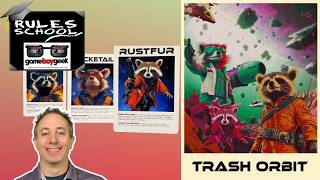
- Quick to learn due to rules teach format.
- Challenging and action-packed gameplay.
- Variety in character and ship abilities.
- Player elimination can lead to early exits.
- Resource management and cost of actions can be high.
- Some negative event card effects can be punishing.
- raccons as galactic scrappers
- space
Mechanics (from transcript analysis)
- Area Movement — Players move their ships around a board, with movement costs and distances dictated by action cards.
- Card Drafting — Players draw action cards and can gain location cards from revealed locations.
- Combat — Players can attack rivals, dealing damage that is paid for in scrap tokens. Defense action cards can be played to mitigate damage.
- event cards — An event card is drawn each round, introducing effects that can be positive, negative, or require specific actions to negate.
- Hand Management — Players draw and play action cards, with a maximum hand size of five unless modified by ship or character abilities.
- Player Elimination — Players can be eliminated if their ship is destroyed or if they lose all their scrap tokens.
- Resource Management — Scrap tokens are used to pay for actions like movement and attacks, and also contribute to the final score.
- Set Collection — Players collect scrap tokens which serve as the main currency in the game.
- ship upgrades — Players can install ship upgrades that provide permanent abilities, affecting movement, attack, or defense.
- Variable player powers — Each player gets a character card and a ship card, each with positive or negative effects that influence gameplay.
Video topics + discussion points
Quotes (from this video)
- Hello, my friends. It's the Game Boy Geek here today.
- So, let's get started.
- Well, I hope this helped you dive right into Trash Orbit faster than you normally would if you had to read the rulebook yourself.
References (from this video)
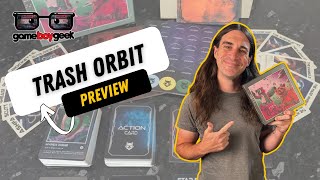
- Fast-playing and approachable
- Chaotic fun with high player interaction
- Permanent upgrades with clear upgrade paths
- Hidden locations add exploration
- Raccoon theming and combat flavor
- Chaos may overwhelm some players
- Elimination can end a player's session early
- Scrap tracking and card management can be fiddly
- Raccoon scavengers competing to collect space scraps
- Outer space orbit with raccoon ships and hidden locations
- chaotic, humorous, fast-paced
Mechanics (from transcript analysis)
- Action cards — Five varieties of action cards; most require scrap to play and drive key decisions on a turn.
- Combat — Attack cards target an opponent within range; defender can play defense cards; damage reduces scrap; elimination occurs when you lose all scraps.
- Combat range — Attacks affect opponents within the range listed on the attack card.
- Elimination — If a raccoon is eliminated, they eject and can no longer participate in combat.
- End conditions and scoring — Eliminate down to a single player or end after the final event; tally scraps plus upgrade scrap values to determine the winner.
- Events — Each round begins with a wild event (solar flare, pirates) that players may ride out or counter with cards.
- Hidden locations / reveal — Ending movement on a faceown location reveals the next card and triggers its effects.
- Movement — Pay scrap to move your ship through orbit; ending movement on a faceown location flips the next card in the corresponding deck.
- Multi-Use Cards — Five varieties of action cards; most require scrap to play and drive key decisions on a turn.
- Player Elimination — If a raccoon is eliminated, they eject and can no longer participate in combat.
- Scrap as currency — Scrap tokens are earned via scavenging and spent to play action and upgrade cards.
- Simultaneous Reveal — Ending movement on a faceown location reveals the next card and triggers its effects.
- upgrades — Permanent boosts in movement, attack, and defense; only one of each type can be in play at a time.
Video topics + discussion points
Quotes (from this video)
- This is a game that mixes chaotic card play, hidden locations, tactical upgrades, and plenty of scrappy raccoon battles, all in a fast playing package for two to five players.
- Action cards drive everything.
- Scrap is the main currency and also the key to victory in a game of trash orbit.
- And there you go. That's Trash Orbit.