




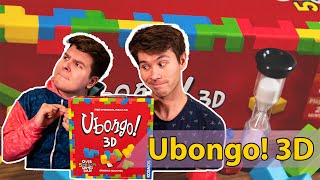


Ubongo 3D Deep Dive
What the Community Thinks About Ubongo 3D
Ubongo 3D takes the tile-fitting puzzles of the Ubongo line and asks players to build them in layers instead of on a flat board. The most detailed commentary comes from the Kovray channel, and its episodes approach the game from different angles. In Kovray, the hosts present it as a fun branch of the series that suits quick finishers and careful puzzlers alike, and they praise how the difficulty scales. Another Kovray episode, Kovray, is a full overview that stresses how short each round is, how the timer adds pressure, and how the large deck of double-sided cards means players rarely recognize a puzzle they have seen before. A third Kovray video, Kovray, names Ubongo 3D as a favorite spatial puzzle during an alphabet challenge, pointing to the sheer number of puzzles as the reason it keeps its appeal.
Outside the Kovray channel, Might I Suggest a Game covered the game at Tantrum Con 2022. Alex found that even the easy setting produced combinations that stumped the group, and described each round as frantic. Alex was not sure the game would stay in a permanent collection but said it would be worth playing again, perhaps when up for a challenge.
Core Mechanics That Define Ubongo 3D
Single Die, Shared Challenge
At the start of each round, one die is rolled, and its result points to the part of the card that determines which wooden pieces every player uses that round. Kovray explains that the die "will correspond to an area on your card that gives you a sense of the puzzle pieces" needed, so the roll sets the challenge before the timer starts. Every player receives the same set of tiles for that round, so the roll shapes the puzzle for the whole table while each player works through the stacking decisions alone.
Polyomino Tile Fitting
Each player works with a set of Tetris-style pieces built from joined squares. Kovray describes them as "tile Tetris polyomino" pieces that must be fitted over a target shape on the card. In the 3D version, the target is a flat picture, but the pieces stack across two layers, so every tile has to fill its space with no gaps and no overhangs. The reviewers stress that the combinations are nearly endless. In the Kovray overview, they note that "there's so many different sets of puzzle pieces that can be put together to make the one shape," so the same picture can be solved many different ways.
The Ubongo 3D Experience
Frantic, Timer-Driven Spatial Racing
The defining feel is urgency. Players flip the timer, race to finish, and yell "Ubongo" when they complete a puzzle first. Kovray calls the game "very stressful pretty fast paced," and Might I Suggest a Game found the rounds "very frantic" even on the easy setting. Some of that pressure is the fun and some of it is the clock. In another Kovray episode, the hosts note that a player who finishes second or later can still draw from the bag and win, which keeps the race from feeling punishing.
Scalable Difficulty for Mixed Groups
The second feel is inclusion. Kovray describes how a partner can play the easy side while the other plays the hard side and both still compete. In another Kovray overview, the hosts explain that players can choose how aggressive they want to be with card difficulty, so an experienced puzzler can take the hardest cards while a newer player takes easier ones and both still race for the same finish. The result is a game where the gap in skill is visible but does not end the contest.
What Makes Ubongo 3D Stand Out
A Wide Difficulty Spread With a Real Solo Mode
The double-sided cards let players choose their own challenge, and Kovray points out that the solo option works as a puzzle collection. In one Kovray video, the hosts describe stacking cards by difficulty and working through them alone, starting with the easiest and moving toward the harder ones. The cards cover a broad range of challenge, so the same box can serve a beginner and a seasoned puzzler.
A Gem Bag That Keeps the Game Close
Finishing first earns the most valuable gem, but drawing from the bag means a slower player can still catch up. Kovray explains that finishing third can still leave a player ahead of the table, because red gems are worth four points, blue three, green two, and brown one. The reviewers call this a neat catch-up mechanic, and it means that a player who consistently completes puzzles is rewarded without making the others feel shut out.
Potential Drawbacks
Frustration With Awkward 3D Stacking
The same spatial challenge that draws players in can irritate others. Kovray says that if you do not enjoy spatial or 3D puzzles, you can get frustrated because the blocks sometimes go in a way that you do not see right away. The pieces are also large and some sit awkwardly, so the game is less comfortable for players who want a relaxed, low-dexterity experience. The reviewers describe the game as basically a dexterity challenge as well as a puzzle.
Time Pressure That Frustrates Completionists
When the timer runs out before a player finishes, the group moves on, and Kovray notes that this is not always the kind of game where players want to rush. A player who wants to solve every puzzle may find the round ends before they have a chance to find the answer, which the reviewers say is not a good feeling for completionists.
If You Enjoy Ubongo 3D
If the appeal is the puzzle itself, Katamino is the closest match. Kovray describes it as a solo puzzle built on the same fit-the-right-pieces idea, where the layout guarantees that the chosen pieces "always fit the area," and notes that a pocket version makes it easy to carry. Ubongo 3D adds height and a timer, but both reward the same spatial thinking and both offer puzzles that feel endless.
For the tile-shape feel, Tetris is the obvious comparison. The Kovray reviewers bring up Tetris as a shorthand for the pieces, and players who enjoy fitting shapes into a space under time pressure will recognize the same satisfaction here, with the added challenge of stacking layers.
What Reviewers Are Saying
"I like that you can play with differing difficulty levels so I can play on easy if I really struggle with it."
— Kovray
"If you love spatial games and 3D puzzles you'll love this because even by yourself you can sit with a stack and just try to solve them."
— Kovray
"Each round was very frantic so we all had a good laugh and a good time."
— Might I Suggest a Game