/pic145204.jpg)
The dream of creating a new civilization in ancient Mesopotamia is within reach. Are you ready to lead your population ?
In the age of its maximum splendor, this vast and fertile geographical area was a scene of destiny for some populations, who resolved to settle in the richest and most strategically advantageous territories. Over the course of centuries these populations succeeded in developing all aspects of their civilization wisely. This was the main factor enabling them to found marvelous cities like Ur and to construct gigantic buildings like Ziggurats.
Just like Mesopotamia’s ancient Kings, each player will have to achieve the highest prestige by precisely dosing the development of Agriculture, Trade, Politics, Culture and finally War, so that thanks to these efforts the long desired construction of five Ziggurats is completed.
But, beware…
If the King becomes guilty of Greed in building them, or pursues improperly the conquest of Lands, this could ultimately lead him to defeat. The intrinsic speed of the game, the simplicity of rules, the very alluring artwork, together with the subtlety of the innumerable strategies which can be pursued, render Ur a gaming experience which you will play and play and keep playing again for a very, very long time!
Online Play
http://www.mabiweb.com/ (turn-based)

Ayar Review - With Graeme

- legendary loggers with a heavy economy and multiple victory condition avenues
- 19th century Cascadia; logging and industry
Mechanics (from transcript analysis)
- economics, farming, transportation, set collection, route building — broad combination of euro-style mechanisms
Video topics + discussion points
Quotes (from this video)
- it looks like this is a 60 to 120 minute game
- the balance between workers (which are warriors) and resources (which are livestock) are two sides of the same coin
- the more of uh one thing that you do the less of the other thing
- this is the next game coming out from delicious games
References (from this video)

- Likes the theme/idea of the theme.
- Doubts about its lasting appeal or uniqueness.
- Hasn't been played, only acquired by brother.
- Theme is liked.
Mechanics (from transcript analysis)
- Worker Placement — Suspected to have worker placement as a mechanism.
Video topics + discussion points
Quotes (from this video)
- this is where I talk about all of the games that I have acquired over the last couple of months
- this is one of the most interesting um combat systems that I think I've ever seen
- one of the coolest components um of the year for sure that is these pens and shields
- Arboretum which which is one of the best card games probably ever made a very nasty game but um but it's brilliantly designed
- it did feature on a a ranking video and it didn't do as good as I thought it would
- it's safe to say it's not for me
- it has this kind of beer and pretzel feel to it
- I'm sure it'll do well because I know these kind of games have a big audience
- so I'm going to be doing again a full video covering the gy series and talking through them in my you in my priority order and how much I like them
- definitely diversifying in what I cover on the channel here
References (from this video)

- Thematic connection to Incan mythology.
- Players control movement and take actions.
- Balanced scoring across multiple tracks is required.
- Complex-looking board with many tracks.
- Intricate action mechanism on player board.
- Pairs of AR who founded Tawantinsuyu, who turned to stone as they traveled.
- Incan mythology
- Players control the movement of the AR following paths on the board.
- Sent Cory
- Murv
- Tawantinsuyu
Mechanics (from transcript analysis)
- icon matching — There's all these icons.
- track movement — those tracks are the tracks that the AR are following as they move through the Incan world, and you, as players, control their movement.
Video topics + discussion points
Quotes (from this video)
- I love this game.
- I don't think I've seen you this excited about any other CMON.
- It looks very thematic.
- I think it looks cool.
- I just think it's a cool mechanic.
References (from this video)

- Impressive gameplay
- Medium plus weight that isn't overly complicated
- Good for players looking for a substantial but manageable game
- Availability at Essen uncertain
- Information about its specific mechanics is limited in the transcript
- Unknown, but fits 'medium plus' complexity
- Children of the Sun
- Theby
- Tianxia
Mechanics (from transcript analysis)
Video topics + discussion points
Quotes (from this video)
- I did not enjoy my first play of Echoes of Time.
- this is a light tableau building card game.
- Flow... it looks gorgeous.
- Covenant. Number two on my most anticipated list.
- Vlaada Chvátil. Do you know what the last game that Vlaada designed was? ... He's not actually designed a new game and had a new game published for almost 10 years.
- It's called Severton.
- I have spent the last 15 years of my life telling everybody that Talisman is such a bad game... And with the fifth edition, I've had to sort of eat my words on that.
- There just isn't enough time to play all of the games.
- IR from Osprey Games. Children of the Sun. Yeah. It is really good.
- Druids of Adora, new Stefan Feld game from Alea
- There may be some Essen live streams while we're there.
- I have written to the publisher to ask for a potential review copy, yeah, but to be fair, I only emailed them yesterday.
- Covenant. I completely forgot that was a thing. Started looking at the pictures and and thinking, yeah, I'm down for that.
- The The Void Voynich Puzzle. Voynich Yeah. Don't forget go to bed reading the Wikipedia articles about the Voynich manuscript.
- Saboteur is the other one which I did know. I saw it on your shelf uh today earlier, but I didn't know much about it. But now you've explained what it is, I'm kind of getting that um like Enid Blyton vibe from it. Yeah. what was it called? The Famous Five. Famous Five. Famous Five. Of that kind of stuff. Yeah. And weirdly, I'm interested. All right. And I've looked at the pictures of that, so yeah. Yeah. Yeah, Saboteur is good.
- I'll be demoing, but I'm demoing um uh Revenant um I think twice on the Saturday from 12:00 till 4:00.
- Trickerion with the Arcane Arts expansion. I think that's my schedule.
- Now, the one game that I am going to be looking at is there's a new game that Mighty Boards have just announced recently called Gods. All right. Which is designed by David Thompson, Trevor Benjamin, and is right up my alley.
- And they said, "Well, at least come round and have a look at it." And I'm like, "Yeah, I'll come round and have a look at it." But I've already agreed that I'm going to be doing content on that.
- I find it really weird and unusual that and and everybody else does this. I'm the odd one, but all of all of these content creators go to Essen, they go to Gen Con, and they have meetings with publishers where they sit down and they make deals about payment and what videos they're going to Right. That's the worst place to have a meeting.
References (from this video)

- Solid Euro game
- Interesting theme
- Strategic depth
- Looks a little busy in some situations
- strategy game with area majority and path building
- futuristic
- Hanza Teutonica
- Shackleton Base
Mechanics (from transcript analysis)
- Area Majority — The game involves area majority, which is a mechanic the speaker enjoys.
- Hand Management — The description implies hand management through managing cards for actions.
- Path building — The game involves building paths, adding another layer to the strategic options.
- Set Collection — The description mentions collecting benefits from civilizations, suggesting set collection.
- Tile Placement — Tile placement is a mechanic present in the game, contributing to its visual appeal.
- Worker Placement — The game uses worker placement with dice, where worker placement determines actions and potential benefits.
Video topics + discussion points
Quotes (from this video)
- Factions that win that have their own abilities that have their own winning combinations.
- It's too heavy for me.
- Yeah, it sounds absolutely amazing.
- Yep. And nobody knows it exists.
- I played Circadian First Light and I liked it.
- Scrolling through this thing with you said with the 300 responses and the people arguing about this game and I s there and it's like it's so amusing. The best part about it is you have these people arguing about Marxism and and uh and democratic socialism everything like that and then you have the people that are just trying vainly to get answers about the mechanics of the game. How does this work with the tricks when you do the thing? And it's just people going back and forth about, you know, screaming about uh, you know, like like how they're going to fix the world or whatever, which I I get it, you know, just it's it's who doesn't do that? But that's that's the part it it reminds me of.
- I watched in disbelief as businessmen voted for a repeat bankrupt, laborers for a boss infamous for stiffing his workers. Evangel evangelicals for a serial adulter for an admitted sexual assaulter. Patriots for a draft dodger who would sell his country's secrets for trivial gain. educated men for an ignoramus. But they did so with fierce gladness in their hearts because what their chosen one had done was open Pandora's box. Yes, the old one filled with the ancient calamities of race hatred and rage and cruelty and blood lust and infinite greed. and tell them that these things were the remedy for all of their grievances, that all their anger was justified, and most important, none of what ailed them was their own fault or ever had been.
- That is like the best paragraph I've ever uh Greg Isles in his book Southern Man.
- That is that is one of the that is uh yeah that was that is one of that is poetry.
- I played it and I could not remember anything. And that's it was such a quarter eater because they would like you'd be dead and it would like make you repeat the the move again and be like, 'Okay, is it left or right or up or down?' And you hit the button.
- No, it was free play, but it was like I played it and I'm like, 'Man, I really loved this back in the day and now I don't like it at all.'
- Everything but the ninjas is easy. The ninjas were like the the the And the ninjas just went on and on and on. You had to defeat like a thousand of them. It felt like
- Happy birthday, Bruno.
- It's just a It's just a It's just a virtual reality pinball.
- The elbow back. It was the most powerful move in the game.
References (from this video)

- Was not as heavy as expected
- Plays pretty quickly
- Action selection mechanism is cool
- Interesting player interaction dynamic
- Something about this game just worked really well
- Happily play it again
- historical ancient societies
- MV
- Sankor
Mechanics (from transcript analysis)
- action selection — Players start with four people on tracks, and one is removed each round, changing available actions over the four rounds.
- player interaction — Interaction arises from the action selection mechanism, where players' interests can diverge based on tile layouts and desired outcomes for available actions.
Video topics + discussion points
Quotes (from this video)
- So yes, if you think my voice is a little bit deeper and a little bit croakier than normal, that's because of it.
- So, please don't think that my channel is now 100% sponsored playthroughs. It's not.
- I wanted to support the game because it was really good game and I didn't want people to have uh to, you know, to get caught out uh in the same position as I was in.
- Yep, that's right. For the second year running, I didn't play a single game at Essen Spiel.
- So, yes, that's just what I wanted to say quickly before we move on to the next game I want to talk about, which is Severton, which is a sponsored playthrough video.
- Um, so yes, that's just what I wanted to say quickly before we move on to the next game I want to talk about, which is Severton, which is a sponsored playthrough video.
References (from this video)
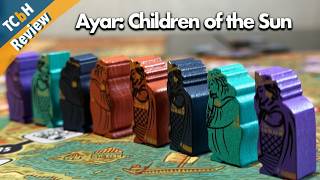
- Beautiful and clever
- Ambitious
- Thematically authentic
- Surprising affordability
- Epic look on the table
- Classy meeple work
- Extremely simple actual act of playing
- Each individual action is simple
- Actions are pretty well sequestered from one another
- Massive opportunity for big brain scheming
- Rewards hyper specialization
- Smart design move with llamas for scoring balance
- Feels like a larger game but true to box time frame
- Completely original
- Gorgeous
- Weird
- Can be dismissed as abstract point salad
- Deceptively bigger than it is (table presence)
- Dizzying amount of information on UI
- Timing is everything makes it complex
- Casual players will be punished
- Analytical agony in figuring out scoring
- More academically interesting than out and out fun (for the reviewer)
- Lack of sense of investment beyond capitalizing on points
- Sacrifice time now for more efficiency is not present
- Try before you buy type of game
- clans aiding the four pairs of IR, the male and female children of Inti and Mama Killa, the sun and the moon
- mythological origins of the Incan people
Mechanics (from transcript analysis)
- action selection — Actions are determined by the space revealed on the player's action column or row.
- Area Control — Implied through 'lay claim to the most lucrative woven islands in Titicaca.'
- End-game scoring — The reviewer mentions 'the final IR's retirement can make up over half of the points that you're going to score, especially from those temples as moon points.'
- Race — Implied through 'race up the lake to lay claim to the most lucrative woven islands in Titicaca.'
- Resource Management — Implied through 'farm some maize for long-term investment.'
- Scoring objectives — Players score sun and moon points differently, with the final score being the lesser of the two totals.
- Set Collection — Implied through 'Grab some pots for set collection.'
- Spatial Puzzle — Implied through 'weave tapestries to complete the spatial puzzle.'
- track movement — Players move corresponding color pieces on a public central board.
- Variable player powers — The inclusion of llamas that can be flipped and converted to sun or moon points to balance scores suggests a form of variable scoring adjustment.
- Worker Placement — Players place a worker at the end of an available column or row on their player board.
Video topics + discussion points
Quotes (from this video)
- IR is weird. Beautiful, clever, original, yeah, but weird.
- Ultimately, the best way that I can put it is that it's just weird and unlike anything else that I've ever played.
- Personally though, I find it more academically interesting in its design than out and out fun, but that might be just more my preferences as a player.
References (from this video)

- Clear graphic design and intuitive board elements
- Relatively simple rules that are easy to get into
- Engaging track movement and timing mechanic
- More interactive than previous games in the trilogy
- The lower of two scores scoring mechanic (conceptually)
- Dull and muted artwork that doesn't stand out
- Repetitive and boring mini-games that don't interlink
- Lack of replay value; game feels the same each time
- Imbalanced sun/moon scoring where moon points always dominate
- Expensive for the content and plays received
- Theme is unusual and difficult to explain
- Controlling characters representing Incan children who are tasked with finding fertile ground and teaching clans civilization skills.
- Based on the mythology of the Sun and Moon gods from Lake Titicaca and the rise of the Inca Empire.
- Lore is presented as an introduction to the game's theme, but is considered unusual and dry for a Euro game.
- MV
- Sanor
- Back to the Future trilogy
- Baghdad
- Ager's Dream
- Dream's Dreams
Mechanics (from transcript analysis)
- Area Majority — The farming mini-game involves placing cubes on a board, with bonuses awarded for the most cubes.
- Scoring Mechanism (Lower of Two) — The final score is determined by the lower of accumulated 'sun' and 'moon' points, though this is noted as imbalanced.
- Set Collection — Collecting pottery tiles of the same color and weaving patterns to form Tetris-like formations.
- track movement — Four characters move along four tracks, with movement dictated by player actions and triggering interim scoring or retirements.
- Variable Player Powers (Implied) — Special bonuses and abilities can be unlocked on player boards using 'mask tokens'.
- Worker placement (implied) — Players place markers on a grid to dictate movement and select actions, referencing rows and columns.
Video topics + discussion points
Quotes (from this video)
- The theme of this game is probably one of the most batshit themes I have ever seen for a Euro game.
- Your moon points are going to eclipse your sun points any day of the week.
- Once you've played it once, you've seen everything. There just isn't enough replay value or enough in the games, the mini games themselves to draw you back.
References (from this video)
- clever mechanic that scales with player thought
- solid on-theme feel and simplicity
- clever manipulation of cards
- card rotation puzzle
- quirky, puzzle-like
- Scout
- Revolve
Mechanics (from transcript analysis)
- Card rotation — rotate/flip cards to reveal new configurations
- spatial/rotation puzzle — manipulate cards around a central axis to optimize outcomes
Video topics + discussion points
Quotes (from this video)
- It's a complete filler, but I really enjoyed it.
- This is my game of the day.
- I love the tightness and I also love the different options you have on there.
- cooperate to play out your hands of cards, but you can't communicate.
- You rotate the card around it. It says up, but backwards it says it either way.
References (from this video)
- strong timing puzzle with meaningful late-game decisions
- quick, approachable teach and solid components
- satisfying diminishing-action ladder
- timing control can be polarizing for some groups
- replayability may feel similar across plays
- Sun and moon gods, AR pairs, and the rise of Tuantu (Income Empire)
- Ancient Peru
- Mythic backstory framing around two-sex pairings and a departing empire
- MV
- Sim Cororey
Mechanics (from transcript analysis)
- action placement behind moved brother — After moving a brother on the main board, a player places an action on their own board behind that brother and resolves that action.
- Compound Scoring — Night scoring of sun/moon dials and temple-based scoring drive endgame points.
- diminishing options — Each round reduces available actions as pairs retire, increasing the value of careful timing.
- Resource Management — Pottery and textiles are purchased with strength, with costs and a weaving/terrace farming track flow.
- round-based scoring — Night scoring of sun/moon dials and temple-based scoring drive endgame points.
- vera/veraculture bonuses — Veraculture tokens placed on the board boost future actions and scoring opportunities.
Video topics + discussion points
Quotes (from this video)
- I really like the look and layout of the board.
- The puzzle is engaging and timing-centric.