


















Vegetable Stock Deep Dive
What the Community Thinks About Vegetable Stock
Vegetable Stock strikes a delightful balance between simplicity and engaging strategy. Reviewers like Board Games With B7 and Chairman of the Board praise it as a light, fast-paced commodity-speculation game that works equally well as a filler or a standalone experience. The game has earned appreciation across gaming communities, with several reviewers noting that despite its modest footprint, it packs surprising depth and replayability. The compact package and quick playtime, around fifteen minutes, make it an ideal choice for casual and seasoned gamers alike who want engagement without heavy rules overhead.
Core Mechanics That Define Vegetable Stock
Stock-Market Speculation and Price Fluctuation
At its heart, Vegetable Stock is a game about timing. Players speculate on commodities by collecting vegetable cards while watching several vegetable types, each tied to a sliding price track. Prices fluctuate throughout the game, creating genuine tension around when to sell. The market moves based on which cards players leave behind during the drafting phase: the card left on the table after everyone takes one actually raises the value of that vegetable. This creates a push-your-luck dynamic where players decide whether to take a vegetable now or leave it hoping for a better price later. Once a card reaches the top of its track, it crashes back to the bottom, so reading the market's trajectory is everything.
Open Information and Strategic Drafting
The game uses an open drafting system where cards are laid face up each round, equal to the number of players plus one. Players take turns selecting, and the remaining card influences the market. This transparent information lets players interact with each other's strategies, whether through targeted card selection or deliberate market manipulation. One reviewer noted the satisfaction of anticipating opponents' moves while managing their own portfolio, observing that the open-information design adds competitive depth without adding complexity.
The Vegetable Stock Experience
Quick, Snappy Decisions
What makes Vegetable Stock memorable is the pace and rhythm of play. Turns are brisk, and the game flows naturally from one round to the next. Players describe the experience as consistently entertaining, with the rhythm of drafting cards and watching markets rise and fall creating satisfying moments of decision. The short playtime means players can run multiple games or teach it to newcomers without commitment, making it perfect for social moments where people want engagement without exhaustion.
Lighthearted Charm
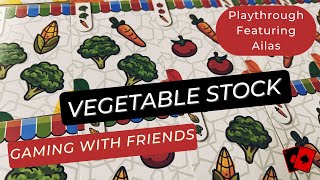
Despite its simplicity, Vegetable Stock delights with its presentation. The cute, whimsical vegetable artwork reinforces the theme without overwhelming it, and the compact box keeps the game approachable and inviting. Players appreciate that it does not take itself too seriously, which fits the lighthearted produce-market premise perfectly. That charm helps the game land with non-gamers and families, not just dedicated hobbyists, while still giving veterans a tight little market puzzle to chew on.
What Makes Vegetable Stock Stand Out
Replayability and Scaling Across Player Counts
Vegetable Stock shines best with four or more players, where the drafting dynamics and market manipulation expand significantly. The game scales across its full player range without requiring variant rules, though reviewers note that higher counts amplify the strategic depth. The replayability factor keeps players coming back, since market timing varies wildly depending on which cards are taken and left, producing different scenarios each game. Its small size also makes it an excellent travel game that slips easily into a bag.
The Tension of Market Timing
The core appeal lies in the constant calculation of risk and reward. Every decision carries weight, because players must balance holding vegetables in hope of a price spike against the danger of a market crash. This timing exercise creates genuine tension in what looks like a simple game, making each moment meaningful. The fact that a sound strategy can be upended by a sudden crash produces memorable moments of both triumph and dramatic failure.
Potential Drawbacks
Limited Decision Space for Deep Strategists
While the simplicity is a strength, players seeking heavier strategic options may find it thin. The decision tree, though meaningful, is constrained by the straightforward card-drafting and market-tracking systems. Those accustomed to games with multiple interlocking subsystems might view Vegetable Stock as a pure filler rather than a main event, enjoyable but not the centerpiece of a game night.
Luck Can Dominate Outcomes
Market crashes depend heavily on which cards remain available during drafting, so a poor sequence of draws can sink an otherwise sound strategy. Players who hit a market collapse at the wrong moment can end up with low scores regardless of their decisions. While this randomness adds excitement, it may frustrate players who prefer skill to consistently triumph over chance, and some games can feel lopsided when fortune favors one player's early acquisitions.
If You Enjoy Vegetable Stock
Reviewers who love Vegetable Stock often gravitate toward other light, quick-playing games with economic themes. Point Salad shares the quick-play DNA and the vegetable theme, though it trades market speculation for card-combination scoring. For those drawn to the timing and push-your-luck of cashing out, Botswana and Wildlife Safari, both Reiner Knizia stock-and-speculation designs, offer similar decisions about when to sell, with comparable playtimes and elegant simplicity. All reward timing and intuition while staying accessible to players of every experience level.
What Reviewers Are Saying
"The gameplay is both entertaining and fun. Collecting vegetable cards face up adds an exciting layer compared to face-down collection. This open information creates ample opportunities for players to sabotage each other's plans and target specific cards, enhancing the competitive edge and strategic depth."
— Board Games With B7
"It's a very simple little commodity-speculation game, and it seems to be getting a bit of buzz now. Really nice game. I taught this to a complete non-gamer and they enjoyed it. Very fast, very snappy: you're just drafting cards and changing the value of the things you're collecting."
— Chairman of the Board
"It's a very small card game you can explain within two minutes, and you can play it with pretty much anyone. It's really whimsical and cute and quick to play. It's a guilty pleasure, not an amazing game, but a very solid one that I really like."
— Sir Thecos