/pic4486030.jpg)
/pic2089536.jpg)
VivaJava: The Coffee Game is all about finding that perfect blend of beans to create the next best-seller in the coffee houses and kitchens of the world.
In the game, players send their researchers to hot spots around the globe to gather the perfect bean. This may bring them into contact with other players who are also on the hunt, creating a crucial choice: Go it alone and continue to research, or join forces with that opponent, hoping to combine beans from both player's bags and share the score with a superblend. Going it alone with research can often prove useful as players spend time in the lab developing abilities that grant them an advantage. However, in VivaJava the bold taste of victory will go only to those players who are able to balance solitary research with cooperation amongst their fellow gamers.
The rich depth of varying strategies and social play will satisfy most players' thirst for unique gameplay, but VivaJava has even more brewing. This flexible game can accommodate up to 8 players, and through smooth simultaneous actions, play is quick and constant with little downtime.
This page includes videos and mentions from the whole VivaJava family. Drill into a specific game below.
/pic4486030.jpg)


- Too much work for its play
- Not as good as the dice game version
- coffee
- Viva Java: The Coffee Game (dice game)
Mechanics (from transcript analysis)
- Back-and-forth — And a lot of back and forth. I felt it was too much work for its play.
Video topics + discussion points
Quotes (from this video)
- A frenetic 10-minute game from Queen.
- This is one of the key games I have not played. This is the sixth one.
- That's a cool name.
- I felt it could have done a little better. Um, it's it's almost too slight for me.
- I found it a little too fiddly, but as you can see, it's moving up in ranks.
- So it it's kind of funny it took him so long to come out with an Axis and Allies World War I game.
- I know I enjoyed it, but also it's 10 years ago, so it's hard to remember.
- This is the prequel to Clue where you're going around trying to kill Dr. Lucky.
- And I found it to be a lot of fun.
- If you like He-Man, this really brings it out.
- I've heard good things about this game, but I have never played it.
- This game is very weird and unique but I like it.
- This is one of the classic war games.
- It's running a kind of like an engine building thing through the space station.
- I liked it, but it has been a while.
- This is the OG Fury of Dracula game.
- I have never played Peanuckle. I know a little bit about it, but it's interesting to see this one kind of rated way here in the middle.
- I find it very odd that they are they're basically the same game. I'm not sure why they have two separate entries.
- Bidding to take Bowolf down a path has almost nothing to do with the theme.
- I liked it fine.
- I do like that you use the box and stuff as terrain.
- This is kind of a holy grail for many people.
- I'm not as big on the horror theme as many other people are, but I know people like this concept here of horror games running around.
- Of the ones I talked about today, I think Masters of the Universe, the board game, um, is my favorite.
References (from this video)
- Fun to play
- Technologically driven Yatsi
- Yatsi
- Agricola
Mechanics (from transcript analysis)
- Dice Rolling — Players roll dice to determine actions or results.
- Roll and Write — The game involves rolling dice and using the results to write on a sheet, with upgrades needed for rerolls.
- upgrades — Players can purchase upgrades, such as for rerolls.
Video topics + discussion points
Quotes (from this video)
- We call a roll and write game a game like yatsi which by the way wasn't in the running for my list where you roll dice and then you use the results of that roll to write something on your sheet.
- So there is really no good term for it but either way it is a fun genre and there are hundreds of games in this category.
- Although these games still come out, they're easy to produce for many companies. All you need to do is make a sheet of paper and put some dice out.
- It's the closest simulation of pinball that we're going to get in a board game.
- This isn't just one game. It's multiple games.
- This is such a huge game. It's by far one of the biggest ones out there.
- It's one of the most thematic rolling rights I've ever played or flipping rights because you're flipping a deck of cards.
- When I was making my list, it was this was such an easy thing. I wrote Flip Town as number one, then 10 as number two. Then I thought about the rest of the list because these those two were just so obvious to me on how much I enjoyed them.
References (from this video)

- highly modular with many interchangeable modules
- pencil scoring mechanism is effective and flexible
- teaching aids (tutorial coaster) help onboarding new players
- quality component production from the publisher
- large number of components; only a subset is needed for a given game
- scoring sheets may require repetition (lamination could help)
- coffee brewing and production
- coffee industry
- modular with multiple content modules and coasters
- Compounded
Mechanics (from transcript analysis)
- Compound Scoring — scoring uses a pad and sheets rather than a fixed score track.
- Dice-based engine-building — dice components drive aspects of engine-building and production.
- Modular Board — coasters provide mini-game modules; many modules can be swapped in/out to alter play.
- modular modules and coasters — coasters provide mini-game modules; many modules can be swapped in/out to alter play.
- pencil scoring — scoring uses a pad and sheets rather than a fixed score track.
- tutorial/coaster for teaching — a tutorial coaster is used to help bring new players into the game.
Video topics + discussion points
Quotes (from this video)
- the board looks really really beautiful
- it's called historia
- the main driving engine of this game is called the impulse
- it's just incredibly modular
- you practically need about the fifth of this box to play a game and the other four-fifths of the box just gets swapped in and swapped out
- I love asymmetric player abilities in games
- it's coming out in Gen Con
- it's a reworking of another game made by Ignasi called 51st State
- the pencil thing is totally fine
References (from this video)
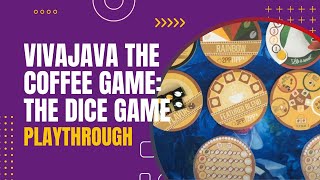
- Engaging solo gameplay with a clear objective
- AI opponent adds challenge
- Vivid dice mechanics and color combos
- Variety with rainbow and featured blends
- Rulebook clarity can be confusing initially
- Some rules may be opaque in solo adaptation
- Array
- Modern coffee industry
Mechanics (from transcript analysis)
- AI opponent in solo mode — A solo mode with an AI opponent competes for blends.
- Compound Scoring — Performance tracks and research tracks determine points and modifiers.
- Dice Rolling — Players roll dice to form color-based blends that trigger scoring or effects.
- Pattern Building — Claim blends by matching dice colors/values to form sets.
- pattern building / set collection — Claim blends by matching dice colors/values to form sets.
- Push Your Luck — Players decide to degrade and reroll or hold on to a blend, risking loss.
- Push your luck / degrade — Players decide to degrade and reroll or hold on to a blend, risking loss.
- Track-based scoring — Performance tracks and research tracks determine points and modifiers.
Video topics + discussion points
Quotes (from this video)
- this game didn't really go the way i thought it would
- the ai is interesting especially with the difficulty of increasing the chances of them rolling more dice
- i'm surprised by how this game went
- i'm not sure this is how all solo games go maybe it's better as multiplayer
References (from this video)
- replayability with dice randomness
- solo play option
Mechanics (from transcript analysis)
- Dice Drafting — roll-and-write style with dice choices
- dice_drafting — roll-and-write style with dice choices
Video topics + discussion points
Quotes (from this video)
- Shelf of opportunity video and the idea that this space is for unplayed games.
- This is all available Adventures for me to go on, so it's a great thing—it's a shelf of opportunities.
- Penny's favorite thing in the world I have a blanket basket.
- Please let me know down in the comments if this is something that you do as well.
- You are somebody's reason to smile.