/pic7275029.jpg)
WEGO World War II: Stalingrad is the flagship of Brian Kelly's operational level, ground-centric, WEGOWW2 game system. Built on the framework of Desert War 1940-42, this hex-based wargame captures the drama of the epic German offensive to capture the industrial city of Stalingrad in the Summer of '42. It consists of a series of historical scenarios and campaigns that allow the players to explore the ebb and flow of the actual combat operations. It’s playable by both sides using hotseat, versus the AI, or Play By Email.
WEGOWW2: In many board and computer wargames, one side will move its units and resolve combat, followed by the other side repeating the process. This game mechanic is known as IGOUGO ("I GO YOU GO"). WEGOWW2 is different. WEGO by its nature is about the player's ability to plan for and manage chaos; to find solutions to perceived challenges and accomplish the mission with the tools at hand. Despite the fog of war...against a thinking opponent who must problem-solve and plan under the same conditions-- Every decision you make must be carefully considered. Learn to think three moves ahead to outsmart your opponent!
WEGO World War II: Stalingrad 1942 comes with three campaigns. Each campaign consists of three to six linked scenarios. The game uses stylized maps of the Russian steppes over which a hexagonal grid system has been superimposed. This grid is employed to help regulate land unit placement, movement, and combat. Air, Naval, and Ground Assets are off-map capabilities that can be brought into play when the owning player sees fit.
Ground units range in size from company to regiment/brigade level and are represented on the game map using counters with stylized or NATO icons to display unit types.
Air assets represent air groups that can conduct counter-air, interdiction, air re-supply, bombardment, and ground support missions. Air reconnaissance assets can collect information about enemy location, unit types and strengths.
Naval Assets represent the Soviet Volga River Flotilla. These assets can conduct bombardment and ground support missions.
Ground Assets provide additional capabilities that can influence the outcome of on-map battles. Ground Assets include electronic warfare assets, command and control (C2) activities, and Special Forces.
Logistics Assets provide additional resources that can enhance the movement, combat, or replacements priority to player selected units or organizations.
Ground Scales: There are two ground scales in the game. The operational maps use 2500 meters (~1.5 miles) per hex. The tactical level city maps of Stalingrad use 500 meters per hex.
Time Scales. The number of turns per day depends on the ground scale of the scenario. Scenarios that have a ground scale of 2500 meters per hex have five game turns per day. For example, game turns 1 through 4 are considered day turns (each ~five hours long); game turn 5 is a night turn (~four hours long). Scenarios that have a ground scale of 500 meters per hex have two turns per day (one day and one night).
Source: The Publisher Website.
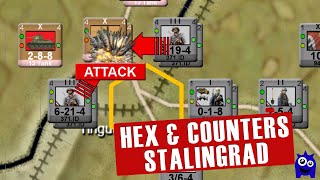
- Innovative We-Go system that blends simultaneous planning with cinematic turn playback
- Two-scale hex system enabling both operational scope and tactical detail
- Rich scenario and campaign depth with long-term strategic choices
- Extensive information overlays and unit data support deep strategic planning
- Strong modding ecosystem (visuals, sounds) that can customize the look and feel
- Steep learning curve due to system complexity and data depth
- Long plays: individual turns can be time-consuming (roughly 4 hours per turn in examples)
- Heavy commitment may deter casual players
- World War II urban and battlefield encirclement, urban warfare around Stalingrad
- Fall and winter 1942, Stalingrad, German Sixth Army vs Soviet 67th Army
- Two-scale we-go planning with cinematic turn playback; chaotic multi-turn resolution
- other Hex Encounters games
- Stalingrad-focused Hex Encounters titles
- We-Go style wargames
Mechanics (from transcript analysis)
- Air operations, recon, and bombardment — Players can conduct reconnaissance, airstrikes, and artillery bombardments to influence battles.
- Chaos/uncertainty via simultaneous action — Units may not behave as expected because both sides act at the same time, creating unpredictable outcomes.
- Combat: Damage Based — Armored units carry shock values that can shift attack columns and improve combat odds against softer units.
- Hexagon Grid — Operational-level 2500 meters per hex transitions to a more tactical scale of 500 meters per hex for the Stalingrad phase.
- Intelligence overlays and information panels — Overlays show formation, zone of control, zone of influence, intel heat maps, and other combat-relevant data.
- Mod support and alternative visuals — Mods such as the WDS graphics pack modify maps, unit visuals, sounds, and can alter the presentation while keeping core systems.
- Planning phase followed by execution — Turns begin with an extended planning phase and end with a cinematic execution of the turn.
- Scenario / Mission / Campaign Game — 18 scenarios and 4 campaigns with both serial and independent scenarios; multiple play modes (AI, hot seat, play-by-email).
- scenario and campaign structure — 18 scenarios and 4 campaigns with both serial and independent scenarios; multiple play modes (AI, hot seat, play-by-email).
- Shock value mechanics — Armored units carry shock values that can shift attack columns and improve combat odds against softer units.
- Simultaneous Actions — Units may not behave as expected because both sides act at the same time, creating unpredictable outcomes.
- Two hex scales — Operational-level 2500 meters per hex transitions to a more tactical scale of 500 meters per hex for the Stalingrad phase.
- Unit granularity and rearrangement — Battalions can be broken into or recombined with their parent regiments, providing flexibility in force composition.
- Unit readiness, strength, and supply — Each unit has readiness, relative strength, and supply considerations that affect combat performance.
- We-Go planning and simultaneous execution — Both sides plan their moves, commit, and the AI merges the orders into a single turn that is then rendered in a film-like playback.
Video topics + discussion points
Quotes (from this video)
- The big thing here is that it's a we go system.
- Chaos management feels to me to be a fairly appropriate term because it just is so unpredictable in terms of what you actually think is happening because your opponent's moving at the same time that you are.
- The maps are quite a bit different, a little bit more colorful, and the units themselves have a completely different graphic nature here.
- There are a wide range of scenarios in the game. This is the introductory scenario.