/pic8669006.png)
Instant Workshop... Infinite Possibilities!
Build adorable robots and golems, with just one finger!
Widget’s Workshop is a “drop-style,” spatial set collection, card crafting board game. You start the game by dropping 80 part cards onto the table, creating a giant, messy pile of parts in the center. Players take turns pulling parts from the pile, using one finger only, attempting to find the best parts for their robots and golems under construction in their workshop bays. Once a bay contains each of the 5 required pieces, the parts are combined to reveal a unique construct and its name.
You win the game by completing the most optimized set of constructs in your workshop!
Prepare to drop some parts and build awesome constructs!
Highlights:
Innovative "drop-style" game set in the Dungeon Drop universe
Highly portable, small-box game playable in under 30 minutes
Elements of card crafting and set collection
Real-world, spatial gameplay
On your turn you will draft either 1 face-down part card from the pile, or 2 face-up parts (choosing one to keep and then tossing the other back onto the pile face-up). Drafted part cards are added to one of your three "bays" where you're constructing these robots and golems. Once you have all 5 parts necessary to complete a construct, you assemble it (consolidate the cards, allowing the completed construct picture to show through the transparent areas of the cards) and move it to your "showcase" area. Once a certain number of constructs have been completed the game end triggers - the player with the highest scoring constructs wins!
—description from the publisher
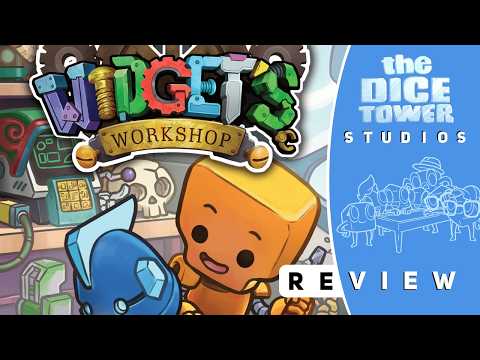

Widget's Workshop | Playthrough
- Building robots and Golems
- Real world spatial game environment
Mechanics (from transcript analysis)
- Card Crafting — Features an innovative blend of card crafting.
- dexterity — Players take turns pulling parts from the pile using one finger only.
- Set Collection — Features an innovative blend of set collection.
Video topics + discussion points
Quotes (from this video)
- Thieves Market is an eye cut you steal game
- energy Empire uses worker placement table building and Resource Management mechanics
- Mares is a large Euro game and is probably my favorite of the Stefan Feld City collection
- Formaggio is a standalone expansion for Forage
- Widget's Workshop features an Innovative blend of card crafting and set collection within a real world spatial game environment
References (from this video)

- Easy to pick up and play
- Fast-playing
- Cool table presence with dropping cards
- Adds flavor and a different experience with robot names and visuals
- Great balance between aiming for perfect scores and making sacrifices
- Element of risk with obscured parts
- Fun and speedy game
- Can be hard to find the perfect leg
- Risk of not finding matching parts leading to low-scoring robots
- Parts can be accidentally obscured by others
- Components are prototypes
- Making robots by grabbing parts
Mechanics (from transcript analysis)
- Card Drafting — Players take turns taking cards (parts) from a central pile, either face-up or face-down.
- End game trigger — The game ends when a player completes their fourth robot, giving the other player a limited number of turns to finish theirs.
- Set Collection — Players collect sets of 'parts' to build robots, aiming to match elements, archetypes, and makeup for points.
- transparent cards — The game uses transparent plastic cards for the robot parts.
Video topics + discussion points
Quotes (from this video)
- The components I've got here should be pretty representative they are just prototype
- it's a really easy to pick up fast play in like set collection game with a Twist really
- it's a great balance trying to like ideally score all of those things but it's very unlikely you'll be able to find all of the bits to your robot you're going to have to make some sacrifices somewhere
- there's a lot of just uh going for it and hoping that the right bits turn up
- it's a really fun Speedy game
References (from this video)

- Offers multiple modes including turn-based and real-time.
- Satisfying robot assembly and completion.
- Creative robot naming based on card components.
- Matching symbols can be tricky, especially in real-time.
- Robot building
Mechanics (from transcript analysis)
- Card Drafting — Players draft cards from a central pile, either one face-up or two face-down.
- Real-Time — One of the game modes is played in real time, a free-for-all drafting.
- Set Collection — Players aim to build robots by collecting matching traits or symbols on gear components.
- Variable player powers — The 'pizza' card acts as a wild and can grant an extra turn in the turn-based mode.
Video topics + discussion points
Quotes (from this video)
- in this game you'll be drafting cards from a chaotic Central Pile in order to build robots with hopefully matching and high-scoring traits
- you're going to start the game by dropping components onto the table and then it's your job to make order from the chaos
- one of the neat things in the game is when you stack up all the gears you actually get to name your robot which is kind of cool
References (from this video)
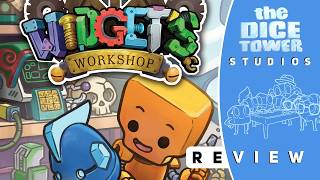
- enjoyable drafting mechanism that allows players to target desired parts
- autonomy in finishing a robot and decision space on when to finish
- flexibility to replace parts as better cards come up
- visibility/readability issues with dark cards; hard to read; requires good lighting
- learning curve and confusion around correct part identification
- chaos mode real-time not appealing to many players; not recommended to start with
- general readability can impact first impression and accessibility
- robot construction with set collection and part matching
- in a factory where robots are built
- explanatory overview with commentary
Mechanics (from transcript analysis)
- chaos mode (real-time) — An optional real-time mode where actions happen simultaneously; not recommended to start with.
- drafting from cards — On a turn, players take either one face-up card or two face-down cards and choose one to keep; remaining part is used or returned.
- part replacement and space management — Parts can be replaced by drawing new cards; replaced parts go back to the center; parts cannot be moved between robots.
- robot assembly / set collection — Players collect body parts to complete robots; scoring based on matching traits.
- scoring by trait matches — Robots score points based on how many matching traits across parts they contain.
Video topics + discussion points
Quotes (from this video)
- Are you holding out for that perfect card or do you let it go with good enough?
- I come down at a 6.5 on this.
- That's going to be a 15 point robot.
References (from this video)

- Fun to build your robots
- Fun to have a whole pile of cards on the table
- The game behind it kind blleh.
- Wasn't particularly inspiring.
- Building robots by overlaying acrylic cards
- Groker
Mechanics (from transcript analysis)
- Card Drafting — You're doing this a kind of galaxy structure style, pulling these cards off the table to build your robots.
- Overlay — overlaying these acrylic cards that are going to both paint a robot
- Set Collection — ultimately trying to match those based on trying to get a full set or as much as possible to a full set to optimize your score.
Video topics + discussion points
Quotes (from this video)
- when you don't have 20 minutes to watch a full review and you're not looking for a how to play or an hourong playrough.
- And let's be honest, when the interest is a little smaller, too.
- This to me is a very very um basic Yatsi style game that felt like an excuse to have something to do once a day every day for 365 days as opposed to being an actual game that is a fully I don't know if it it felt like an excuse to have a daily activity as a game. That's what it feels like.
- The gimmick, the gimmick of overlaying cards, that's cute and charming. The game behind it is not that great.
- It's a very straightforward dexterity stacking game with a cute theme, but not particularly amazing.
- I read the rules and I just I just didn't see it working in theory, but then actually after having played it, it's very it gives you a lot of opportunities to get the cards you want.
- Do not judge a game either by its cover or by reading the rules alone.
- I love the concept of this, but I actually haven't lost. And so that removes some of the challenge of it.
References (from this video)
- Innovative blend of card crafting and set collection
- Strong theme integration and components
- Complex setup
- Steep learning curve for new players
- Constructing robots and golems with part cards
- Real-world spatial game environment centered on customization
- Puzzly, deduction-based with tactile components
Mechanics (from transcript analysis)
- Card Drafting — Drafts of part cards are used to assemble constructs.
- Set Collection — Players aim to complete optimized sets of constructs.
- Spatial/deduction elements — Many part cards are hidden or flipped, rewarding deduction and memory.
Video topics + discussion points
Quotes (from this video)
- what is the name of the Dome shaped clear plastic button encasing the dice in trouble
- an instant workshop with infinite possibilities featuring an Innovative blend of card crafting and set collection within a real world spatial game environment
- the player who completes the most optimized sets of constructs from among the chaotically cascading CS wins the game
- we are going to pick sale as this episode's game night pick
- two-player trick-taking game is quite the you know tricky needle to thread there
- I think you'll have pulled ahead of me now probably right with your wager there that's how it's done
- El Grande is a good older classic game that's what made me choose it
- top secret spies to me sounded like the oldest game on the list
- which of these regions has the most action spaces i.e. the biggest gear
- what you know what actually all you need is your your Dome just bring your brain