









Wings of Glory: WW1 Rules and Accessories Pack Deep Dive
What the Community Thinks About Wings of Glory: WW1 Rules and Accessories Pack
Wings of Glory has built a passionate following among both wargamers and miniature enthusiasts. Reviewers consistently praise the elegance of its core system and the accessibility it offers to newcomers. The game strikes a rare balance: simple enough to teach in minutes, yet strategically rich enough to sustain complex aerial campaigns. Zilla Blitz calls it an example of "clean, crisp execution" that remains "true to the spirit of the original board game experience," while Watch It Played's Rodney found the system compelling enough that a single enthusiastic review from Marco War Gamer convinced Rodney to explore the hobby. The expansion ecosystem around Wings of Glory speaks to collector enthusiasm, with miniature prices suggesting significant demand for rare aircraft packs. What stands out is not a single unanimous opinion but rather consistent recognition that this is a well-crafted tactical system worthy of investment.
Core Mechanics That Define Wings of Glory: WW1 Rules and Accessories Pack
Card-Driven Maneuvering and Aircraft Characterization
At the heart of Wings of Glory sits an elegant maneuver system built on aircraft-specific decks of cards. Each plane in the game, published by Aries Games, has its own deck that reflects its historical flight characteristics. A Spitfire's deck differs from a Messerschmitt's not just in the maneuvers available, but in how many times each maneuver appears, directly encoding the aircraft's real-world agility and speed profiles. Players simultaneously reveal maneuver cards, then move their miniatures along the paths those cards dictate. This hidden planning phase creates genuine tension: you commit to a course of action without knowing what your opponent intends. The system uses overlaid arrows on physical cards to guide placement, making even complex maneuvers like immelman turns (climbing turns that reverse direction) straightforward to resolve. Box Delight's demonstration shows how different aircraft decks unlock different strategic options, with bombers relying on steady maneuvers while fighters can execute tighter turns.
Range and Firing Arc System with Damage Tokens
Combat resolves through a measuring-stick mechanic that feels both tactile and fair. Players use a transparent ruler to determine whether a target falls within firing arcs and at what range. Aircraft have firing arcs based on historical gunnery positions: single-engine fighters have one forward-facing arc, while twin-engine bombers have front and rear gunner positions with separate arcs. Range falls into bands, and different range brackets yield different damage outcomes. Instead of rolling dice for each shot, players draw tokens from a bag. These tokens carry values (A tokens do less damage but hit more often; C tokens do more damage but represent less-reliable hits). Special damage tokens introduce cascading consequences: a fire token forces the aircraft to take additional damage each turn before it can clear the flames; a rudder jam restricts available maneuvers. This token-based resolution system removes randomness from whether you hit, but keeps the outcome uncertain, creating moments of both triumph and despair as a lucky draw or unlucky pull changes everything.
The Wings of Glory: WW1 Rules and Accessories Pack Experience
Elegant Mechanical Simplicity
What makes Wings of Glory memorable is how it compresses tactical complexity into a rules set anyone can grasp. Watch It Played notes that the game has "very simple rules" with "a variety of rules you can add in if you want more complexity," a structure that lets newcomers enjoy a basic dogfight in their first session and progressively unlock advanced play. The measuring stick, the maneuver cards, and the damage tokens all feel intuitive once explained. Box Delight walks through the entire system in a single sitting without confusion, demonstrating that the elegance is genuine: the game doesn't hide depth behind complexity, it reveals it through elegant constraints. This accessibility means the barrier to entry is low, but the skill ceiling remains high. Veterans will use altitude, fuel management, and special pilot abilities; new players can enjoy a tense, tactical dogfight knowing only the basics.
Immersive Aerial Combat and Strategic Positioning
Reviewers consistently emphasize how the game captures the feeling of air combat. Zilla Blitz describes the PC version's experience as wrapping "it in a very elegant visual presentation with sounds and visuals that just pull you into the combat," but that immersion stems from the tabletop rules themselves. The hidden planning phase forces you to anticipate your opponent's moves. The firing arc system punishes sloppy positioning. The damage token system creates real consequences: taking fire forces you into a spiral of damage management, with special conditions like pilot wounds preventing you from seeing your opponent's position on your next turn. Box Delight's extended demonstration shows moments of genuine tension as a pilot takes fire, catches flames, and now faces the choice of staying aggressive despite the handicap or breaking off to recover. This is not a game where you move figures and roll dice; it is a game where you make calculated bets about where your opponent will be and what you can accomplish before they outmaneuver you.
What Makes Wings of Glory: WW1 Rules and Accessories Pack Stand Out
Three Distinct Solo Play Pathways
Wings of Glory excels at solo play in a way few miniature games achieve. The WW1 Rules and Accessories Pack includes three separate approaches. The basic method uses automatic maneuver rules that force enemy aircraft through predictable patterns. The intermediate method uses AI charts that randomize enemy behavior based on relative positioning: roll a die, cross-reference the sector where your target flies, and draw the corresponding maneuver card. The advanced method ties into expansion-specific scenarios that bring historical flair, like the Lancaster's Dambusters run or bomber raids on Britain, each with tailored solo objectives and environmental hazards. Box Delight spends significant time on these systems and shows they work: solo play is not an afterthought tacked on for solo hobbyists, it is a core part of how the game is designed. This flexibility means players without regular opponents can sustain engagement for months.
Miniatures, Expandability, and Collectibility
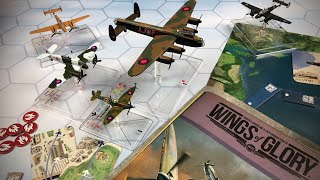
The physical production quality draws repeated praise. Watch It Played highlights that miniatures come pre-painted, removing a common barrier for newcomers who might otherwise hand-paint hundreds of tiny aircraft. The expanded content ecosystem is significant: Aries Games has released dozens of aircraft packs representing different nations and eras, with Rob's Tabletop World noting individual plane packs typically cost $30-$40, reflecting the care in the sculpts and paint jobs. This ecosystem creates a natural draw for collectors: each new aircraft pack opens different scenarios and strategic possibilities. The game has been in print long enough that it accumulates weight in the community. Zilla Blitz places Wings of Glory alongside digital ports of acclaimed board wargames, suggesting it has earned a place in serious wargaming discourse, not just as a novelty miniatures game.
Potential Drawbacks
Significant Collectibility Overhead
Wings of Glory's strength becomes a weakness if you want to play many scenarios. The WW1 Rules and Accessories Pack provides core rules and a small fleet to get started, but advanced solo scenarios ask for specific aircraft. Box Delight recounts hunting across European online stores to find a Heinkel 111 for a particular campaign, eventually succeeding but noting these planes are "hard to come by." Completionists will find themselves chasing rare packs. The game never forces you to buy every expansion, but the marketing clearly assumes you will: scenario descriptions reference aircraft that are not in the base set, creating a natural incentive to keep collecting.
Requires Dedicated Play Space and Careful Miniature Handling
Wings of Glory needs room. Box Delight shows the recommended play surface is at least one meter long and 70 centimeters wide; Box Delight's own play area falls short and constrains the maneuvering space. The delicate altitude stands that show aircraft height must be carefully handled during play; Box Delight mentions breaking a few just removing them from packaging. Players must organize damage tokens, track special status conditions for each aircraft, and maintain altitude markers. This is not a compact game to carry or play on a cramped table. It demands ritual setup and careful handling, which adds to the engagement but also sets expectations: this is a commitment to the hobby, not a casual evening game.
If You Enjoy Wings of Glory: WW1 Rules and Accessories Pack
Players drawn to Wings of Glory's elegant card-driven movement system will find similar satisfaction in Wings of War, the predecessor system. Zilla Blitz compares Wings of Glory to other PC wargame ports that respect their tabletop roots: games like Twilight Struggle and Lock and Load Tactical reward players who appreciate rules depth married to tight mechanical design. If you love the historical flair and scenario-driven campaigns Wings of Glory offers, wargaming series like Strategic Command and Panzer Corps 2 capture that same blend of operational planning and tactical resolution. The accessibility that makes Wings of Glory inviting suggests trying Pavlov's House or other solitaire wargames that emphasize clear rules and strong AI opponents.
What Reviewers Are Saying
Planes use unique decks of cards for maneuvering, and the entire system is so elegantly executed. It's a beautiful game with a strong following. The PC game takes that original experience and adds three levels of AI play and online play to the experience, all the while wrapping it in a very elegant visual presentation with sounds and visuals that just pull you into the combat.
- Zilla Blitz
I watched a really fantastic review by Marco War Gamer, one of the reviewers that I really enjoy watching. He covers a lot of war games. His review won me over. It had me quite interested in checking this out, especially since it has very simple rules, looks like you could learn very quickly, and then a variety of rules you can add in if you want more complexity. And these miniatures are painted, so they already come painted, which is kind of cool.
- Watch It Played
So that's automated airplane movement. It's it works really well.
- Box Delight