


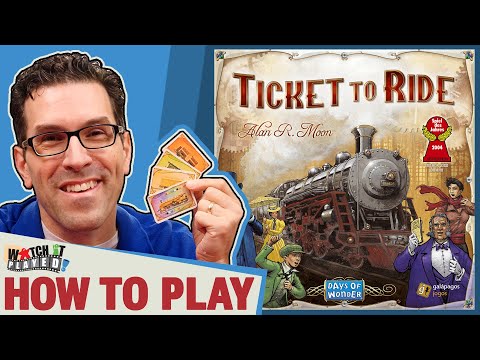















































Ticket to Ride Deep Dive
What the Community Thinks About Ticket to Ride
Ticket to Ride holds a unique position in modern board gaming: it is simultaneously one of the hobby's foundational gateway games and a title that continues to reward experienced players after hundreds of plays. Reviewers consistently identify it as a design that accomplishes a rare feat, remaining accessible enough for newcomers while maintaining genuine strategic depth that keeps dedicated players engaged decade after decade.
The game's longevity in collections is striking. Experienced players report 126 to 150 logged plays, with some noting they have been returning to the game for over 15 years without experiencing fatigue. This sustained appeal across such disparate play counts suggests the design succeeds both as a teaching tool and as a legitimate strategic experience.
Core Mechanics That Define Ticket to Ride
Network Building Through Card Collection
The core system revolves around collecting matching train cards to claim railway routes on a shared map. Players acquire cards from a face-up display or from the draw pile, then spend complete sets to place trains and connect nodes. The elegance of the system lies in its clarity: learn four actions, understand the scoring, and the game emerges through play. Set collection, drafting, and network building coexist without overwhelming new players, yet create meaningful strategic decisions for experienced ones.
What makes the mechanism compelling is the information asymmetry and timing element. A player must balance gathering information (taking more cards) against claiming crucial routes before opponents block them. This creates persistent tension: do you take cards to understand what is available, or commit to routes and risk being cut off? The longer you gather information, the more likely key routes will be claimed by others.
Hidden Destinations and the Penalty System
Players draw destination cards that represent optional objectives, worth positive points if completed and negative points if left unfulfilled. This system transforms the game from pure network optimization into a push-your-luck exercise. A player pursuing five ambitious destinations across the map plays differently from one targeting three nearby routes. The penalty for incomplete objectives adds genuine tension to endgame decisions, forcing players to weigh ambition against certainty. Reviewers highlight this as a key factor in why the game remains tense even after many plays.
The Ticket to Ride Experience
Accessible Yet Tense
Ticket to Ride succeeds because simplicity and tension coexist. The rules are straightforward enough that a newcomer can grasp the objective in minutes, but the strategic layer is genuine. Blocking opponents, reading intentions, and optimizing route combinations reward engagement without requiring exhausting analysis. The game flies by, rarely overstaying its welcome, yet each play feels distinct because the map evolves differently and destinations shuffle unpredictably.
Replayability Through Geography
The game's multiple map expansions (USA, Europe, India, UK/Pennsylvania, Nordic Countries, and others) provide meaningful variety. Each map creates different competitive pressures and strategic priorities. The USA map emphasizes long-haul routes and blocking; India is notably stressful for players; the UK/Pennsylvania version introduces technology cards that gate longer routes. This variety means 150 plays need not feel repetitive; the geographical and mechanical differences between maps ensure fresh experiences.
What Makes Ticket to Ride Stand Out
The Gateway Game That Doesn't Overstay Its Welcome
Ticket to Ride is perhaps the most successful modern gateway game because it recognizes a fundamental truth: new players and experienced players do not want the same thing from a game. New players want to understand the rules quickly and feel the satisfaction of building something. Experienced players want meaningful decisions and genuine competition. Ticket to Ride delivers both simultaneously. It teaches the building blocks of modern board gaming (drafting, set collection, spatial planning) while offering enough depth that experienced players can compete on skill.
The Board as Living System
Reviewers frequently comment that the board "evolves differently every game." The map begins as an open canvas. As players claim routes, the landscape becomes contested. Opportunities disappear. New strategies become viable. This dynamic creates a distinct experience from other network-building games: players are not executing predetermined strategies but reacting to a changing board state. The combination of hidden destinations, random card availability, and opponent blocking means no two games follow identical patterns, even after many plays.
Potential Drawbacks
Hand Limits and Player Behavior
The game imposes no limit on cards held in hand, a rule choice that creates strategic depth but can backfire. Some groups interpret this as permission for extreme card hoarding, where a single player accumulates 20+ cards while others wait for turns. This behavior slows the game and frustrates table experiences. While not a flaw in the design itself, the rule does require some group maturity and communication to manage.
Requires Balanced Competitiveness
Ticket to Ride involves significant blocking and can foster contention when routes are scarce or destinations are particularly fragmented. Some groups find this confrontational element off-putting, preferring purely cooperative experiences. The game works best with players comfortable with competition, though the blocking is mechanical rather than personal. Additionally, with five players competing for a limited map, some routes inevitably become inaccessible to all but one player, which can feel frustrating in certain configurations.
If You Enjoy Ticket to Ride
Reviewers suggest exploring network-building games with greater complexity, such as Power Grid (economic optimization and market dynamics) or Empyreal: Spells and Steam (fantasy setting with deeper engine-building). For players wanting similar accessible design with different mechanics, Cascadia (tile placement with animal objectives) offers comparable elegance. Railways of the World provides a heavier train-themed experience for groups ready to graduate to more complex route-building. Many experienced Ticket to Ride players maintain interest through exploring the game's map expansions rather than moving to entirely different titles, suggesting the core system has tremendous depth in the hands of dedicated players.
What Reviewers Are Saying
"Ticket to Ride is one of the most successful Foundation games in the Hobby and with good reason. It's a simple enough game that can be learned by practically anyone. Drafting, set collection, hidden objectives, and network building are great mechanical building blocks for learning more complex games."
— 3 Minute Board Games
"I just love that you lose points for not completing objectives. It makes the end game a lot tenser. The best thing about this game is the board starts as an open canvas and every game evolves differently."
— 3 Minute Board Games
"I have played a good amount of Ticket to Ride and every time I sit down for a game of Ticket to Ride and be like, 'No, I'm always game. It's always just like, 'Yeah deal me the tickets, let's go.' The tension of trying to figure out where to play first, obviously you can get blocked, and the tension of how many tickets do you go for, it just all comes together so it's so simple but really gives a fun tension every single time."
— Rolls in the Family