












































Harmonies Deep Dive
What the Community Thinks About Harmonies
Harmonies has arrived as one of the most celebrated abstract strategy games of 2024, climbing to position 7 on BoardGameGeek's rankings within months of release. The game draws passionate advocacy from the community, with reviewers consistently praising its elegant design and gorgeous presentation. Many describe an immediate love for the game despite initial skepticism, finding that it succeeds in refreshing a crowded tile-placement category. The consensus centers on Harmonies as a polished, satisfying experience that respects player time while delivering genuine strategic depth beneath its beautiful surface.
Core Mechanics That Define Harmonies
Token Drafting and Tableau Building
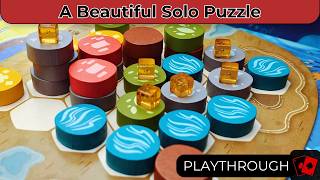
Harmonies strips its core interaction to an elegant simplicity: each turn, select three colored tokens representing different landscape types and place them onto a hexagonal grid-based personal board. Rather than the traditional flat tile drafting of games like Cascadia, Harmonies introduces three-dimensional placement. Tokens can stack vertically, creating elevation that becomes central to strategy. The drafting mechanism operates from a coaster that automatically refills after each selection, creating a constant stream of new options without the downtime of manual shuffling. This streamlined drafting makes the game feel snappy while maintaining meaningful choice about which tokens to prioritize.
Animal Cards and Layered Scoring
Beyond basic terrain placement, players optionally draft animal cards throughout the game. Each unique animal card specifies landscape patterns it needs to score points. When players create the correct configuration of terrain types and elevations, they place animal tokens in corresponding board spaces. This dual-scoring system gives Harmonies surprising strategic flexibility. Players must balance between advancing their terrain board state and pursuing specific animal patterns. Unlike fixed-scoring systems in comparable games, Harmonies lets players customize their scoring focus by choosing which animals to pursue, adding negotiation and tactical timing to table talk.
The Harmonies Experience
Visual Beauty Meets Satisfying Puzzle
Reviewers consistently highlight Harmonies as visually stunning. The colorful tokens, animal artwork, and compact personal boards create remarkable table presence, especially when viewed from above as vertical stacks emerge. Yet beneath the beautiful packaging sits a genuinely tight puzzle. The finite board space forces decisions with real consequences. Filling the board ends the game for everyone if only two or fewer open spaces remain, creating urgency without harsh punishment. This structural elegance means each placement decision matters while players never feel locked into failure, even when optimized opponents build faster.
Accessibility Without Shallow Strategy
Harmonies occupies a clever sweet spot between entry-level appeal and substantive gameplay. Reviewers note it appears lighter than it actually is, with most rule overhead resolved in a first playthrough. Yet the game rewards deeper thinking on subsequent plays as players begin pattern recognition. The tight spatial constraints demand genuine spatial reasoning. Vertical building offers secondary paths to avoid opponents' strategies, and experienced players develop tells through their placement patterns. Newcomers can enjoy immediate tactile satisfaction, while veterans find puzzle depth that sustains multiple plays.
What Makes Harmonies Stand Out
Superior Execution Over Cascadia
Many reviewers position Harmonies as a meaningful evolution of Cascadia, not merely an alternative. Where Cascadia offers boundless expansion and coarser scoring, Harmonies' constrained board creates tension. Both games share tile-placement DNA with animal-scoring layers, but Harmonies' vertical dimension and dynamic animal card selection create more interconnected decisions. Community consensus suggests Harmonies as a direct replacement for Cascadia when seeking a higher strategic ceiling. The spatial constraint transforms play from relaxing landscape creation into focused puzzle-solving that doesn't overstay its welcome despite added crunch.
Remarkable Design Craftsmanship
From box insert to token quality, Harmonies demonstrates obsessive attention to component care. Reviewers note that even storage organization reflects deliberate design. This polish extends to rules clarity and pacing. A 30 to 45 minute runtime respects player investment without dragging. The game scales smoothly from one to four players without rule exceptions or lengthy downtime. Such craftsmanship appears rare in modern board games, communicating respect for player experience before profit margins.
Potential Drawbacks
Restrictiveness and Unforgiving Board Spaces
Harmonies' finite board creates its defining tension but also its primary criticism. Unlike Cascadia, where poor placement simply means fewer points, Harmonies punishes mistakes harshly. A misoriented token blocks future options permanently. Some players describe this as satisfying optimization challenge; others find it frustrating rigidity. Players who value creative freedom or enjoy relaxing puzzle experiences may prefer Cascadia's unbounded nature. The constrained space feels intentional rather than arbitrary, but it removes the safety net some players expect from pastoral, animal-themed games.
Limited Animal Card Variability and Strategic Draw
The animal cards available during play depend on drafting luck and opponent choices. While this creates dynamic tension, some reviewers note it lacks the strategic clarity of fixed scoring. In Cascadia, knowing your target animals from the start lets you plan systematically. In Harmonies, the scrolling market of available animals means waiting for cards that never appear, or adapting on the fly. This creates occasional frustration when the perfect animal never materializes, though experienced players learn to recognize when pivoting serves better than hoping.
If You Enjoy Harmonies
Players who love Harmonies often reach for Cascadia next, seeking that same pastoral feeling without spatial constraints. Others explore Calico, which offers similar spatial puzzles with cat-themed charm. Tiny Towns delivers comparable board-filling tension through different mechanics, while Reef provides three-dimensional spatial building in smaller scope. Azul offers drafting and tableau building on grids, while Aqaba delivers similar environmental themes. For those seeking the puzzle satisfaction at higher weight, Life of Amazonia combines bag building with terrain and animal placement across a larger tableau.
What Reviewers Are Saying
"Harmonies really does take all of that and put it together in just a very succinct satisfying package. Instead of drafting tiles you're drafting tokens which represent your different landscapes and you're placing them out onto your hexagonal grid. Harmonies is kind of like Cascadia and Reef came together and had a baby and the baby came out looking like a model and had like 160 IQ."
— Meeple University
"I immediately fell in love with this game. It broke my heart because after playing it I was like this is definitely in my top 10, top 20 games of all time because this is so amazing. The way everything comes together is perfect."
— Watch It Played
"Harmonies looks like a kid's game, but it's not. The level of complexity is actually higher than Cascadia. If you want something that has higher crunch factor, Harmonies does give you more crunch. You are restricted and you do need to think through your decisions way more."
— Peaky Boardgamer