10 great board games for couples
Games in This Video
10 games are featured in this video — they unlock as you watch.





Transcript
This video is brought to you by the 3minut board game patrons. Keep us independent by supporting us on Patreon. Kyoto and welcome to this very special video from 3minut board games. Today I'm going to be talking about games for couples, specifically for couples game night. Now, I've done a list about two-player games in the past, but this has very different criteria, and it's based around a specific scenario of games that you might play after dinner once the kids have gone to bed or you've got some time, and you play them on the kitchen table. So, the criteria these games need to fulfill are one, that they set up and pack away easily. Two, that you can fit them onto a kitchen table rather than a big gaming table. Three, that they are excellent for two-player, but not necessarily only good at two-player. and four, have a reasonably short play time, or at least the ability to save the game after a short amount of play so you can return to it later. Oh, and five, games you can play a heck of a lot. There's not much point buying a game on this list if you're going to play it once or twice and then go, "Oh, yeah, that was nice." and put it away and never play it again. So, with those five criteria in mind, I'm going to review the list, not from worst to best, but from smallest box to biggest box.
So, I could have gone more extreme and gone with something as small as Mint Works, but I decided to start off the list with Jaipur. Jaipur is a two-player card drafting game where you are trying to build sets of goods and outsell your opponent. The quirk here is when you're trading cards with the middle row, those are cards that your partner can pick up as well. There's a lot of back and forth and head-to-head play in this game. Each time you play through a round, you'll score a point and the winner of the game is the player to score two points, which means you'll be playing two or three games and that takes a grand total of 30 minutes. The reason I've put Jaipur on here is because of just how interactive it is. One of the core actions is you're allowed to take one card from the display or you're allowed to return x number of cards to pick up x number of cards and you're trying to build sets. So sometimes when you return a bunch of stuff you think is junk, it is exactly what your partner is looking for. And I find that back and forth of the card play especially rewarding in Jour. Also takes next to no time to set up, plays in 30 minutes and is infinitely replayable. Really good game.
Next up on the list is Castle Combo. A wonderful card drafting game with a super cutesy medieval theme. In Castle Combo, you'll take nine turns, and in each of these turns, you'll be drafting one card from the display. Now, there's an upper class display or a lowerass display. And you can change which row you're drafting from, but it does cost resources. Each time you pick up a character, you'll place it into part of a 3x3 grid that you're forming. And each of the cards is unique and scores points in a different way based on how it is placed. There are tons of different ways to maximize your points in Castle Combo. The reason this one's on the list is because of how the drafting works. Because a lot of characters when you draft them will bump the draft marker either up or down. And if you're watching what your partner is doing, you can manipulate that to give them worse outcomes. It's also a remarkably quick game with each player only getting nine actions. And at two players, that just flies by. There's also very little setup required. I think Castle Combo is really good at just about every player count, but at two, the back and forth drafting adds just that little bit extra to it.
Wonderfully neat game and also great for when you've got other people around and it's not just couples game night. Next up, we have probably the most serious game on the list, and that game is Watergate. Watergate is a two-player card- driven game full of cat-and- mouse gameplay and back and forth card interactions. One side is playing President Nixon, and the other side is playing the reporters trying to expose him after the Watergate incident. You'll play cards to manipulate the positions of evidence and try to collect those pieces of evidence and put them on the board to link Nixon to various informers. Nixon, on the other hand, is trying to block those links and just hold on to the end of his presidency. I didn't want to put any war games on this list because my other two-player lists tend to be full of them, but Watergate has that war game vibe while clearly not being an actual war game. It shares a lot in common with games like Votes for Women or Twilight Struggle with excellent back and forth cardplay and real deep thinking strategy here. It's also a wonderful little historic piece and fits away into a really tidy box.
Sets up in minutes and there is a ton of game in here. You can go back and forth countless times playing Watergate. And the game play is quick enough that you can play one game as one side and then reverse and play as the other and score that match overall. This is possibly the most competitive game on the list as well. So, if you're one of those couples that really likes throwing down and having a good battle, this is a great choice. Next up, we have Harmonies. A wonderful little game about card drafting and then building habitats. And the wonderful thing about building habitats in this game is that they're three-dimensional. That might not sound like much, but it really matters. In harmonies, you'll draft cards that represent types of animals. These types of animals will want a specific habitat to suit them. You'll also be drafting terrain tiles and building those up to represent that habitat. The person who wins this game is the player that gets the right matching terrain to the animals that they've drafted and who builds up those habitats quickly to score points before the game runs out. One thing that's cool about harmonies is even if you win or lose, there's something soothing about building the habitats up and having this little 3D thing that you've built. It's also neat to look over at your partners and see what they've built as well and you know swap stories about how you were trying to get your animals in different spots. This is quite a competitive game, but it's one of those competitive games that afterwards I've never had bad vibes because of playing it. And I put that down to the fact that regardless win or loss, you got to build something. You got to play with something. And that in
itself is a fun thing to do and it's a fun thing to share. It's another game that works really well at three or four players as well, but I find at two players, it just zips along really quickly. Next up, we have Calico. A game that looks like it's perfectly pleasant. It's about cats and buttons, but Calico is an absolute mindbreaker and one of those games that you'll be playing and as the game gets closer and closer to its end, steam will start coming out your ears. Calico is all about drafting these tiles from the bag. They have different colors and different patterns on them. And to maximize your points, you have to arrange those in very specific ways around the scoring tiles. This one in the middle, for example, will give you maximum points if you have six different patterns and six different colors. Completing all of these goals will score you a lot of points. But that becomes exceedingly hard to do as your options diminish. See, why Calico is killer is because at the start of the game, you have a big tapestry, a big open space where you can just grab any old tile and put it where you want. But as the game keeps going, you'll see that there's a handful of specific tiles or maybe one specific combination of pattern and color that you really really want to complete and score a lot of points and you're waiting for it to come out and then the back and forth drafting that is happening between you and your partner becomes super super tense. In a game of four players, uh something can come out.
It can go all the way around. and you're like, "Well, I didn't get it because it came out there and there was no way it was going to come all the way around to me after three players." But when it's back and forth, if you can spot what tiles your partner needs and they're still good to you, you take them and you can just ruin their night. Absolutely cutthroat game in that regard, while also being a brain teaser of of the highest order. A wonderful little game, Calico. I really rate it. Next up, we have the Lord of the Rings jewel for Middle Earth. Alternatively, you could put Seven Wonders Jewel in here because this really is an iteration or reimagining of Seven Wonders Jewel. And if you don't care for the Lord of the Rings, that's probably going to be a better fit. In Jewel for Middle Earth, there are multiple ways to win and different ways that you can build your power set and your engine. Each time you're taking a card, you're building up a pool of capabilities, and every card you take is a card your opponent can't have, and vice versa. Some of the win conditions include controlling the entirety of Middle Earth. That sounds like it'd be difficult, but if someone doesn't pay attention to this board, it can get out of hand really quickly. You can also build alliances amongst all the races. And again, that happens if someone's not paying attention. The game is all about focusing on what your opponent is doing as well as what you're doing. you're trying to move ahead your scoring opportunities while cutting off theirs. This is one of the most popular couples games in the world right now, and for good reason. There's a lot happening in it, but most of it is pretty damn good. And I think the highlight for me for this game are those
different win conditions that you have to pay attention to everything that's happening on the board. There doesn't feel like there's a lot of unimportant decisions in the game. And for me, that makes for an excellent two-player experience. Next up is Pandemic. And Pandemic is here both for itself, but because it represents a whole meu of other games. Games I call firefighting co-ops. And the core idea behind a firefighting co-op is you're playing against the board as some kind of calamity is happening. Pandemic is of course one of the most famous games in this genre where you're members of the CDC fighting against a pandemic and you're trying to find four different cures for four different diseases. But it is far from the only game in this genre. And I'm just going to rattle through 10 other titles that would make fantastic couples game nights where the two of you play cooperatively against the game. You could always try out Flashoint Fire Rescue if you're interested in firefighting. Horrified if you want to battle against the universal monsters or other monsters from other parts of the world. Pandemic the Cure if you like the idea of Pandemic but want to play with dice instead. Alien: Fate of the Nostromo if you want to replay the Alien movie. The Captain is Dead if you're a fan of science fiction shows. Star Wars the Clone Wars if you want to play Pandemic but really like Star Wars as well. And the same is true for Fate of the Fellowship if you want to play Pandemic but also want to play Lord of the Rings. There's also these three other versions of Pandemic.
Each of which presents their own unique challenge. Firefighting co-ops are a really good time and Stephanie and I have played a bucketload of them over the years. I'd even consider Arkham Horror Second Edition to be a very big version of the firefighter co-op and that's one we've played together a lot. This whole genre is just full of great games for couples game night. But if you want a start point, kick it off with the original pandemic. Next up, we have D for Romantic or in this case Dormantic Sakura. You could choose either one of them. Do for Romantic is based on a single player computer game where you get different terrain tiles and have to place them and maximize your points. The board game is just like that, but it's cooperative. You're trying to draft terrain tiles and place them in a way that maximizes your scoring. And you'll score points by connecting specific size sets of different terrain types, specifically when their scoring markers are out.
After each game, you'll score up and that'll give you some points and allow you to advance down these progress tracks. And as you go down these progress tracks, you'll unlock more features for the game. The reason I think this one's a really good game for couples game night is that sense of progress. Each discrete game of Dwolf Romantic takes about half an hour to play, but at the end of that play, you'll have unlocked new features for the next time you come back to it. And playing through, you get a sense of achievement, a sense of growth as you unlock more and more features for the game. Plus, the core gameplay is a lot of fun. Alternating tile drafting and trying to do the best you can do on your kitchen table. For me, this gives you all the benefits of a legacy game without it being a destroyable game as well. And it's one that if you've unlocked everything in the game, you can still just keep on playing. It has a certain timeless quality to it in that regard. Before we get on to the last two games, I'm going to run through a whole bunch of other honorable mentions very quickly that would be excellent for couples night, but I didn't want to make this a 20 games for couples night list.
Hopefully, you get some ideas here as well. Hidden movement games like Last Friday, Scotland Yard, or Letters from White Chapel work really well at two players. In fact, I prefer them at that player count most of the time. Hidden Movement games come alive for me at two players because then it becomes a real cat and mouse experience. Any of these titles on screen would be a great fit at two players. There are board game escape rooms like the exit series and the side quest series that you can try out. Now Stephanie and I enjoy escape rooms and the idea of an escape room in a box that we can do at home is a really neat thing as well. We just haven't personally got round to doing these an awful lot because we have so many escape rooms in Wellington and just not enough time to do them. But if you do like the idea of escape rooms in a box, there are tons out there. Assembly is an outof print game, but I am including it as a fantastic couples game because of the interesting puzzle it presents. The game features limited communications and it's a real good puzzler. If you can track down a copy of it, I do recommend it. I just don't think it's been available for a number of years now. Then there are puzzle games. Things like Genius Star from Smart Games. These are less like conventional board games and more like real-time puzzles that you're trying to solve competitively. This one in particular is a time puzzle to see who can solve a geometric puzzle the fastest. These are a really good time, but I don't know if they're technically a board game. Another great thing for couples board nights are two-player abstracts. This one's Parv, which is only available in New Zealand and Australia, but it's a neat little two-player abstract game. Or we could
also play other well-known two-player abstracts like chess or back gamon or checkers or go or any of those games. Santorini is another great example of an abstract two-player game that we've played an awful lot. I think we sometimes overlook two-player abstract games like back gammon on lists like these. So, it's worthwhile including here. Lawyer up is a fantastic back and forth two-player game with a really neat theme that lends itself to two-player adversarial conflict and that is the courtroom. I unfortunately haven't done a full review of this one, but it's a game with a fantastic premise and very solid gameplay. And the last honorable mention is Cgraphers and just rolling rights in general. If you're looking for something non-confrontational to play at the dinner table after dinner, a classic roll and write like cgraphers or garon clever or railroad inc.
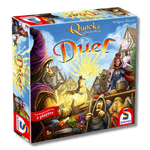
There's not a huge amount of player interaction, but they are a lot of fun. Next up, we have the Quacks of Quinnlandberg, or as it likes to be known these days, just Quacks. Quacks is a push your luck game where you're adding ingredients into your potion bag and then pulling them out one by one. The person who scores the most points will get the best rewards. But if you draw out the wrong things, you'll explode and lose. The reason I think this is fantastic at two-player and probably better at two-player than any other player count is that you can simultaneously draw out your tokens and compare the results back and forth. That way, it becomes a direct head-to-head game of chicken each round. You reach into your bag, your partner reaches into their bag, and you pull out your tokens at the same time and put them down. If one of you explodes, it's hilarious. And if you don't, well, do you keep pushing your luck and going? what's your what's your partner going to do? And that back and forth really makes quacks at two players just that little bit different because if you're playing in a big group and you can have people off the other side of the table pulling out stuff and they'll go, I exploded. You have no idea what score they're on and you'll just be doing your own thing. But when it's headto-head and you're watching each other play, very different vibe. And that's why I think Quack, despite being a pretty good group game, just excels at two players.
Next up, we have Lands of Galzia. And this here is representative of another genre, and that's the adventure game genre. Games like Agents of Smursh, Tales of the Arabian Knights, Sleeping Gods, or Vantage. Games where one player is taking some actions, and then they have to resolve something in a book. So, someone has to read from the book and tell them what's happening, and then they get to roll some dice or make a decision, and then the book tells them what happens. Those work really well at two-player because you're alternating going back and forth between who's doing stuff and who's reading. Lands of Galzer itself is a wonderful adventure game full of anthropomorphic animals on a very well-built world. And each of you will be wandering around trying to complete your own personal goals and basically getting into mischief. It's a game where your actions change the setting as well, so you can come back to the game time and time again and have new adventures. It might look like there's a lot happening in here and it might look like a really big box and it's got a ton of stuff in it, but it does take remarkably little time to set up because the vast majority of cards in this box aren't used at the same time.
So, you really grab your character save cards, you populate the board, and then you just get straight into playing. It does require an app, though. And if you want a similar kind of vibe, but a game that is 100% pick up and play, try Vantage. It's a very interesting game as well. But for me, if I'm going to pitch a game to couples in this genre, Atlanta gals has the right combination of interesting story, a sort of cozy pace to it, and that you can set your own tone and go and do what you want to do. It's a little bit of a sandbox game and a little bit of a cozy game as well as being an adventure game, and you can get into the characters. It's a lot of fun. That brings us to the end of my list for games for couples game night. I reminded Thminute Board Games does not do paid content. Keep us independent by supporting us on Patreon. And if you have any other suggestions for great couples game night games, just let me know in the comments. And if you enjoyed this video, hit the notification button, like, share, and subscribe to the channel. Until next time, take care.