











































Recall Deep Dive
What the Community Thinks About Recall
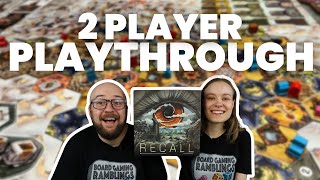
Recall, designed by Christian Ospy, Helge Meisner, Anna Vermlin, and Chatil Spencson, has generated genuine excitement among the board gaming community since its debut at Essen Spiel 2025. The game is the unofficial sequel to Revive, and reviewers across channels like Board Gaming Ramblings, Allies or Enemies, and Rahdo Runs Through have grappled enthusiastically with the question of how it relates to its predecessor. The consensus landing point: Recall shares DNA with Revive but plays meaningfully differently, with most reviewers concluding it is the stronger of the two games.
Rahdo Runs Through calls it one of the best games of the year, flat out, and describes it as "so satisfying" and "so much fun," noting that the game's more strategic, less cutthroat nature makes it work better than Revive did for players who disliked the negative blocking in that earlier game. Allies or Enemies similarly describes being "shocked if this didn't end up in our top five of the year" and praises the game's streamlined feel relative to Revive, calling it "a very thinky engine-building combo game where there are a lot of different paths." Board Gaming Ramblings, which has played the game the most extensively, rates it 8.5 and 9.0 from its two hosts, with Johannes noting that "the more I play this, the less I was thinking about Revive because they're not similar in many points."
The Broken Meeple offers the most measured take, giving Recall a 7 out of 10 and calling it definitively Revive 2.0 rather than a fundamentally different game, while still acknowledging it as the better of the two and the best game of its type in the 2025 release cycle. The critical discussion tends to cluster around a few tension points: the recall action consuming a full turn, a relatively low level of player interaction on the shared map, and some imbalance in tribe powers and gadgets. But even critics acknowledge the game's satisfying turn structure and its ability to reward engaged play with an escalating sense of accomplishment.
Core Mechanics That Define Recall
Reclaim as Action: The Key-Slot Worker Placement
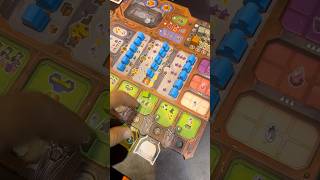
The central mechanism of Recall is its key-slot worker placement system, which functions as the game's action engine. Each player has a board with six action spaces. On their turn, they slot one of their key cards into an open action space and perform both the action on the space and any bonus printed on the key itself. Actions cover the core activities of the game: moving followers across the modular map, revealing new terrain tiles, developing spaces by excavating or building, recruiting new followers, and copying completed actions. Keys start blank but can be upgraded over time through the point-scoring track, and players can also acquire entirely new, more powerful keys by building workshops.
The titular recall action is how players reset. When a player has used all their keys, or chooses to stop, they take back every slotted key and collect income from their player board: one income slot for each key recalled. This makes the recall turn feel, as The Broken Meeple notes with some frustration, like a "null turn" where momentum briefly stops. But Board Gaming Ramblings identifies the genuine strategic interest here: players try to stretch their chains of actions as long as possible, deferring recall until they have maximized their turn's output. "I thought I would recall my workers a lot in this game," Johannes says. "But I've actually done that only twice every single time we play. You're trying not to do it a lot." The tension of how many keys to accumulate, how to upgrade them, and how to time the recall turn is where much of the game's strategic depth lives.
Engine Building Through Knowledge Tracks and Gadgets
Recall builds its engine through a trio of knowledge tracks on the shared board, each associated with one of three mystery tribes hidden at game start. As players excavate relic cubes from the map and deposit followers to study them, they advance along these tracks. Reaching the third step reveals which ancient tribe occupies that track, unlocking a new gadget for everyone who gets that far, and reaching the fifth step unlocks that tribe's special ability as a free action available to the player who reaches it.
Gadgets slot onto the left side of the player board and can be activated by spending ability stones: the same stones collected during excavation actions and returned at every recall. By mid-to-late game, a player might have four gadgets and four tribe abilities, each triggerable with these stones, enabling chains of five or six bonus free actions on a single turn. Allies or Enemies describes the pacing as elegant: "It just kind of drip feeds you those through the 13 rounds. If you had all of that at the beginning, it would be way too much. But by the end, you can have some really combo-heavy turns that can feel really rewarding." Rahdo Runs Through calls the resulting play "super mega turns that you programmed yourself to perfection," describing the experience as "so satisfying."
The Recall Experience
Satisfying Engine: The Escalating Combo Payoff
The experience Recall delivers most reliably, and which reviewers return to most enthusiastically, is the satisfaction of watching a personal engine accelerate. The Broken Meeple compares the game's reward structure favorably to The Gallerist, noting that "this game is very good at rewarding you piecemeal: lots of little bonuses that reinforce fun, reinforcing a feeling of satisfaction or fulfillment." Early turns feel constrained and simple. Later turns expand dramatically as upgraded keys, unlocked tribe abilities, and accumulated gadgets begin chaining together into sequences of six or more actions from a single key placement.
Board Gaming Ramblings describes the shift in experience between early plays and later ones: "The first time we played, it was overwhelming. By the third time, I sat down and I knew I was going to have fun now because I had started to get it." Johannes rates it a 9 specifically because of how the game reveals itself over repeated plays, delivering "that feeling of adrenaline" when a well-planned combo finally executes. The Board Game Dad runthrough captures this rhythm in real time, showing how a single turn can cascade through excavations, track advances, tribe reveals, gadget unlocks, and bonus actions, all triggered by positioning followers correctly over several preceding turns.
Crunchy: Deep Decisions Across a Short Game
Recall plays in 13 rounds, and reviewers consistently note how much decision weight the game packs into that compressed structure. Players must choose between six action types every turn, decide which buildings to prioritize on their board, manage three colors of crystal resources, time their recall to maximize income, select which of six path-of-power scoring conditions to specialize in at three points during the game, and keep one of two objective cards to score at game end. Allies or Enemies describes it as "a heavy puzzle, very thinky" while still calling the rules teachable, and notes that "each game has felt very different" across their plays.
The path-of-power specialization system is a recurring point of interest. Three times across the game, players choose one of two available scoring focuses, locking in an extra bonus scoring condition and immediately collecting a small resource. This shapes strategy mid-game rather than forcing players to commit to an endgame path from turn one. As Board Gaming Ramblings explains: "The first choice is pretty early, after round four. You haven't maybe done anything towards those yet. So, you have to be like, okay, what will I do for the rest of the game? That kind of shapes how you play." The result is a game where the path to victory is always partially improvised, adjusted in response to what the modular map reveals and what resources prove accessible.
What Makes Recall Stand Out
Strategic Variety Through Tribes, Gadgets, and Asymmetry
Recall generates its replayability through the intersection of 14 different tribe leaders, the gadgets paired with each, the random arrangement of the modular hex map, and the shuffled path-of-power scoring conditions. No two games present the same combination of tribe powers, available gadgets, or scoring priorities. Board Gaming Ramblings emphasizes this, with Sonova noting: "The leaders, there are 14 different leaders and they all do feel very different. Some of them have ongoing powers. Others let you put out tokens, build pig farms, or deploy rafts of followers. So, all of them feel different." Allies or Enemies describes wanting to "play and discover new combos and new pathways and try different leaders" even after several plays, which is a meaningful signal for a game this length and weight.
The optional companion app adds a layer of asynchronous community connection. Players can log their tribe combination, starting gadget, and final score to a global leaderboard, effectively competing against other players who ran the same setup. Board Gaming Ramblings finds this "fun" as a way of seeing what score the unique combination of a given play produced. The Broken Meeple is more skeptical of score validation, but acknowledges the idea works in concept. The app also lets players submit scores from the setup at round reveals, which creates a sense that each specific tribe-and-gadget pairing has its own performance benchmark to chase.
Streamlined Design Compared to Revive
Recall succeeds in part by learning from the criticisms of its predecessor. The Broken Meeple, who gave Revive a 6 and found it kitchen-sink-bloated, notes that Recall "doesn't feel as much of a mess" and "doesn't overbloat itself," calling the map improvement specifically significant: "The map in Revive was just boring. The map in Recall is more interesting because you're all condensed together, starting in a corner and fanning out, so you're already in each other's faces." Allies or Enemies calls Recall "more streamlined" and "more direct," with the main resources reduced from three complex tracks to followers and crystals, making the player board easier to read at a glance. Board Gaming Ramblings puts it plainly: "I feel like everything in here feels more direct. This is a fairly streamlined game for this weight class. For actually teaching this game, it's not that difficult." The dual-layer player boards, which allow keys to slide cleanly beneath the board surface rather than being jammed under lifted boards, also draw consistent praise for their physical elegance.
Potential Drawbacks
Low Interaction and Player Count Scaling
The most consistent criticism across reviews is that Recall offers limited player-to-player interaction. The Broken Meeple is direct: "The only bit of interaction in this game is the map. The knowledge tracks don't block each other. The endgame scoring paths are shared. Everything you do on your board is entirely your thing." Allies or Enemies acknowledges the same: "There isn't a ton of interaction in this game. The main thing is rushing for stuff on that map." Because the board does not scale with player count, adding more players does not increase map resources, only competition for the same tiles. Allies or Enemies notes that higher player counts produce longer games with potentially more contested building spots, but cautions that turns can stretch to ten minutes after a recall, and at four players the downtime between turns becomes significant. The Broken Meeple suggests that two-player or solo is the optimal experience, and that three players represents the upper limit before the game starts diminishing.
The solo mode receives mixed assessments. The Broken Meeple finds it "bare bones," pointing out that the only mechanical change from multiplayer is starting with three objective cards instead of two and needing to complete two of them. The optional app leaderboard provides a secondary challenge but is unverified, and some posted scores appear implausibly high. Rahdo Runs Through takes the opposite view, calling the solo runthrough "one of the best games of the year," though acknowledging that the solo game moves faster and allows a more efficient personal engine because no other players are competing for map resources.
Turn Economy and the Recall Turn Tension
The Broken Meeple raises a structural concern about the recall action's cost. In a 13-round game, players who do not accumulate enough keys will find themselves recalling every third turn, effectively spending three or four turns of the game on what amounts to a reset with minimal income. The concern is that the game funnels players toward collecting additional keys, since playing with only the two starter keys results in frequent recalls and limited action density. "I don't like that 20 to 25 percent of my game is just recalling, which is a very null and uninteresting turn especially with the income restriction," the Broken Meeple notes, arguing the recall action would feel better as an optional start-of-turn phase rather than consuming a full turn. Board Gaming Ramblings experiences the same system very differently, finding that expert play pushes recalls to a minimum and that the tension between stretching a chain of actions versus acknowledging when to reset is one of the game's genuine strategic pleasures. The degree to which recall turns feel punishing or interesting likely reflects how many keys a player has accumulated and how fluently they can read the action sequence ahead of them.
If You Enjoy Recall
Players who love Recall should explore its natural predecessor, Revive, to see how the design lineage evolved. The two games share the same art style and the same DNA of slotted action cards, knowledge tracks, and an explored modular map, but Revive is sharper in competitive interaction and more chaotic in resource management. Reviewers consistently frame Recall as the better version of the same impulse, and owning both is generally not recommended. Agricola and Caverna, cited as references in the Meeple University overview of the broader Recall design space, scratch a similar itch for players who enjoy worker placement games where careful resource cultivation leads to a satisfying late-game engine. Those games are heavier in resource conversion but share the tension of deciding when to spend and when to hold. Root and Feast for Odin offer useful counterpoints: Root for players curious about true asymmetric factions and high interaction; Feast for Odin for players who want the feel of an expansive engine-building Euro with multiple paths to points, where turns feel equally bountiful but the game is less reliant on discovery and more on efficient conversion. Recall sits between these poles: more interactive than Feast for Odin, less cutthroat than Root, and more streamlined than Agricola's full complexity.
What Reviewers Are Saying
"This is one of the best games of the year. Hands down, bar none, I am so much in love with this. The game is bright and vibrant and colorful and fast even though some of our turns can get really big. They're still somehow really really quick and incredibly satisfying. History repeating itself: Revive was a top 10 of the year and so is Recall."
— Rahdo Runs Through
"I like this game more and more. The first couple of times, I had so much trouble getting my brain to understand it. But then the third time I sat down, even before we did the first turn, I sat down and I knew I was going to have fun now because I had started to get it. They make games that speak to me, that work with my brain after a while. For this one, I needed to get past the learning curve to get into that feeling I'm looking for when I play a game."
— Board Gaming Ramblings
"It is a very thinky engine building combo game where there are a lot of different paths and it feels different so far every time we've played it. I really like how smooth this game is because we keep saying it is a thinky game, it is a heavy game, but it is also a fairly accessible game to get into. I would be shocked if this didn't end up in our top five of the year."
— Allies or Enemies