














































Sky Team Deep Dive
What the Community Thinks About Sky Team
Sky Team has captivated reviewers across the board gaming community, though reactions reveal distinct fault lines about what the game is and whether it executes on its promise. Most reviewers praise its bold design and production values, celebrating how it transforms a two-player experience into something genuinely tense and thematic. Board Stupid, kovray, Brains On Games, and Shelfside all emphasize the game's elegant marriage of mechanics and theme. However, the critique is sharp from some quarters: 3 Minute Board Games finds the gameplay predictable and hollow, arguing that mandatory actions leave little room for meaningful choice. TheGameBoyGeek notes the surprise of Sky Team's Spiel des Jahres win in 2024, observing it broke the mold by being more complex than typical award winners. The consensus: Sky Team succeeds brilliantly at what it attempts, but its narrow scope and two-player-only limitation divide the audience.
Core Mechanics That Define Sky Team
Dice Placement Under Hidden Information
Sky Team's core engine is straightforward in principle but demanding in execution. Each player rolls four dice behind their own screen, hidden from their partner, then takes turns placing dice on designated spaces on the control panel. The twist is that certain spaces are mandatory each round: the steering and engine controls must receive dice, or the plane crashes. This forces players to commit dice to critical functions without knowing what their partner rolled, creating a puzzle where incomplete information and limited options generate real pressure. Some actions trigger immediately when both dice are placed, so timing matters. Reviewers highlight how this system keeps games tense across all twenty minutes: there's no moment where the threat recedes, only the relentless forward march of the altitude track toward the runway.
Limited Communication as Signaling Puzzle
Sky Team's signature mechanism is that players cannot discuss numbers once the round begins. What they can do is watch where each die lands and extract meaning from those placements. A player might deliberately place a risky number in a non-critical space to signal that they lack safer options elsewhere. A die placed on the radio when no planes threaten might hint that they have few other good actions available. Brains On Games emphasizes executive functioning: budgeting dice across competing priorities, planning ahead, and sustaining attention through seven rounds of escalating pressure. The signaling creates an intimate dance where players must read each other's hands by observing choices, not words. Luc Remond and Scorpion Masque designed this to make the co-pilot and pilot feel like a genuine team, and most reviewers agree the system earns that thematic payoff.
The Sky Team Experience
Tense and Relentless
Nearly every reviewer characterizes Sky Team as intensely tense. The altitude track advances every round whether players move forward or not, the list of hazards grows if the plane lingers, and mandatory dice placements mean there is always something that must go right. Reviewers repeatedly note that tension never breaks: from the opening round to the final approach, players feel the pressure to land safely. The best games end with the plane horizontal, all switches green, and the speed just below the braking threshold. The possibility of failure is always present. Shelfside describes how the theme meets gameplay to create this ratcheting tension, while Brains On Games lauds the escalating stakes as rounds proceed toward landing.
Intimate and Collaborative
The two-player-only restriction is a feature, not a bug, for those who embrace Sky Team's tone. The game creates a closed conversation between pilot and co-pilot, where success depends entirely on reading your partner's intentions and acting in concert. This intimacy is heightened by the nonverbal phase of each round: sitting in silence, placing dice, watching reactions. Couples and longtime gaming partners report the deepest satisfaction, though Brains On Games notes that even unfamiliar players can learn to trust through the structure of the game itself. The theme reinforces this: you're not competing to score the most points; you're trying to keep your shared plane in the sky.
What Makes Sky Team Stand Out
Thematic Design That Serves the Mechanics
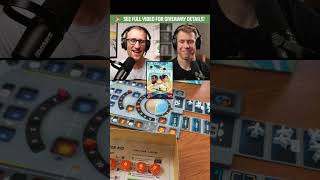
Sky Team's production is stunning, but more importantly, every component reinforces what you're trying to do. The control panel looks like a cockpit. The switches toggle as you deploy flaps and landing gear. The altitude track sits front and center, advancing with each round to remind you of your deadline. Dice shields represent the hidden information barriers between crew members. Coffee cups track mitigation resources. The wind module, kerosene leak, traffic die, and intern all add emergent challenges that feel like real problems a flight crew would face. Board Stupid praises the production value; Shelfside emphasizes how readable and functional the board is, making it easy to see what each die placement accomplishes. This is not window dressing: the theme and mechanics are inseparable, which is why the game works as well as it does.
Modular Difficulty Through Airport Scenarios
The box includes a tutorial mission at Montreal, multiple standard missions, and harder variants. Players can dial difficulty up or down by choosing which airports and modules to include. A beginner might start with landing gear and flaps only; veterans can add turbulence, icing, alarms, and dynamic wind. This modularity means the game has real staying power: each scenario feels like a distinct puzzle with new priorities and hazards. kovray praises the campaign-like structure and variability. Reviewers consistently note that the campaign structure provides gentle on-ramps for new players while offering dozens of hours of content for those who commit to the game.
Potential Drawbacks
Constrained by Two-Player Scope
Sky Team is exclusive to two players. This is by design: the nonverbal communication system and dice hiding depend on exactly two hidden hands and two sets of signals. However, the restriction means the game sits on a shelf whenever a group larger than two arrives at the table. Reviewers acknowledge this is a deal-breaker for some households and game groups. Shelfside notes that some players tried workarounds (split into teams), but the core experience is firmly two-player. Board Stupid and kovray both mention this limitation as a factor in their overall assessment, though they don't see it as a flaw, just a constraint.
Limited Decision Space and Predictable Patterns
3 Minute Board Games articulates a sharp critique: half the mandatory actions remove choice, and many optional actions are obvious given the board state. There is no surprising twist, no emergent storytelling beyond the theme. Certain sequences become routine after playing multiple scenarios. Shelfside's Alexander gives the game a 6-7 because while the tension is real, the puzzle space is narrow and consistent. The game, in this view, is a very good execution of a narrowly scoped idea rather than a generative engine for surprising moments. TheGameBoyGeek notes that Sky Team is a harder game to teach than lighter Spiel des Jahres winners, yet it won despite breaking the pattern, suggesting the jury valued its thematic cohesion and innovative communication system over broad accessibility.
If You Enjoy Sky Team
Players drawn to Sky Team's two-player cooperative focus will find similar satisfaction in Sale, another trick-taking game that requires close partnership. Those who love the limited-communication puzzle will appreciate The Crew, which layered cooperative trick-taking with hidden constraints, or Assembly, a silent coordination puzzle for two. For players wanting a cooperative game with modular missions and escalating difficulty, Cascadia and In the Footsteps of Darwin offer tile-placement alternatives with replayability. If you crave the push-your-luck and modular variety without the two-player constraint, Captain Flip and Trio deliver accessible, fast-playing options that reward multiple plays.
What Reviewers Are Saying
"Sky Team is actually a big signaling exercise as you have four dice hidden from your teammate and then you're guessing each other's dice as you're placing more dice on the board."
— Shelfside
"It's been a while since I played a Cooperative game like this that's got a two-player count where you're really limited in terms of what you can say during your turn and the tension ramps up and ramps up and ramps up the closer you get to your altitude coming down to the bottom here on this track."
— Brains On Games
"I did not find this game had meaningful decisions. Half your actions are mandatory each turn and the rest are usually very obvious."
— 3 Minute Board Games