

































Timber Town Deep Dive
What the Community Thinks About Timber Town
Timber Town has earned consistent praise from reviewers as a standout two-player tile placement experience. The consensus is remarkably unified: this is a beautifully executed game that brings together elegant mechanics, gorgeous production, and a whimsical theme that doesn't overshadow the strategy underneath. Reviewers describe it as a game that feels "cozy but still locked in," mixing comfort and accessibility with genuine strategic depth. Some reviewers, particularly those from Crimsonboardgames, highlight its potential as a gateway game that introduces players to more tactical puzzle design. Meanwhile, The Broken Mele offers a contrarian view on one specific rule, arguing the scuttling mechanic makes board connections slightly too forgiving for experienced players, though this remains a minor critique in an otherwise enthusiastic reception. The game sits comfortably alongside classics like Cascadia and Calico in the eyes of the community.
Core Mechanics That Define Timber Town
Tile Placement with Column Restriction
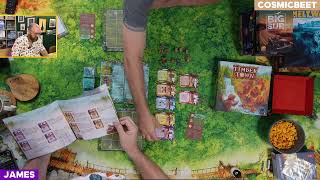
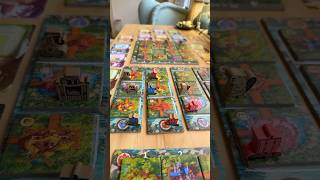
At its heart, Timber Town is a tile placement puzzle. Each turn, players claim a building tile from the river and must place it into the matching numbered column on their town board. The tiles themselves feature boardwalks that must connect orthogonally with existing tiles, creating path networks that structure your growing town. Rotation is allowed, and tiles can be placed anywhere within their designated column, but dead ends are forbidden: every path connection must either reach the board edge or link to another boardwalk. This restriction creates the mechanical tension that makes placement feel satisfying. The designer, Ryan Busher, layered this with optional construction tokens (cranes, dams, rafts) that can temporarily break the rules in specific ways, giving players tools to solve the trickiest puzzles without removing challenge.
River Flow and Dynamic Tile Availability
The river mechanic is what elevates Timber Town from a static puzzle into a tense drafting experience. Before your turn, you face tiles flowing down a four-column river. When you claim a tile, it locks you into placing it in that specific column, but here's the twist: the river moves every round. Tiles slide downstream, new ones appear from the stacks, and tiles fall off the end, gone forever. This means the building you want might not be in the right column yet. You can use your raft token to reserve a tile for a future turn when it drifts to a better position, but your opponent could claim it in the meantime. The elegance of this mechanic is that it ties strategic choice directly to timing and spatial planning. As reviewers noted, every game's flow is different because the river doesn't refresh: once a tile falls off, it's gone, creating genuine scarcity alongside the row-matching constraint.
The Timber Town Experience
Puzzle-Solving Satisfaction
Reviewers consistently described the play experience as deeply satisfying puzzle-solving. The game locks you into focused thinking on each turn: which tile can legally go where, how does claiming this tile now versus waiting affect future options, and am I setting myself up for a dead end later? This isn't a game about aggressive play or blocking your opponent. Instead, it's about optimizing your own town while staying aware that tiles you might want could be snatched away. The moment when a tile clicks into place and connects your boardwalks is a quiet victory. Iris from Crimsonboardgames particularly praised this: "You cannot be snoozing while you play this game. You need to be locked in, strategizing." The puzzle deepens as your board fills and your options narrow, especially in the final third of the game.
Cozy Competition
What stands out to multiple reviewers is that Timber Town avoids the cutthroat feel of many two-player games. This isn't about screwing each other over; it's about both players building their best towns. The low-conflict, almost meditative quality comes through in how reviewers describe their experience. One reviewer from The Broken Mele noted that "this one isn't about players trying to screw each other over... you're just trying to be more efficient than the other player is." The aesthetic also contributes: the cute artwork and beaver theme create a gentle atmosphere. Several reviewers mentioned the appeal of sitting down with a friend or family member to collaboratively solve a spatial puzzle rather than engage in combat. This makes Timber Town unusual among two-player games, and reviewers see this as a strength, not a limitation.
What Makes Timber Town Stand Out
Variable Scoring Cards and Replayability
Every game of Timber Town uses a different set of scoring objectives. Each of the five building types (temples, parks, markets, homes, workshops) comes with four different scoring cards that vary wildly in how they reward placement. In one game, temples might want to cluster together; in another, they score points only if surrounded by specific colors. Parks might reward corner placement one game and center placement the next. This system ensures that no two games play the same way because your strategic priorities shift with each card combination. With five building types and four variants each (plus fixed beaver and construction cards), the possible combinations run into the thousands. Reviewers were struck by how this simple design choice prevents the game from becoming stale. As one reviewer put it, "every time you play, you're going to get a different puzzle to solve."
Elegant Production and Approachable Teaching
Reviewers from multiple channels praised the production quality. The tiles are thick, screen-printed wooden pieces with gorgeous artwork by Isabelle Overturf. The player boards are sturdy, the tokens are delightful, and nothing feels cheap despite a retail price under $25. The rulebook is generally clear, though some reviewers noted minor ambiguity in the placement rules section. What impressed reviewers most, however, was how quickly the game teaches. Multiple reviewers emphasized that Timber Town can be explained in five minutes and played in 30 to 45 minutes, making it ideal for both new players and experienced gamers. The accessibility combined with the strategic depth creates a rare combination: a gateway game that doesn't bore experienced players and a meaty game that doesn't intimidate newcomers.
Potential Drawbacks
Scuttling Rule Reduces Difficulty for Experienced Players
Luke Hector from The Broken Mele identified one mechanical critique: the scuttling rule, which allows players to use construction tokens to artificially create boardwalk connections between tiles, makes path creation slightly too easy. While designed to help new players and keep the game casual-friendly, experienced players may find that this rule removes some of the spatial puzzle's challenge. Once you have construction tokens available, you can usually force most tiles into place. This is a personal gripe rather than a design flaw, and Hector noted it can be house-ruled away for players who want more difficulty, but it's worth knowing if tight spatial constraints are your preference.
Two-Player Only Limits Flexibility
Timber Town is strictly a two-player game with no solo variant and no four-player option. While reviewers acknowledge that the two-player constraint works perfectly for the design (the river mechanic and turn alternation are tightly balanced for exactly two), this does limit when and how often the game gets played. Players who live alone or primarily play in groups of three or more may struggle to get this to the table. One reviewer wondered aloud why there's no solo mode, noting it would probably work well, but accepted that the designer may have had good reasons for keeping it purely two-player.
If You Enjoy Timber Town
Players who enjoy Timber Town's tile placement puzzle will find similar satisfaction in Cascadia, which uses a hand-drafting system to build landscapes with spatial constraints and multiple scoring paths. Those drawn to the cozy aesthetic and gateway-game accessibility should explore Azul and Sagrada, which offer tile placement with pattern-building satisfaction but without the river mechanic. Calico and Tiny Towns share the four-by-four grid and variable objectives that make each game feel fresh. For players who want the same designer's spatial innovation with slightly more complexity, Patchwork offers a head-to-head tile puzzle with its own novel mechanic. If the river mechanic intrigues you, Cascadia again comes to mind as the closest mechanical parallel in the modern catalog. Those wanting a longer, heavier two-player experience might try Seven Wonders Duel, which similarly focuses on tension and timing without direct confrontation.
What Reviewers Are Saying
"It's so fun to really think about what to place where and when, how you can reserve tiles with your raft so the other player can't take that tile. It's really a strategic way of thinking, and it's really, really fun. I think it's a wonderful family game."
— Crimsonboardgames
"This whole river mechanic is kind of what makes this game because it's one thing to say I want this tile, but you need it to be in the right column. And while all that's going on, the opponent could still take the tile. So you've got to pay attention to what they want and think about whether to reserve it with a raft or take something else."
— The Broken Mele
"There is a similarity here to things like Cascadia, which has been dominating the whole gateway game scene, but what you haven't seen is the really cool twist here, bringing conveyor belts in. This game lives on the shelf alongside things like Calico and all of those because it does such a smart job of building something over the course of the game, something real, something tangible."
— Meeple University