Timber Town - How to Play. Complete, Clear, Concise Board Game Tutorial
Games in This Video
1 game is featured in this video — it unlocks as you watch.
Transcript
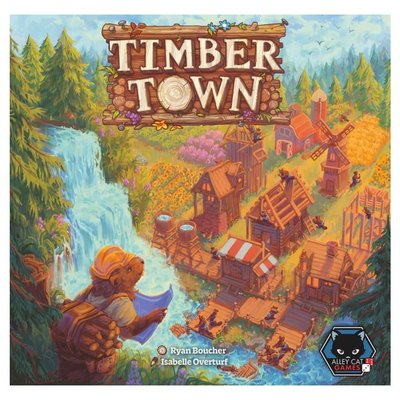
Fast and Furry Forest Fest with you as beer architects grabbing the drifting buildings on the river to construct in Timbertown. And today we'll be teaching you how to play Timbertown game designed by Ryan Boucher and published by Alleycat Games and Seabbrook Studios. And do check out the link to the games page in the video description below. And hi everyone, it's Stella and Tarant. Welcome to Melan University. And hey, if you enjoy this video after watching, subscribe and comment. You know what to do. All right, now let's get to the classroom. In Timbertown, players are rival beaver architects on opposite sides of the river, each trying to build the highest scoring town. Round by round, players will claim the best buildings from the river, assembling them in their grids before they drift away forever and are replaced by new ones from upstream. With seven different types of building, each scoring in a different way. Whoever can assemble the best town by these scoring objectives will be the winner. To set up, each player takes a playerboard and sits opposite each other so that the column numbers line up. Take the single colored raft piece which matches your player color. And be clear, this is the one only in your color, not the one which shows both colors and some brown. Randomly place a river tile in the first column. And lay the rest out, alternating between the two player
colors. Shuffle and make three stacks of building tiles and flip the top tile from each stack onto the first river tile. Find the scoring cards. Choose one in each of the seven colors and place them face up in the area between the players. For the brown beavers and the red construction yards, there's only one card. For all the others, either choose the one with this icon for your first game, or choose a card randomly. Points in Timbertown will come from how well you meet these seven objectives with the building tiles you place in your town. nearby. Make common supplies of the construction tokens, rafts, dams, and cranes, as well as the three beavers and the five point builder beaver. You're now ready to play. Timber is played in rounds, and in each round, each player will take one turn starting from whichever player is showing on the first river space.
On your turn, you'll have the chance to claim a single building tile from the river to build into your town either immediately or on a later turn. In the first round, there'll only be three buildings to choose from. While in later rounds, there will be a mix of filled and empty spaces. At the end of each round, after both players have claimed one tile, you'll set up for the next round by discarding any tiles which were on the final river tile, moving that tile to the front of the queue, and flipping a new building onto each empty space of that tile. So, now let's zoom in on a single player's playerboard and learn how to claim and build tiles.
On your turn, you may claim a single building tile from the river, a tile which you alone may build in your town. There are two ways to do this. And the first is to take it and build it immediately. If you do this, choose any face up tile and note which column of the river it came from. Now build it in an empty space in the same numbered column of your town board. You can choose any space, but only within that column. And you can rotate to any orientation. But any tile with boardwalks at the edge must join up to either the edge of your town board or other boardwalks. As such, I could place this tile here or here, but not here since this boardwalk does not join up. And likewise, this placement would be acceptable, but this one would not.
Then if the tile you placed was a construction yard showing the red saw and with an icon in its top right corner, gain the construction token corresponding to that icon. So a dam or a crane or a raft which you would flip to your colored side. If the tile shows a beaver, then place one of the beaver meeples onto that tile. Once you have these construction tokens, you can use them as a free action on your turn to give you building flexibility, including on the same turn after you've gained them. Firstly, any one of these three construction token types can be scuttled to create a boardwalk connection where one doesn't exist.
Usually that means that as you're placing a tile, you can scuttle one of these, placing it over a gap to make it validly connect. You could also choose to scuttle across a legal tile placement like so, specifically to create a path since some scoring cards look for paths. Each construction token also has a unique purpose. with the crane. When building a tile from the river, you can spend the crane to build it in any column rather than just the column you took it from. The dam lets you claim a second tile on the same turn. So here, my turn could be to build this tile off the board and then spend the dam to build another. The last type of construction token is the raft. And this brings us to the second way that you can claim a tile on your turn, and that is to place a raft. You begin the game with a permanent raft solely in your color. And you can collect rafts from construction yards as well. On your turn, instead of picking up a tile from the river and placing it in your town, you can place one of your raft tokens onto a tile.
When a building has your raft, your opponent cannot take that tile nor place their own raft on it. That building is now yours to build and you can build it as a free action into its current column on any future turn. And this is in addition to the tile that you build or otherwise claim on that turn. So, for example, I've claimed this with my raft while it's in column three, but I've built nothing on this turn. Next round, that raft and tile will have moved one step along the river. And as my turn with the board laid out like this, I could now, for example, build this tile into column two and build this tile into column four.
When you build a tile with your permanent raft, it returns to your supply. If you build a tile which you marked with a construction yard raft, then discard it from the game. You'll mostly be using rafts to claim tiles when they're upstream on the river and then later build them when they're further downstream. But you could also use your raft to block a tile so your opponent can't take it. You can't voluntarily move or take back a raft unless you build the tile under it. But if the tile falls off the end of the board, then discard the building and retrieve your raft if it was your specific raft or discard the raft permanently if it was from a construction yard.
So to summarize the turn sequence again, each player takes one turn per round, starting with whoseever icon is in the first space of the river. On your turn, you either claim and build a tile immediately or state claim to one for a future turn using a raft. You may also choose to pass, not claiming any tile if there's none you want or none you can legally claim. You can also take the free actions of taking a tile from under a raft or using a crane or a dam or scuttling a construction for its bonus. You can refer to your player aid card for this turn sequence, the effects of the construction tokens, and the distribution of building tiles in the game, including how the boardwalks are laid out on them. Continue playing rounds in this way.
Once the draw decks of tiles are empty, you'll still continue. The game can go on for as long as there are still tiles in the river. One way to score points is to be the first player to completely fill your town board. If you do this, you take the fivepoint builder beaver token and you pass the rest of your turns. The other player keeps taking turns alone, either until their board is also full or until the river no longer has any tiles in it for them to take. Now players count up their final scores based on the seven different card scoring types. Red construction yards always score two points per tile, plus one point for each unspent construction token.
This here would be two points plus one for three points. The brown beaver town squares score five points if the beaver on it can walk via boardwalk paths so that it moves off the left of your board and off the right of your board. So this beaver scores five points. It can walk off here and walk off here as does this one which walks off here and off here. And these paths can follow scuttled construction tokens. However, this beaver has no path off the left hand side of the board, so scores nothing. For all the others, follow the scoring objectives on the cards. There's a variety of types with some scoring based on where they're placed in your grid, making clusters of the same color, having one type of tile in proximity to other different tiles, and so on.
Finally, the player with the builder beaver gains five points. The player with the higher score wins. If tied, the builder beaver breaks the tie. And if neither player claimed it, the victory is shared. Thanks for watching. And if you like this video, maybe you'd like to watch this next one. Have a great day. Bye.