


Fighters of Europe Deep Dive
What the Community Thinks About Fighters of Europe
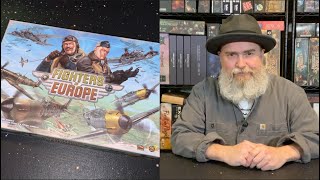
Fighters of Europe has earned a devoted following among wargame enthusiasts, particularly on The Discriminating Gamer channel, where reviewers consistently praise it as a masterclass in elegant WWII air combat design. The game strikes a rare balance: simple enough to teach and resolve quickly, yet strategically rich enough to reward careful planning and forward thinking. Reviewers who remember Fighters Over the Pacific, its predecessor covering Pacific theatre combat, find Fighters of Europe equally compelling with fresh scenarios and new aircraft that distinguish it as its own distinct experience rather than a simple reskin. The consensus centers on a game that distills complex aerial dogfighting into an almost abstract tactical system without sacrificing thematic engagement or visual appeal.
Core Mechanics That Define Fighters of Europe
Damage-Based Combat
Fighters of Europe employs a straightforward yet tactically nuanced damage system where each aircraft carries hit points that accumulate over the course of engagements. When a plane successfully fires on a target that cannot maneuver away, it deals one point of damage, which is immediately marked on the plane with a smoke token indicating its wounded state. Some aircraft, particularly those equipped with cannons or advanced weaponry, can inflict multiple damage points in a single strike. The system rewards positioning and tactical awareness because a plane that has already activated cannot escape or take evasive action; only unactivated planes can dodge incoming fire. This creates cascading decisions throughout each round as players must weigh the risk of attacking now versus the certainty of taking damage themselves if they commit their planes first. Once a plane reaches zero hit points, it is removed from the board, and the attacking player scores victory points. The victor is determined either by eliminating all enemy aircraft or, more commonly, by controlling the most points when the scenario timer expires.
Hex-Grid Maneuvering and Elevation Control
Movement and positioning form the heartbeat of Fighters of Europe's gameplay. Each aircraft moves across a modular hex-based board, spending movement points to execute a variety of maneuvers: turning left or right, slipping laterally into adjacent hexes, diving from high altitude to low altitude, or climbing to gain elevation advantage. Not all maneuvers are created equal; a dive or climb costs more movement than a slip, and certain maneuvers cannot be chained in succession. The genius of the system lies in elevation: aircraft at high altitude are marked with white backgrounds while low-altitude aircraft use colored backgrounds, and maintaining or changing altitude is crucial to tactical success. A firing arc defines where a plane can shoot, but more importantly, only planes that have not yet activated in the current round can attempt to dodge incoming fire. This creates emergent play where maneuvering into position is as much about forcing your opponent's hand (activating their planes before they are ready) as it is about lining up your own shots.
The Fighters of Europe Experience
Chess-Like Strategic Depth
Playing Fighters of Europe feels like conducting a chess match compressed into one or two hours. Reviewers consistently highlight the forward-thinking required: if you attack your opponent's plane here, will their counterattack leave your aircraft vulnerable, or will your next move put you in position to defeat them before they can retaliate? The system forces players to think two or three moves ahead, calculating branching sequences of activation, movement, and combat. The theme of WWII aircraft is heavily integrated into this puzzle, not as chrome but as genuine mechanics; each plane's attributes (speed, armor, special abilities like good diving or low ammunition) create meaningful asymmetries that reward understanding the strengths and weaknesses of RAF Hurricanes versus Spitfires, or the nimbleness of the Messerschmitt Bf109 against the heavier German bombers. Yet the experience never feels overwhelmingly complex; the rule set is lean and the decision space is bounded. This is abstract tactical play with substance.
WWII Dogfighting Immersion
Despite its elegant abstraction, Fighters of Europe preserves the feel of aerial combat over the skies of Britain in 1940. The modular board depicting satellite imagery of the terrain creates a top-down perspective that evokes reconnaissance photos. Scenarios range from simple fighter skirmishes to bombing runs against ground installations, with later expansions introducing massive B-17 bombers occupying multiple hexes and elite German fighters like the Me 262 equipped with experimental weapons. The game captures the asymmetry of historical air campaigns: sometimes you are defending your homeland with nimble fighters, and sometimes you are pushing enemy aircraft away from targets, managing formations to preserve speed advantage and initiative. The scenario book provides ten distinct setup configurations in the base game, many with evocative names and objectives (Blitz, Rough Journey Home) that anchor the abstract maneuvering in the drama of specific historical moments.
What Makes Fighters of Europe Stand Out
Formation and Initiative System
The formation mechanic is Fighters of Europe's signature innovation. Before each round, players count the number of distinct formations they have on the board (groups of planes at the same elevation in contiguous hexes). Whoever has fewer formations gains initiative, deciding which player activates planes first that round. This is not merely a bookkeeping detail; it creates genuine tension and strategy around whether to keep planes grouped for initiative control or spread them out for tactical advantage. Maintaining formation confers power but costs flexibility, forcing players to constantly negotiate the tradeoff between cohesion and adaptability. Combined with the elevation system, which adds a second axis of grouping, the formation mechanic prevents the game from devolving into isolated dogfights and instead builds toward tactical play where understanding three-dimensional space and group coherence matter.
Production Quality and Elegant Component Design
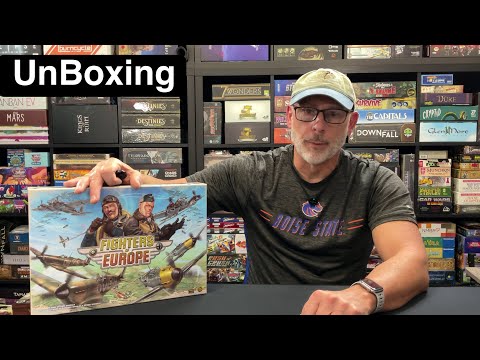
Reviewers consistently celebrate the physical design of Fighters of Europe, particularly the decision to use flat aircraft tokens on a modular board rather than requiring miniatures on stands. This saves significant table space while the artwork on each token is genuinely beautiful, featuring detailed period-appropriate aircraft silhouettes and paint schemes. The board itself is composed of eight individual tiles that interlock without folding, allowing scenarios to range from intimate skirmishes on a small map to sprawling campaigns across a larger space. The insert is thoughtfully designed with bags for tokens and room to organize the modest number of components. The clarity of the rules is also noteworthy; the eight-page command training manual covers everything needed to play, avoiding the rulebook bloat that plagues many wargames. Scenarios are presented in a bifold format where each player can see only their own setup, enforcing information asymmetry without requiring a referee. All of this contributes to a game that respects the player's time and table space.
Potential Drawbacks
Small Aircraft Identification Text
One reviewer noted difficulty distinguishing between RAF aircraft types at the table. While each aircraft token is labeled (Hurricanes marked with an H, Spitfires with an S), the text is small and requires holding the token close to the eyes to read reliably. For players with vision challenges or those playing over extended sessions, this is a friction point, though it is minor in context of the overall experience. A larger or higher-contrast identifier on each token would resolve this without substantially altering the design.
Abstract Theme Integration
Fighters of Europe is intentionally abstract in its mechanical design, and while reviewers appreciate this abstraction paired with heavy WWII aircraft theming, some players may find the disconnect between the elegant ruleset and the historical setting unsatisfying. The game does not attempt to simulate realistic aircraft performance in terms of energy management or aerodynamic modeling; instead, it captures the essence of air combat positioning and targeting through a streamlined system. Players seeking a more simulationist wargame experience may find the system too simplified, though most reviewers would argue this is precisely what makes the game accessible and replayable without requiring hours to learn and resolve.
If You Enjoy Fighters of Europe
Fighters of Europe shares lineage with Fighters Over the Pacific, its spiritual predecessor covering the Pacific theatre between American and Japanese naval air forces. The two games use nearly identical mechanics, so fans of one typically embrace the other for its fresh scenarios and aircraft variety. For those wanting similar hex-grid maneuvering and tactical positioning, Fighters Over France extends the family to yet another historical theatre. All three are published under the same design philosophy and are commonly referred to as a game family on boardgaming forums.
What Reviewers Are Saying
"I love this game. I love the theme. I love the artwork. I love the game play. The gameplay here is just so much fun. I think it's wonderful kind of World War II dog fighting that again it has a real chess-like feel to it as you are trying to maneuver your planes into the best possible way to get the attacks and not get attacked themselves."
— The Discriminating Gamer
"These games to me are really, really fun games. They're not complex, they're very simple, and that's what I like about them. There's not a lot of rules and everything else."
— The Discriminating Gamer
"Fighters of Europe is a great game where it's very abstract. It almost feels like a chess match, and you're just kind of maneuvering on these hexes for position to fire on your enemies."
— The Discriminating Gamer