














Fortunes of Scoundrel Bay Deep Dive
What the Community Thinks About Fortunes of Scoundrel Bay
Fortunes of Scoundrel Bay has found enthusiastic support among board game reviewers as a sophisticated Euro-style pirate game with surprising depth. The game generates strong opinions across the board, with reviewers consistently highlighting its tight design, interactive gameplay, and thematic immersion. What emerges most clearly from the community is admiration for a game that rewards strategic planning while maintaining meaningful player interaction throughout, even when players pursue different paths to victory.
Core Mechanics That Define Fortunes of Scoundrel Bay
Multi-Use Cards
At the heart of Fortunes of Scoundrel Bay lies a multi-use card system that creates the tough decision-making space reviewers consistently praise. Every card in the game can be used for three distinct purposes: recruiting new crew members, sailing to move your ship along the board, or invading territories for area control. The tension comes from the fact that each turn you play exactly one card for only one of those three uses. This creates constant opportunity-cost puzzles that shape every single turn. Reviewers note this mechanic is not hard to learn, yet produces genuinely difficult choices that feel meaningful from start to finish.
Area Control and Territory Interaction
The board is divided into five distinct regions, each presenting different scoring opportunities through area control mechanics. Players compete to establish presence in harbors, villages, hideouts, and beaches, with the scoring value of each location determined by majority control at game end. This spatial competition combines with the multi-use card system to create layered strategic decisions: you must choose not only which card ability to activate but also which location to invest in, knowing that opponents are evaluating the same board state and responding to your moves.
The Fortunes of Scoundrel Bay Experience
Sandbox Freedom with Strategic Direction
One of the most distinctive qualities reviewers attribute to the game is its sandboxy feel. The game offers genuine freedom in how players approach victory. Some reviewers describe choosing to focus entirely on monster hunting, while others prioritize treasure delivery or harbor control. The absence of a single forced path creates a game that feels different depending on what players choose to emphasize, which builds replay value and accommodates different player preferences at the same table.
Surprisingly Competitive and Mean
Despite its thematic presentation and multiple viable strategies, the game delivers a surprisingly interactive and competitive experience. Reviewers emphasize that player-to-player interaction is constant and direct, with opportunities to manipulate the game state in ways that disadvantage opponents. One reviewer notes that the game allows you to starve other crews of resources, forcing them to fall behind while you accumulate advantages. This meanness operates within the Euro-game tradition of strategic efficiency rather than luck-based elimination, making it more satisfying to competitive players who appreciate well-designed indirect conflict.
What Makes Fortunes of Scoundrel Bay Stand Out
Thematic Integration and Visual Design
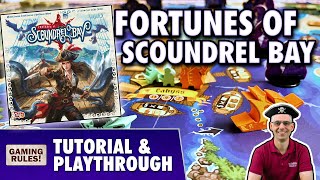
The game's art direction creates an immediate and distinctive impression. Reviewers describe the artwork as looking like a poster for an old pirate movie, with rich thematic flavor that extends beyond pure aesthetics into the game's systems themselves. The physical components reinforce the pirate setting. Captains provide asymmetric abilities that make each player's experience feel unique, while milestone tiles offer variable objectives that reward different strategic approaches. This thematic coherence means the mechanical decisions feel naturalized by the setting rather than arbitrary.
Rewarding Multiple Playstyles and Learning Curve
A game's design often reveals itself through how it teaches itself. Fortunes of Scoundrel Bay benefits from repeated play in a deliberate way. Reviewers report that the first few plays can feel awkward if players try to do everything, but once players internalize how to pace their progress and read the race elements, the game opens up dramatically. The competitive timing mechanisms reward players who understand when to push forward and when to build their engines. This learning arc means newcomers and experienced players can enjoy the same game while still having distinct experiences and challenges to overcome.
Potential Drawbacks
Player-Driven Pacing Requires Table Awareness
The game's reliance on player choices to control pacing means that inexperienced players can accidentally drag out the game. Because there is no external timer forcing progress, players focused on optimization can theoretically spend many turns building up their crew before moving forward, which can make early plays feel slow. Reviewers note this is less a flaw and more a fact about games with such open strategy spaces. The game rewards tables that develop a shared understanding of healthy pacing.
Moderate Complexity with Interacting Systems
The combination of multi-use cards, area control, resource management (food, treasure maps, crew), and the linear progression along the board creates a game with genuine depth. While none of the individual systems is complicated, their interaction means the first play requires teaching and attention. Some reviewers suggest the game is best appreciated by players comfortable with moderately heavy Euros.
If You Enjoy Fortunes of Scoundrel Bay
Players who love Fortunes of Scoundrel Bay's multi-use card system will find similar satisfaction in Revive, which shares the same design team and explores comparable decision-making depth. Those drawn to the thematic pirate setting and sandbox exploration will appreciate Maracaibo, which offers a different but equally rich Euro-style take on the age of sail. Fans of the area control and player interaction mechanics will find meaningful challenges in Maracaibo as well. For players who want a game with comparable learning curves and emergent strategy, Maracaibo delivers similar rewards for mastery.
What Reviewers Are Saying
"This is all about multi-use cards. Every card can be used for three things. But when you play the card, you can only use it for one of those things."
— Grant Lyon
"As soon as one person recognizes that, the game opens up and makes it quicker, better, and more fun. You are pirates moving on a one-way street basically fighting monsters, getting better at different abilities, interacting with different locations depending on the cards you play."
— Board Gaming Ramblings
"This is like a heavier pirates game, but the actions that you're actually doing are fun. You're digging up treasure on islands, you're raiding ports, you're attacking other players. But you're fighting monsters, too. So, it almost feels to me very sandboxy. Like you've got the sky's the limit to what you can do."
— Man vs Meeple