


Tiny Epic Crimes is a fast-paced, crime-fighting, deduction game for 1 to 4 players that offers multiple ways to play. The game can be enjoyed competitively, cooperatively, or solo.
Players take on the role of detectives, and depending on the game mode, will be working either together…. OR separately…. to crack the murder case. Time matters, and the first 48 hours after any crime are the most critical. Players race around Echo Ridge City collecting evidence, such as the murder weapon, forensics, or the getaway vehicle.
This secret evidence is sifted through using the novel Tiny Epic Decoder System, which keeps all of the murderer’s other evidence hidden. This knowledge eliminates suspects and helps identify the true killer. But crime doesn’t stop for one investigation. Players must answer the call of duty, juggling their time as other criminal activities arise across the city. Resolving these events allow players to gain useful alibis and powerful Force Cards, but knowing full well that their actions will take them hours closer to a reckoning.
In their final hour, players will stake their careers on a final guess: who they think the murderer really is… hoping that their wits and detective skills are enough to bring the correct suspect to justice.
Can you hold this city of crime together long enough to crack the case, or will it go cold and your time on the force run out?
This page includes videos and mentions from the whole Tiny Epic Crimes family. Drill into a specific game below.


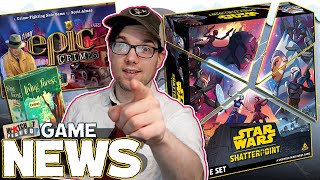
- Offers multiple ways to play: competitively, cooperatively, and solo.
- Crime fighting deduction
- Echo Ridge City
Mechanics (from transcript analysis)
- Deduction — Players take on the role of detectives to crack a murder case.
- Set Collection — Collecting evidence to eliminate suspects and identify the killer.
- Variable player modes — Offers multiple ways to play competitively, cooperatively, and even solo.
Video topics + discussion points
Quotes (from this video)
- I mean seriously hello
- look I like crime as much as the next guy and contrary to popular belief crime does pay and it makes you look cool
- The design and development of Star Wars shatterpoint miniatures game is really our love letter to the excitement and energy of being a kid on Saturday mornings
- which is why I'm bad at this game of area control tile placement negotiation and of course a bit of dice rolling
- I'm sure to be checking it out
- I am well and truly intrigued
- I've always wanted to jump into this system it looks fun I've Heard lots of good things about its mind melty nature so maybe this is my chance
- this is your chance to meet the other sponsor that helped make this episode possible Wayland games
- I love this type of thing it makes me smile
- I bet it's lovely
- I want to thumb through a scurvy rule book as soon as I get a chance
References (from this video)
Mechanics (from transcript analysis)
- Tiny Board Game — A small game that can fit into a pocket.
Video topics + discussion points
Quotes (from this video)
- Creativity rarely works that way.
- So, SCAMPER is essentially a checklist, seven letters each representing a different approach that you could take to modify an existing product.
- Most ideas will be bad, but occasionally, a prompt forces you into a design space you would never have explored otherwise.
- SCAMPER will create weird and wacky games, innovative new takes on a tried and tested formula. And that's great, but commercially, without an understanding of your potential audience, it's a shot in the dark.
- Your player persona is there to help you with your own focus. It acts as a lens through which you can view your developing game, a different set of eyes to your own.
References (from this video)

- Two-mode design (competitive and cooperative) adds flexibility and learning curve
- Engaging time-pressure and event-driven challenges
- Dynamic information flow and selective action access creates interesting dice-and-deduction tension
- Solid production, compact box, attractive components, and thematic presentation
- Event cards can be harsh or punishing in early games
- Two-player balance can sometimes skew with limited clue tokens and increased risk of dead ends
- Clue-like envelopes for clues can become nicked or stiff, affecting usability
- Kingpin expansion adds considerable complexity and can overwhelm new players
- Detective noir / crime investigation under time pressure, with investigators racing to solve the case
- Urban city police precincts and a city-district crime scene environment, with a time-based ticking clock influencing decisions and events
- Array
- Clue
Mechanics (from transcript analysis)
- action selection — Drive around town, search for evidence, catch informants or witnesses, and maneuver through checks to collect clues.
- Cooperative Game — Players can play cooperatively or competitively, each mode changing access to actions and information flow.
- cooperative vs competitive modes — Players can play cooperatively or competitively, each mode changing access to actions and information flow.
- Deduction — Clues are gathered through a mix of actions and positioning, forming the core path to identification of the culprit.
- evidence collection — Clues are gathered through a mix of actions and positioning, forming the core path to identification of the culprit.
- final deduction reveal — At the end, players reveal the murderer based on gathered information, with the best detective named.
- suspect management — Suspects are acquired and revealed; the correct combination of suspects and clues leads to the solution.
- Time Track — Time advances as players act; crossing thresholds can trigger negative events or alter available options.
Video topics + discussion points
Quotes (from this video)
- two different options of choosing the competitive and the cooperative
- this plays way way different to how clue plays
- I would say this is solid and does something different than any of them do
- this will probably make like my top five in the series
- the city is placed differently and the puzzle's always going to be new
- I think the capos are great; there's kind of no reason not to add them