

Not long from now, the world as we know it is an overgrown memory — and though the world has changed, we've changed with it, using anything we can find to build a new way of living.
Life in Reterra is a (re)building game, and it's up to each player to build a community of their own. To set up, choose one of three ready-to-play themed building sets, or put together a set of your own. Each set consists of five building cards, with associated building tiles for each card.
Each player starts with one square land tile in play. Each land tile is divided into a 2x2 grid, with one of five types of terrain in each grid space; a space might also hold a gear icon or one of four types of relics. Players also have three land tiles in hand, and five land tiles are displayed face up.
On a turn, choose a land tile from your hand or the display, then add it to your community, which can be at most four tiles on each side. When the tile has a gear, you can either place an inhabitant from the reserve on this gear or place a building tile in your community...but each part of the building must be supported by a gear and all of these gears must be on the same type of terrain.
After you have a building in play, you gain the power of the building card and can use it once on each of your subsequent turns. Maybe you can place relic tokens for additional points, place additional inhabitants, junk an opponent's relics, or score for building large sections of a terrain or having more of a building than anyone else.
Once everyone has sixteen tiles in their community, players score for what they've built, earning points for blocks of terrain of at least seven spaces, surrounded energy sources (which are a special type of tile), inhabitants, relics, and buildings.
This page includes videos and mentions from the whole Life in Reterra family. Drill into a specific game below.



- High replayability due to variable setup
- Clever engine-building elements
- Resource management and exploration
- Post-apocalyptic world with discovery (mass-market publisher)
Mechanics (from transcript analysis)
- resource/engine optimization — manage resources and titles to maximize scoring.
- Tile Placement — lay tiles to build your world with variable setup each game.
- tile placement / world-building — lay tiles to build your world with variable setup each game.
Video topics + discussion points
Quotes (from this video)
- It's not a party game it's a card game but you use it at parties.
- I would use this every time over Code Names.
- This is a blast, a super fun game.
References (from this video)

- very approachable
- good price point
- engaging puzzle feel
- some replayability questions may arise
- terraforming and resource optimization
- Earth-like terraforming with tile-placement
- abstract, puzzle-like
- Cascadia
- King Domino
Mechanics (from transcript analysis)
- area/territory scoring — scoring based on controlled areas and resource generation
- Tile Placement — players place tiles to optimize scoring and terraforming progress
Video topics + discussion points
Quotes (from this video)
- it's going to be the hit of the Q4 next year
- absolute topnotch game we are super excited to play that again
- production quality is phenomenal
- one versus one asymmetric
- it's a fan service game if you like Mass Effect
- we're going to pre-order it because it's a great price point
- Dirty Harry
- World Order my goodness that sounds amazing
References (from this video)
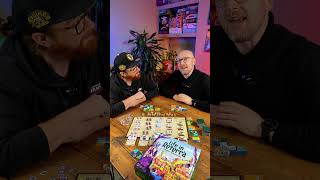
- Cozy vibe paired with meaningful strategic decisions
- Interactive and competitive without losing thematic charm
- Tight tile placement and area-control decisions
- Moonrise expansion enhances replayability with new scoring and buildings
- Recognized for sustainable production through recycled materials
- Limited supply of buildings can lead to crowding and potential blocking
- May require careful pacing to maintain smooth player interaction
- Eco-reclamation and community-building with a competitive edge over scarce resources.
- A nature reclaimed world where players cultivate a growing town by placing land tiles, grabbing buildings, and fostering a community in a lush, post-nature setting.
- Cozy, optimistic town-building in a world being returned to nature.
Mechanics (from transcript analysis)
- Area control / territory majority — Players compete for control of spaces through tile placement and building choices.
- Building acquisition / limited supply — Buildings are limited in supply, forcing strategic choices and timing.
- Interim scoring (Moonrise expansion) — Moon tiles enable mid-game scoring events to boost strategy and replayability.
- Thematic resource management and shrine mechanic — Sacred/shrine elements influence community progression and scoring incentives.
- Tile Placement — Players place land tiles to expand their town and influence the board.
Video topics + discussion points
Quotes (from this video)
- Sustainable, strategic, super fun.
- This is Life in Retera.
- It's got a cozy vibe, but every placement matters.