























Soda Jerk Deep Dive
What the Community Thinks About Soda Jerk
Soda Jerk has earned enthusiastic praise from reviewers across the board gaming community as a standout lightweight game that punches far above its tiny box. Reviewers consistently highlight its approachable design paired with surprising depth, crediting designer Chris Ye and publisher Allplay for delivering a game that feels both simple to teach and endlessly engaging to play. The game has resonated particularly strongly with players looking for quick, replayable games with genuine strategic meat, positioning it as a standout of 2025 in the lightweight category. What emerges across multiple playtest reports is that Soda Jerk succeeds where many minimal games struggle: it offers real decision-making wrapped in a package so elegant that nearly anyone can learn it in minutes.
Core Mechanics That Define Soda Jerk
Face-Down Card Play and Information Management
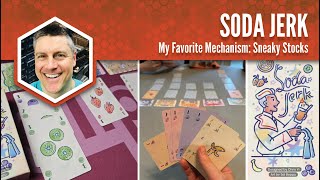
At its core, Soda Jerk centers on playing cards face-down to five flavor taps while managing hidden information. Players hold cards representing five different fruit flavors and each turn choose between placing a card face-down at a tap or revealing a card that's already been played. This mechanic creates a constant tension between executing your own strategy and gathering intelligence about what opponents have committed to the table. The decision to reveal rather than play is elegant: when you flip a card instead of playing, you don't spend a card from your hand, leaving you more options to score at round's end, but you sacrifice forward progress on your own position. Reviewers note that this forces players to constantly weigh the value of information against board development, making each turn thoughtful without becoming cumbersome.
Market Pricing and Commodity Manipulation
The second pillar is how card values are determined and manipulated. Each flavor's value depends on the net sum of cards played to its tap: matching flavor cards add to the value, while mismatches subtract. If the sum of Kiwi cards at the Kiwi tap equals three but there's one Orange card (worth negative one), each Kiwi card remaining in your hand is worth two points. This creates powerful incentives for players to mislead opponents about which flavors they're pursuing. Players can tank a flavor they know an opponent needs by playing off-suit cards to that tap, or boost their own flavor by playing high-value cards. As one reviewer notes, this is where "the jerk" element of the game's name truly shines: you can be sneaky, deliberately poisoning flavors for others while quietly building your own winning commodity.
The Soda Jerk Experience
Misdirection and Psychological Warfare
What emerges across gameplay descriptions is that Soda Jerk creates a remarkable psychological metagame around bluffing and misdirection. Early play focuses on literal information gathering, but as players grow familiar with the game, a layer of deliberate deception emerges. Players begin talking around the table, announcing false preferences ("I really love bananas") to bait opponents into flipping their cards or playing defensive cards to the wrong tap. The game supports escalating levels of psychological play: basic "I don't like this flavor" statements give way to deliberate misdirection, where players claim to love a flavor they actually want to sink. Reviewers describe households where play evolves into a meta-layer where players second-guess each other's intentions, trying to determine if an opponent is being honest or setting a trap. This psychological depth creates genuinely memorable moments and drives repeated play even among players who lose frequently.
Social Interaction and Kingmaking Potential
The game thrives on player interaction and creates rich opportunities for alliances and table dynamics. Because scores are visible, players often conspire mid-game to "sink the leader," pooling their cards to tank a frontrunner's key flavor. This can lead to kingmaking situations where the player who orchestrates the takedown isn't the ultimate winner. Reviewers note that this dynamic is not a flaw but a feature: the game embraces the chaos and messiness of direct player conflict. Some households lean into pure chaos, with players focusing more on preventing others from winning than on winning themselves. Others prefer a gentler approach, playing cards strategically for personal gain without sabotage. The game accommodates both playstyles equally well, making it flexible for different table cultures.
What Makes Soda Jerk Stand Out
Deceptive Simplicity in a Compact Package
Soda Jerk occupies a rare design space: it sits in the bottom 1 percent for rules overhead and bottom 10 percent for complexity, yet delivers genuinely strategic gameplay. The ruleset is so minimal that it can be taught in minutes, with only two choices per turn: place a card or flip a card. The scoring math is straightforward addition and subtraction. Yet reviewers consistently marvel at how this lightness of mechanics gives way to rich strategic layers once players understand the incentive structures. The tiny box format, part of Allplay's acclaimed line, enhances the charm and portability while the clear artwork makes cards easy to parse at a glance. Multiple reviewers describe Soda Jerk as their best lightweight game of 2025 precisely because it achieves rarity in game design: true accessibility without sacrificing depth.
Replayability and Flexibility in Social Context
The game's structure supports play across multiple table contexts. It works equally well as a quick cooldown game between heavier titles, as an ice-breaker early in game night, or as the main weeknight attraction. The fifteen-minute playtime means minimal commitment, and the interaction-driven nature ensures players remain engaged throughout. Reviewers note that they reach for Soda Jerk repeatedly precisely because the ratio of fun to play time is exceptional. The game also scales fluidly between competitive play, where winning matters, and purely social play, where the psychological jockeying becomes the real reward. Some players report playing Soda Jerk many times without ever winning, yet continuing to bring it to the table because the experience of being "jerks to each other" is the actual appeal.
Potential Drawbacks
Take-That Mechanics May Not Suit All Tables
The game's strength in player interaction becomes a drawback for tables that prefer cooperative play or individual optimization. Soda Jerk explicitly rewards sabotage and direct interference with opponents' plans, making it capable of creating frustration for players who dislike confrontational mechanics. Because flipping cards can reveal information and players can choose to repeatedly target the same opponent's strategy, the game can feel mean-spirited to players who value harmony at the table. The potential for kingmaking, where a player's sabotage helps someone else win rather than themselves, may frustrate competitive players who expect clear cause-and-effect between their play and their outcome.
Reliance on Table Metagame Over Pure Strategy
Soda Jerk's depth emerges from psychological play and misdirection, not from tight mathematical optimization. This means the game rewards reading opponents and bluffing skill as much as strategic planning. For players who prefer games where optimal play can be calculated or whose enjoyment depends on mastering a defined system, Soda Jerk's reliance on table talk and negotiation may feel insubstantial. The outcome of a round can pivot on table banter and social dynamics as much as card play, making results feel somewhat volatile or dependent on the group's engagement level. Players seeking games where individual skill determines the winner in a measurable way may find Soda Jerk's emphasis on collaborative chaos unsatisfying.
If You Enjoy Soda Jerk
Players who love Soda Jerk should explore Vegetable Stock and Batswana, both cited by reviewers as spiritual predecessors to Soda Jerk's commodity manipulation design. These games share the same DNA of price-shifting and player-driven market manipulation but in slightly different packages. Flip Tunes offers a complementary lightweight experience with a similar approachable teaching curve and surprising decision space. For those drawn to Soda Jerk's social deduction and bluffing layers, Tulip provides another stock game with sneaky hand management mechanics. All of these games deliver the mix of accessibility, interaction, and hidden information that make Soda Jerk special.
What Reviewers Are Saying
"The ratio of fun around the table to how slick the play is makes this one that will come out a lot as either a cooldown game, something to play early before folks get to game night or as a weeknight game. Super easy to teach and play, highly interactive around the table, and replayable."
— Board Game Animal
"It's the jerk part because my wife and I love being jerks to each other. And that dynamic, that psychological metagame of misdirection and sabotage is exactly what makes this tiny card game so special in my mind."
— Watch Review
"This is sneakily a sneaky stock game where you are trying to score the most points at the end of the round. I really like this sneakiness element. You can be sneaky, but you can also just use your turn to get information."
— Jamie, Stonemire Games