




















First Giants Deep Dive
What the Community Thinks About First Giants
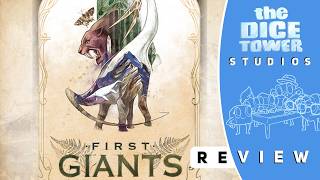
First Giants arrives as a fresh, streamlined take on competitive paleontology, a card game where players become paleontologists assembling the most prestigious exhibition of extinct dinosaurs and giant prehistoric mammals. Designed by J. Gilbert and published by Space Cowboys, it drew strong first impressions at industry showcases. The Cardboard Herald called it a standout of the Asmodee lineup, Tantrum House praised how easily it flows while still offering meaningful choices, and The Dice Tower folded it into their coverage of notable new releases. The consensus is a game that hits the table fast and rewards clever timing.
Core Mechanics That Define First Giants
Worker Placement and Token Recall
First Giants employs a streamlined worker placement system with two core actions. On your turn, you either place one of your tokens on a dig site where you have not already placed a token, or you recall all your tokens at once. When you recall, you gain amber, the game's currency, or the ability to move cards from your study into your display for points. This economy between exploration and consolidation creates meaningful tension, since you are constantly weighing whether to place tokens to access new cards or pull back to gather resources and start scoring. The architecture limits decision paralysis by reducing available dig sites as you place tokens, creating natural momentum.
Set Collection and Set Building
Your main scoring comes from building sets in your display. Cards carry both a number and a color, and you score by creating sets of the same number across different colors or runs of the same color across the numbers. A single card in isolation scores nothing, but once it connects with another card, you mark the junction with a display token. Completing a full set flips those tokens for significantly higher value. This creates two layers of reward: partial progress feeds points early, while completing entire sets generates outsized value, pushing toward satisfying payoffs for complete color runs.
The First Giants Experience
The Tension Between Collection and Exhibition
The game's most interesting dynamic emerges from a theme-mechanic union: cards you collect sit in your study where they generate powerful abilities, but those abilities vanish once you move them into your display for scoring. Cards grant immediate effects, persistent powers while face-up in your study, and conditional triggers like herd icons that activate whenever anyone collects a matching dinosaur. This creates compelling timing decisions. Do you hold a powerful card in your study longer to benefit from its abilities, or move it into your display to start building point-scoring sets? Reviewers highlighted this as the game's strategic core, where reading opponents and pivoting between available paths matters more than following a rigid plan.
Elegant Presentation and Thematic Clarity
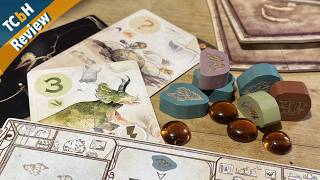
First Giants excels at making its mechanical layers feel natural. The watercolor fossil-journal aesthetic looks clean and sophisticated without demanding attention. Cards standing vertically represent your study, while rotated cards become your museum display, making the game state instantly visible. The amber components are glass, the dig-site artwork aligns across cards, and player tokens feature distinct shapes. The rulebook includes an icon reference and an appendix tying every card to actual prehistoric families. Reviewers found this combination made the game easy to teach and approachable for players spanning casual to hobby experience.
What Makes First Giants Stand Out
Quick Play and Meaningful Choices
First Giants completes in well under an hour, fitting nicely into the casual game-night slot. Despite its brevity, reviewers emphasized that choices feel consequential. You are not executing a predetermined strategy but reacting to card availability, player interaction, and the race for bonus tokens. The game also scales to five players while staying tight, addressing a real need in many collections. One reviewer noted this accessibility makes it an easy sell to non-gamers and dinosaur lovers, yet it delivers enough mechanical interest to satisfy players seeking more than randomness.
Shared Benefits and Player Interaction
First Giants turns the typical competitive dynamic on its head. Herd-icon cards provide beneficial effects to all players who hold them face-up, so when opponents draw those dinosaurs, you benefit too. Certain abilities activate only when another player takes a card of the same family, creating unexpected synergy. As reviewers pointed out, it is unusual for a competitive game to genuinely help opponents while advancing your own position, which removes spite-driven nastiness and creates a friendlier table.
Potential Drawbacks
Random Card Availability and Strategic Reliability
The shuffle determines which fossils appear at which dig sites, and reviewers observed that this randomness sometimes undermines deep strategy. You might need a specific card to complete a lucrative set, only to watch it surface at sites you have already occupied. The tension between where you have been and what you need creates occasional groan-worthy moments. The display does not offer enough reliability for players who want to lean hard into a single strategic path, and the game's light weight is partly an excuse for that. It means First Giants lacks the strategic density of heavier titles, which some players may find limits long-term appeal.
Amber Economy and Limited Pivots
Your only reliable source of amber comes from recalling workers, and recalling always gives the same fixed reward. One reviewer observed a tension here: you are sometimes forced to take cards simply to access the workers needed for future amber, ending up with cards whose abilities you never activate. The amber economy can feel tight once you account for the cost of flipping cards. A reviewer suggested that an extra amber path or a way to trade cards for resources would accelerate play and extend the engine-building. The game feels correct at its published length, but players craving more combo potential might imagine house rules for additional amber.
If You Enjoy First Giants
Reviewers compared First Giants to Elysium, an earlier co-design that serves as its spiritual predecessor, noting Elysium offered greater complexity, more card families, and richer combos across longer sessions. First Giants strips away that overhead for something faster, more flexible in player count, and more approachable, and reviewers expected to reach for it more often as a result. Fans of the stylized scientific-illustration look of Encyclopedia will appreciate its presentation, while players who love sub-hour set collection and worker placement where options naturally narrow will find a comfortable home. The game bridges dedicated hobbyists, who enjoy the timing and pivoting decisions, and casual players drawn to dinosaurs and elegant components.
What Reviewers Are Saying
"I first played it at PAX Unplugged at the Asmodee showcase where they were showing some of their lineup for the upcoming year, and both Eric and I walked away from that going like, wow, that game was really the standout there. It just flowed well, had great components, it made you want to play it, and there were lots of neat levers within the game."
— The Cardboard Herald
"I think the game flows really easily. You don't feel overloaded with a lot of rules going into the game, and you can take, I think, meaningful choices in the game, and sometimes you feel pretty clever as you're doing it."
— Tantrum House
"There's a little bit of that tension and strategy with the cards that you have collected and they're in your study and maybe they're working really well for combos, they're giving you points or triggering when things happen. How long do you keep them up there and when is the right time to bring them down?"
— Tantrum House