


Peacemakers: Horrors of War Deep Dive
What the Community Thinks About Peacemakers: Horrors of War
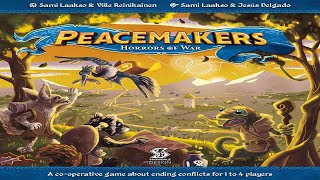
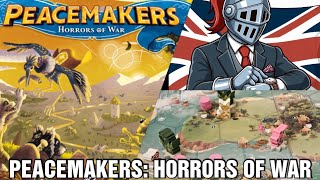
Peacemakers: Horrors of War, from Snowdale Design and designers Sami Laakso and Ville Reinikainen, draws a warm but not uncritical response. The premise is the headline: players are not soldiers but a band of animal adventurers trying to talk two warring armies down to a peace treaty. Allies Arena Enemies, who note that their copy was provided for review, call it genuinely different from most cooperative games. Rob's Tabletop World calls it a keeper and one of the channel's games of the year. Tabletop Tolson describes it as accessible and family friendly but still deep. The most reserved take comes from Chairman of the Board, who ranks it fifth of five recent plays and says the concept appeals more than the game itself, while stressing that cooperative games generally do not suit him. The Dungeon Dive covered a prototype sent by the designer ahead of the Gamefound campaign, so that impression reflects pre-release components.
Core Mechanics That Define Peacemakers: Horrors of War
Two Phases: Adventurers, Then Armies
Each round opens with the adventurer phase. Four resource cards are drawn no matter how many people are playing and shared out among the group, which Tantrum House notes can be divided however the table decides. Every card is multi-use. Its side icons let an adventurer survey an army's upcoming order, move across the hex map, fortify a space so the units there absorb damage, or delegate the card to a teammate. The bottom half holds a special action, such as food poisoning an enemy commander, with a stronger version for the matching adventurer. Many effects work only on something "nearby," which Board Games UnLocked and Tabletop Tolson both clarify means the same space.
The army phase follows. Each faction has two order decks; one card is flipped from each and combined. Their initiative values are added together, with a decimal to break ties, and the faster army acts first. The Dungeon Dive explains that factions behave almost like pre-programmed forces with their own tactics, so learning how each one moves and attacks is central to winning. Chairman of the Board singles out this initiative system as the highlight, praising how one army taking cover before the other strikes can blunt an attack.
Morale, Peace and Losing
Every faction has a morale track. Victory comes when both armies sit in the green peace zone at the end of a round. Push one side all the way to surrender, or let a commander die, and the players lose. Tabletop Tolson frames it as finding a sweet spot: calm both sides without breaking either one.
The Peacemakers: Horrors of War Experience
The Horror Deck
When units die, horror cards enter the adventurers' resource deck and clog future turns. Tantrum House describes being a hero of war as psychologically draining, with a card that can give an adventurer a mental block. Board Games UnLocked mentions horror cards such as "the shakes" and "self-doubt," and Allies Arena Enemies explain that some are one-off effects while others linger. Tabletop Tolson says the system recalls The Grizzled, another cooperative game about the toll of war. Allies Arena Enemies add that the theme is a bit dark and harrowing.
Pacing and Difficulty
Pacing is the most discussed trait. Allies Arena Enemies note that on some turns the right move is to play no cards at all. Chairman of the Board goes further: when the board already sits where it should, doing nothing is best, which makes the player feel like a true fly on the wall. The same review warns of lulls between rounds that demand real intervention and says it can sometimes feel like two automas fighting each other. Players who want constant agency should take that seriously.
Allies Arena Enemies report five or six plays with just one win, and that one came from getting a rule wrong; they have not won with the correct rules. They expect most groups to lose their first game. Board Games UnLocked describe a slow start until the rhythm clicks. Tabletop Tolson notes that the scenarios grow harder in order, so the opening scenario serves as a gentler entry.
What Makes Peacemakers: Horrors of War Stand Out
A Different Kind of Co-op
Allies Arena Enemies observe that roughly 80 percent of cooperative games feel like Pandemic, putting out fires in different places, and that Peacemakers breaks that mold. Tantrum House sees a Spirit Island feel in trying to stop an intruding force together. Chairman of the Board, despite reservations, calls it a fresh take on the genre.
Scenarios, Replay Value and Production
The box holds six scenarios, each with its own faction decks, horror deck and terrain, and the scenario books show maps and setup directly on the page. The Dungeon Dive lists four achievements per scenario: reaching peace, doing it with no casualties, and two custom goals. Allies Arena Enemies mention three difficulty levels per scenario, and Board Games UnLocked describe challenge variants such as shuffling horror cards in from the start. Rob's Tabletop World says the shuffled faction cards push replayability "through the roof." Board Games UnLocked wish there were more than six scenarios, plus a generic setup page for mixing factions freely.
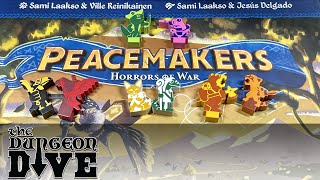
Praise for the components is consistent. Allies Arena Enemies highlight the figures, the map books and an insert with top-notch labeling. Tabletop Tolson calls the box clean, thoughtful and organized, with labels on the map showing where every unit goes. Rob's Tabletop World calls the rulebook "done to perfection." The factions include ocelots, scarlet macaws, a tuatara, spectacled bears, toucans, green iguanas and strawberry poison frogs. The Dungeon Dive, a fan of beast epics, adds that the book-based setup probably solves the long setup some players reported with Dawn of the Peacemakers, which this game replaces.
Potential Drawbacks
Player Count
Because only four cards come out per round, a four-player game can leave each person with one card. The Dungeon Dive doubts that four players would be fun and expects the game to shine solo or at two. Allies Arena Enemies and Board Games UnLocked also prefer one or two players.
Smaller Irritations
Allies Arena Enemies say the wound discs look like antacid tablets and must be moved along with the figures, and that figures sometimes hide map icons. They also point out that the adventurers are not the main characters; the armies are. Board Games UnLocked, who score it a 7 and an 8, call it a game for people who dislike war themes, which is a selling point for some and a mismatch for players seeking battlefield action.
If You Enjoy Peacemakers: Horrors of War
The Dungeon Dive points to Lands of Galzyr, a personal favorite set in the same world. Board Games UnLocked mention Snowdale's Dale of Merchants, where players simply pick factions and shuffle them together, and Rob's Tabletop World says the shared universe makes the Merchants game one to check out. Tabletop Tolson connects the horror cards to The Grizzled, and Tantrum House compares the cooperative defense to Spirit Island. Allies Arena Enemies use Pandemic as the contrast: fans who have tired of fire-fighting co-ops are the audience most likely to value what Peacemakers does differently.
What Reviewers Are Saying
"You're trying to stop war. You're trying to keep everybody from surrendering, but demoralizing everybody so they just go home. And I think that's brilliant."
— Rob's Tabletop World
"This is something that's actually different where you are these mediators mediating peace and it's just interesting that it is so different."
— Allies Arena Enemies
"just this world is so cool it's so evocative and pleasant to be in I love Beast epics like Watership Down and red wall and uh book of the done cow so this is kind of it thematically it's definitely in my wheelhouse"
— Daniel, The Dungeon Dive