









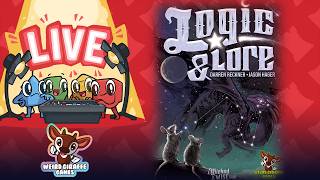

Logic & Lore Deep Dive
What the Community Thinks About Logic & Lore
Logic & Lore has emerged as a standout success in the modern board game landscape. The community consensus is overwhelmingly positive, with reviewers consistently praising it as an elegant, accessible entry point into deduction gaming. Weird Giraffe Games delivered something special with this two-player title. The game sold out its first print run within five months, and its rapid Kickstarter success for the second edition speaks to its reputation. Reviewers across different channels find common ground in their enthusiasm: the game feels like a premium experience despite its compact footprint, and it offers surprising depth for players seeking genuine strategic challenge alongside those looking for a quick, satisfying mind game.
Core Mechanics That Define Logic & Lore
Deduction Through Questioning
At the heart of Logic & Lore lies its deduction system, where players uncover hidden information by asking targeted questions about two face-down cards revealed each turn. The mechanic is beautifully simple: show your opponent two cards, ask a series of yes-or-no questions to determine the cards' values, and use the answers to narrow down which cards belong where in your 1-through-9 sequence. What elevates this beyond a basic guessing game is the escalating complexity available through different modes. In easier variants, all questions are available immediately. In harder modes, players must earn access to more nuanced questions by collecting dragon tokens. This scaling means the core deduction mechanic works equally well for casual players and competitive strategists.
Memory and Information Accumulation
Beneath the questioning lies a memory challenge: tracking what you have learned about your opponent's cards based on their answers and their earlier actions. Players must remember which cards their opponent has already revealed, what questions were asked, and what the answers revealed about card positions. This accumulation of information over a game creates a tug-of-war dynamic where both players know roughly how close their opponent is to victory. Reviewers note this creates genuine tension in the final turns. The addition of a number tracker and note tokens (included in the expansion materials) helps players manage this information load while preserving the mental workout of tracking patterns and logical deduction.
The Logic & Lore Experience
Tight, Competitive Tension
Logic & Lore delivers a racing experience wrapped in deduction clothing. Players feel the pressure to ask the right questions in the right order because they know their opponent is also racing toward alignment. Every turn matters. A single misstep in question sequencing can cost precious time, while a clever line of questioning can accelerate toward victory. This pressure transforms a logic puzzle into a race where strategy and speed coexist. Reviewers consistently mention how close games feel; it is common for the winner to complete their sequence just one turn ahead of their opponent. That proximity keeps both players engaged throughout.
Elegant Satisfaction and Strategic Depth
The satisfaction of correctly deducing your sequence comes wrapped in an experience that feels both clean and substantive. Reviewers use words like breezy, compact, and accessible to describe the feel of play, yet the game does not sacrifice depth. The expansion variants prove the designer understood how to layer complexity without losing the core elegance. There is a meditative quality to working through the logical chains, combined with the visceral thrill of declaring your sequence correct. Whether you are playing the gentle Starlight mode or wrestling with the probability calculations of Star Sprite, the game delivers a satisfying arc from uncertainty to confidence.
What Makes Logic & Lore Stand Out
Exceptional Accessibility with Scalable Depth
Few games manage to welcome newcomers while rewarding skill development as effectively as Logic & Lore does. The base game offers multiple difficulty modes that let experienced players compete against less experienced ones on different difficulty tiers within the same game, a design choice reviewers specifically praised. This is not a surface-level feature. It is core to the appeal: you can teach the game in five minutes to a partner, yet competitive players find room to optimize their question sequences and risk calculations. The expansion adds dice-driven variants that introduce probability without abandoning the deduction core.
Beautiful Design and Component Quality
Reviewers consistently highlight the craftsmanship. The card art evokes a celestial, astrological theme that reviewers find visually striking. The components feel premium despite the small box footprint: foil accents on the cards, thematic dragon and mouse meeples, and a well-organized layout that supports different game modes without creating table chaos. The playmat and number tracker add functional beauty. This is not gratuitous luxury but thoughtful design that makes the game a pleasure to look at and handle during play. Weird Giraffe's attention to aesthetic detail elevates the experience beyond mechanics alone.
Potential Drawbacks
Rules-to-Fun Ratio for Initial Learning
Reviewers note that Logic & Lore can feel heavy on explanation relative to playtime for first-time players, particularly if you are teaching all the mode options at once. The game is not difficult to learn, but there are enough moving parts (the dragon token economy, different question sets per mode, the number tracker usage) that a player fresh to deduction games might feel overwhelmed before the fun clicks. The solution is straightforward: start with Starlight mode and save the variants for once players have internalized the basics. Still, this pacing curve warrants mentioning for anyone accustomed to simpler rules-light experiences.
Two-Player Only Scope
Logic & Lore is locked to exactly two players with no partnership or team variants. This is not a weakness in design; it is an intentional focus. However, it means the game cannot fill the role of a group deduction experience. Reviewers who favor games that scale to larger player counts will find this limiting. The trade-off is worth it for the developers: the two-player exclusivity allows for the asymmetric information and head-to-head tension that defines the experience. Still, potential buyers should be aware this game will never become your go-to deduction title for a game night with four or more players.
If You Enjoy Logic & Lore
Players drawn to Logic & Lore tend to enjoy other compact deduction games that reward sharp thinking over luck. Planet X and Cryptids offer similar deduction mechanics at a larger scale and player count, though they trade the head-to-head intensity for group mystery-solving. That's So Clover shares the word-association and deductive reasoning bones but plays cooperatively with more players. All three are legitimate alternatives if you want deduction variety, but Logic & Lore's tight two-player format and elegant question economy give it a distinct niche. Fans of abstract strategy games like Santorini or 7 Wonders Duel will appreciate the puzzle-like depth, while those who value theme and art direction will find themselves drawn to Logic & Lore's celestial world-building.
What Reviewers Are Saying
"This is one of the coolest deduction games I have ever played. It is a two-player only. It has so many different ways you can play it."
— Weird Giraffe Games
"Logic and Lore is a fantastic game that has been at least fascinating, if not a full hit with pretty much everyone that I've shown it to."
— The Cardboard Herald
"Logic and lore, another one that I'm very happy about. Logic and lore has become like a sleeper hit for me. I've enjoyed playing it so much. My daughter enjoys playing it so much. I've introduced it to a bunch of friends."
— BoardGameCo