Game Info
Collection
Your Tier
Loading…
Mechanic profile
Not enough video data yet
Vibe profile
Not enough video data yet
Description
No description available.
Featured Videos

Ask a Rules Question
Images

GID0452977.jpg

GID0452977_thumb.jpg
All mentions
Browse transcript mentions, sentiments, pros/cons, mechanics, topics, quotes, and references.
Total mentions: 2
This page: 2
Sentiment:
pos 0 ·
mix 0 ·
neu 1 ·
neg 0
Showing 1–2 of 2
Video nfm24kRJdTw
Meeple University Rules Teach
video_pk 70492 · mention_pk 167501
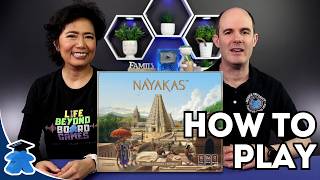
Pros
none
Cons
none
Thematic elements
none
Comparison games
none
Mechanics (from transcript analysis)
Mechanics unknown.
Video topics + discussion points
No key topics recorded for this video.
Quotes (from this video)
- On your turn, you will take a single action by placing one pawn from your supply, either a laborer or a diplomat, onto a valid action space and immediately resolving the effect.
- There are two main building resources, stone and clay, as well as gold, which can be spent as either stone or clay for any action.
- Nayakas plays in rounds, and you can carry over resources between rounds, but your artisans reset to zero at the end of each round.
- Choose a starting first player who takes the conch, and you're now ready to play.
- The game can end in one of two ways: either at the end of the ninth round after the third event has been resolved and scored, or at the end of the round in which the building marker reaches or passes the player count position on this track.
References (from this video)
No references stored for this video.
Video nfm24kRJdTw
Meeple University Rules Teach at 0:00 sentiment: neutral
video_pk 70492 · mention_pk 204747
Click to watch at 0:00 · YouTube ↗
Overall sentiment (raw)
neutral
Pros
- Asymmetrical kingdoms with distinct homeland mechanics and temple progression
- Rich action economy across homeland, borderlands, empire with culture and diplomacy dynamics
- Depth of end-game scoring through temples, buildings, events, and prosperity tokens
Cons
- Complex rule set with many interacting systems and spatial constraints (homelands, borderlands, empire spaces, temples, and events)
- Potential for long playtime due to round structure and multiple tracks
Thematic elements
- Array
- 16th century Southern India, Vijayanagara Empire after the Battle of Talikota
- instructional
Comparison games
none
Mechanics (from transcript analysis)
- Asymmetric Player Powers — Each player has a unique homeland with special actions and temple progression, creating asymmetry in capabilities.
- Asymmetrical Player Powers/Setup — Each player has a unique homeland with special actions and temple progression, creating asymmetry in capabilities.
- Building/Construction — Spend resources to construct buildings and acquire market/temple tiles that grant ongoing or end-of-game benefits.
- Conch-based Turn Order and Tiebreakers — The conch determines the starting player and the tiebreaker in culture and other comparisons.
- Event Tokens and Trading Posts — Events tokens are earned and placed; the board evolves over time, affecting scoring and strategy.
- Resource Management — Track multiple resource types (stone, clay, gold, culture) with set caps; resources carry over between rounds but can be spent to take actions.
- Temple Market and Market Tiles — Use temple market and market tiles to gain benefits and influence end-game scoring.
- Worker Placement — Players place laborers or diplomats on action spaces to gain resources, artisans, or other effects.
Video topics + discussion points
No key topics recorded for this video.
Quotes (from this video)
- On your turn, you will take a single action by placing one pawn from your supply, either a laborer or a diplomat, onto a valid action space and immediately resolving the effect.
- There are two main building resources, stone and clay, as well as gold, which can be spent as either stone or clay for any action.
- Nayakas plays in rounds, and you can carry over resources between rounds, but your artisans reset to zero at the end of each round.
- Choose a starting first player who takes the conch, and you're now ready to play.
- The game can end in one of two ways: either at the end of the ninth round after the third event has been resolved and scored, or at the end of the round in which the building marker reaches or passes the player count position on this track.
References (from this video)
No references stored for this video.
Transcript Navigation
Showing 1–2 of 2