/pic8768219.jpg)
Displeased with his subordinates and facing the difficult task of deciding which vampire will be his right-hand ally, Dracula decides to summon the most influential vampires to Transylvania and propose a competition in which, for three days, they must compete to determine who is the most powerful vampire, after Dracula, of course! But they must be cautious, as Van Helsing is in the region.
The game accommodates 1 to 6 players, with each player controlling a vampire. Over three days, they traverse the map of Transylvania, taking actions based on the location and the time of day. Terrorize lesser creatures, engage in a power struggle with other vampires, and prove your devotion to the legendary Dracula.
[Solo Mode]
Has eternal life made you lazier?
With multiple difficulty levels and extra cards, prove your worth to Dracula while being hunted by Van Helsing and his allies.
—description from the publisher


Images



- Ambition, power, feeding, and undead minions
- A vampire-themed world with a map and day/night cycle
- Competitive, tongue-in-cheek vampire intrigue
Mechanics (from transcript analysis)
- Area Movement — Players move their vampires across the map on their turn.
- Card play / horror cards — Horror cards and other cards affect players or defenses.
- Chase / attacker mechanic — Vampire hunter Van Helsing chases the highest-influence player, blocks locations, and affects the game.
- Final scoring — Final scoring costs fear you hold and determines the winner.
- High table phase — Noon: players exchange resources in a strategic order for power.
- Hiring / minions — Hire pupils for extra abilities and summon minions with limited capabilities.
- Hunting targets — Hunt prey such as villagers, nobles, and religious prey.
- Location actions — Each location provides resources or actions when visited.
- Movement on a map — Players move their vampires across the map on their turn.
- Resource Management — Collect resources like blood, influence, money, etc.
- Timing / day-night cycle — Map flips between night and day, changing actions and when scoring occurs.
Video topics + discussion points
Quotes (from this video)
- That's Vamp Order, a game of movement, hunting, card play, timing for one to six players.
- Sink your teeth into it on crowdfunding, and do check out our how-to play video on YouTube.
- The map keeps flipping from night to day row by row, which changes what locations do and when the big scoring phase kicks in.
- I love it when I combine business with pleasure at the cost of everyone's safety.
- Love that.
References (from this video)
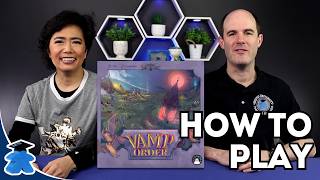
Mechanics (from transcript analysis)
Video topics + discussion points
Quotes (from this video)
- The game resolves in 20 rounds, and each round has five main phases.
- This is a mini game in its own right, as players need to position themselves tactically while they make these exchanges in order to make the most of it, and not be left holding resources they can't exchange.
- High table plays in clockwise turns beginning with whoever has the most influence with ties broken by current turn order.
- If you're unable to make one of these moves legally or if you choose not to then you must lie your meeple down in place making it inactive.
References (from this video)
- Vampire court intrigue to impress Dracula as his right-hand vampire
- Transylvania
- instructional/tutorial
Mechanics (from transcript analysis)
- Area Movement — Locations offer primary and/or shared action spaces; actions may differ between day and night; occupancy rules apply for spaces.
- combat and resolution — Horror cards can target locations; attackers pay dark blood; defenses can block; expulsion can force opponents from a space; the High Table phase includes combat-like exchanges.
- Dusk / Dawn and Noon / Midnight — Sun direction is tracked and rows are flipped; noon and midnight trigger specific scoring and effects on the board.
- High table phase — Occurs after rounds 4, 12, and 20; players bid to move or play horrors and gain power; privacy screens keep most resources hidden.
- horror cards — Horror cards (advance, attack, defense) are played from hand to target locations; dark blood is spent to reach destinations; defense cards block attacks; played horror cards are placed face down unless fully blocked.
- Hunting and prey — Hunting uses villagers, nobles, and religious prey from the prey deck; rewards vary by type and by day/night; religious prey may yield special rewards from the lower half of the card.
- Location actions and spaces — Locations offer primary and/or shared action spaces; actions may differ between day and night; occupancy rules apply for spaces.
- minions — Pupils can be recruited as minions; minions can be activated or moved and take actions; minions can be killed by Van Helsing; there is a minion phase later in the round.
- Movement — Vampire meeples move orthogonally; first steps may be free depending on player count; after free moves, further movement costs red blood and vigor; must finish in a location with a valid action space; Van Helsing can block movement.
- Phases and rounds — The game resolves in 20 rounds; each round has five phases: movement, actions, minions, Van Helsing, and dusk or dawn; noon/midnight scoring occurs during intermediate phases.
- Power and scoring — Power is gained at the High Table and during intermediate scoring; fear reduces power points at the end; players aim to maximize power to win.
- Resource Management — Eight resource types exist (money, red blood, dark blood, blue blood, vigor, perversion, influence, fear, letters of permission, pastoral rings, Dracula's favor, minions); Black Market trades and cemetery interactions affect exchanges and costs.
- Resource market / exchanges — Eight resource types exist (money, red blood, dark blood, blue blood, vigor, perversion, influence, fear, letters of permission, pastoral rings, Dracula's favor, minions); Black Market trades and cemetery interactions affect exchanges and costs.
- Variable Phase Order — The game resolves in 20 rounds; each round has five phases: movement, actions, minions, Van Helsing, and dusk or dawn; noon/midnight scoring occurs during intermediate phases.
Video topics + discussion points
Quotes (from this video)
- The game resolves in 20 rounds, and each round has five main phases.
- This is a mini game in its own right, as players need to position themselves tactically while they make these exchanges in order to make the most of it, and not be left holding resources they can't exchange.
- High table plays in clockwise turns beginning with whoever has the most influence with ties broken by current turn order.
- If you're unable to make one of these moves legally or if you choose not to then you must lie your meeple down in place making it inactive.