/pic6368858.png)
The Cave of Ederoth is home to the most dangerous monsters and dragons anyone has ever seen. But with such danger, the rewards must be even greater! Rumors have spread of artifacts and gold in vast quantities, and mysterious stones that possess unlimited energy: Shadow Stones. The kingdoms of many different realms have sent their best champions to claim the wealth of Ederoth for their own, but only one may emerge victorious.
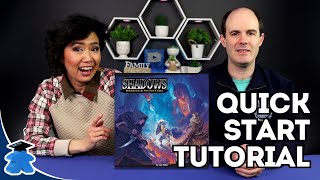
Shadows: Heroes & Monsters is a competitive Hybrid Collectible Card Game for two to three players, set in a fantasy world where a portal brings together different ages, technologies, items, magic, and species in a fierce battle for riches and glory! Each player takes control of a hero, each with their own agendas, to hunt monsters and battle other player’s heroes. If a player plays their cards well, their hero will gain experience and gold, empowering their own abilities and earn more of the powerful Shadow Stones. Whoever earns the most Stones wins!
—description from the publisher

Images


Mechanics (from transcript analysis)
Video topics + discussion points
Quotes (from this video)
- and that's our quick start tutorial for Shadows Heroes and monsters
References (from this video)
- artifacts, gold, Shadow Stones; heroes battle monsters
- the cave of etero
- fantasy dungeon-crawl with deck-building and combat
Mechanics (from transcript analysis)
- Bounties and rewards — Knocking down opponents yields rewards; bounties increase the gold reward for the next player to knock you down.
- Buildup and item/library purchases — In buildup, players buy items with gold and may purchase from their library to improve their deck; purchasing cards grants Shadow Stones and advances progression.
- Combat and responses — During combat, players attack monsters or opponents and opponents can respond with blocks or other effects; damage and special abilities resolve according to initiative and card text.
- Combat: Damage Based — Damage reduces health; shields mitigate damage; being knocked down penalizes resources and health, with recovery mechanics.
- Damage, health, shields, and knockdowns — Damage reduces health; shields mitigate damage; being knocked down penalizes resources and health, with recovery mechanics.
- Deck Building — Players build up a deck of skills, spells, and creature cards and upgrade their standard hero deck using neutral skill cards and library purchases.
- deck-building — Players build up a deck of skills, spells, and creature cards and upgrade their standard hero deck using neutral skill cards and library purchases.
- End Game Bonuses — The game ends after three monsters are defeated or nine Shadow Stones are gathered.
- end of game conditions — The game ends after three monsters are defeated or nine Shadow Stones are gathered.
- Keywords and card interactions — Cards have keywords that determine resolution and trigger interactions with other cards.
- Leader-driven actions and initiative — The leader assigns goals or experience, draws monster action cards, and passes cards to players; combat proceeds in initiative steps with sequential resolution.
- Market, upkeep, and refresh phases — The game includes a market for items, upkeep actions, and a refresh phase to refill markets and reveal new monsters when applicable.
- Predict — Players can predict an opponent's card in a given initiative; a correct guess yields a positive or negative effect for the predictor, and the same prediction cannot be repeated in the round.
- Predictive Bid — Players can predict an opponent's card in a given initiative; a correct guess yields a positive or negative effect for the predictor, and the same prediction cannot be repeated in the round.
- Resource Management — Players optimize resource generation (gold, experience) to enable playing stronger cards and acquiring Shadow Stones.
- Resource management and deck economy — Players optimize resource generation (gold, experience) to enable playing stronger cards and acquiring Shadow Stones.
- Shadow Stones and scoring — Shadow Stones are earned during buildup and used to determine the end of the game; nine stones are a win condition, and the player with the most stones wins (with tie-breakers by items and experience).
- Six-phase round structure — Each round consists of six phases: team up, plan, combat, buildup, initiative, and cleanup/refresh, with actions divided among leader and players.
- Variable Phase Order — Each round consists of six phases: team up, plan, combat, buildup, initiative, and cleanup/refresh, with actions divided among leader and players.
Video topics + discussion points
Quotes (from this video)
- and that's our quick start tutorial for Shadows Heroes and monsters