



Rogue Dungeon Deep Dive
What the Community Thinks About Rogue Dungeon
Rogue Dungeon has earned its place among solo gaming enthusiasts as one of the most beloved small-box dungeon crawlers available. Reviewers consistently praise its ability to pack a massive dungeon crawl experience into a compact package, with multiple players ranking it within their top games overall. The consensus is clear: despite its modest physical footprint, Rogue Dungeon delivers the depth, replayability, and thematic satisfaction that normally comes with sprawling, table-consuming adventures. What makes this particularly remarkable is how the game achieves this without sacrificing accessibility or play time, making it equally appealing to newcomers and veterans of the dungeon crawling genre.
Core Mechanics That Define Rogue Dungeon
Hand Management and Character Progression
At its heart, Rogue Dungeon combines hand management with experience-driven character growth. Players acquire equipment cards and manage their hero's resources as they push deeper into a five-level dungeon, building up stats and abilities along the way. Each card drawn represents a choice: engage the monster or monster encounter, interact with a trader, rest at a shrine, or face a trap. The game's elegant design means players can feel the weight of their decisions without complex calculations. With seven distinct heroes to choose from, each bringing different starting stats and abilities, characters feel meaningfully different in both mechanics and playstyle. This variety means that learning which hero suits your approach becomes part of the ongoing challenge.
The Map as a Strategic Tool
Unlike many card-driven dungeon crawls that feel linear, Rogue Dungeon uses a functional dungeon map that grants genuine agency. Players choose which rooms to visit and in what order they descend, creating natural pressure between risk and resource management. This system elegantly solves a design problem: without map-based progression, dungeon layouts become meaningless decoration or lead to wildly divergent power curves. By distributing different card types across specific rooms on each level, the game ensures players can adjust their strategy based on their current strength and needs. Want to grind experience before facing a dangerous encounter? The map lets you plan that approach. Need healing urgently? You might gamble on finding a shrine rather than grinding through combat. This spatial element transforms Rogue Dungeon from a pure card game into a satisfying dungeon crawl simulator.
The Rogue Dungeon Experience
Portable Solo Immersion
One of Rogue Dungeon's greatest strengths is its accessibility as a solo experience without the usual sacrifices. Setup requires minutes, not hours. Play time averages one to two hours for a full run, making it easy to fit into constrained schedules. The game teaches quickly and plays quickly, yet never feels rushed or shallow. Players can complete multiple runs in a single session, creating natural opportunities to experiment with different heroes or refine strategies. This makes Rogue Dungeon ideal for travel, small tables, or anyone seeking meaningful solo play without the overhead of larger campaign games. The modest box and manageable component count mean the game doesn't demand the dedicated table real estate that many dungeon crawlers require.
Escalating Challenge and Roguelike Tension
Rogue Dungeon captures the spirit of classic roguelike games through its one-shot structure and punishing difficulty curve. There is no saving, no reloads, no campaign carry-over. You descend into a randomly generated dungeon, make your tactical decisions, and either triumph or perish. This approach creates genuine tension with each card draw and each monster encounter. The game aims for a roughly 30 percent win rate, making victory feel earned rather than inevitable. Yet the difficulty never feels unfair. Well-informed choices and smart resource management can stack the odds in your favor, but random layout and monster draws ensure no two runs feel identical. This balance keeps players returning, each defeat teaching a lesson and each victory feeling significant.
What Makes Rogue Dungeon Stand Out
Clever Component Economy and Big Impact From Small Design
The game's greatest design achievement is how much it accomplishes with minimal components. Despite fitting into a small box with card decks for monsters, traders, traps, and special encounters, Rogue Dungeon does not feel constrained or repetitive. Reviewers note that players forget they are playing a compact card game once play begins. The map provides context for encounters, the hero card tracks meaningful progression, and the encounter variety keeps players discovering new tactical situations. This clever economy of design shows in every system. Heroes are simple to track yet mechanically distinct. Combat resolution uses straightforward dice and cards yet remains tense. The whole experience proves that complexity and depth come not from component count but from how those components interact.
Strong Thematic Execution Despite Aesthetic Inconsistency
Reviewers highlight that Rogue Dungeon's core strength lies in how its mechanics serve the theme of a desperate solo delve into a dangerous dungeon. The permadeath structure, random room layout, escalating power curve, and equipment-driven progression all reinforce the fantasy of a lone adventurer growing stronger as they descend. The game feels like a traditional dungeon crawl despite its card-based nature. However, reviewers consistently note that the visual presentation does not match the thematic ambition. Artwork feels inconsistent, with varying styles and tones across different card sets. Component presentation lacks the polished aesthetic that would elevate the overall experience. This gap between mechanical excellence and visual cohesion is the game's primary weakness. Several reviewers express hope for a second edition that would provide a unified artistic vision without changing the elegant systems that make the game special.
Potential Drawbacks
Limited Visual Variety and Aesthetic Presentation
The game's greatest limitation is its inconsistent art direction and visual presentation. Cards feature varying illustration styles and quality levels, and the overall component design feels less polished than comparable dungeon crawlers. While this does not diminish the gameplay, it impacts table appeal and first impressions. Players encountering Rogue Dungeon for the first time may underestimate its depth based on component presentation alone. The game does not inspire the same immediate aesthetic appeal as higher-budget productions, which means it requires players to look past the surface to discover its mechanical excellence.
Encounter Variety Within a Single Box
While the base game offers respectable variety within its random generation system, extended play reveals a natural repetition ceiling. A single base set contains a finite pool of monsters, traders, and encounters. Experienced players eventually see all available cards and must choose whether that repetition constitutes replayability or staleness. The game benefits from expansion content to stretch the variety pool and maintain fresh discoveries. This is by design rather than oversight, but represents an additional investment for players seeking long-term freshness. Some reviewers note that while the core experience remains engaging even with card familiarity, the thrill of discovering new encounters diminishes over time without new content.
If You Enjoy Rogue Dungeon
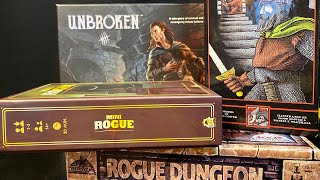
Players who love Rogue Dungeon often appreciate compact solo experiences with meaningful decision-making, such as Unbroken or Mini Rogue. HeroQuest delivers a similar dungeon crawl spirit with lighter rules. For those seeking more expansive exploration, Iron Helm offers a card-based dungeon experience with modular flexibility, while Tangled Deep provides a roguelike video game adaptation of dungeon crawling mechanics. The core appeal Rogue Dungeon shares with these games is the marriage of limited resources, escalating challenge, and character growth, each reinforcing the fantasy of a desperate hero fighting through overwhelming odds to victory.
What Reviewers Are Saying
"this game i think does a very good job of simulating a large box dungeon crawl"
— Dungeon Dive
"for just a purely card based dungeon crawl rogue dungeon feels it has the feeling of a big dungeon crawl and it is an excellent roguelike experience"
— The Dungeon Dive
"as long time viewers of the dungeon dive know this is one of my favorite uh solo only games I absolutely love Rogue dungeon"
— Dungeon Dive