











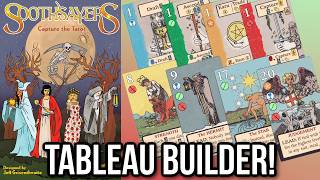
Soothsayers Deep Dive
What the Community Thinks About Soothsayers
Reviewers who got Soothsayers to the table came away enthusiastic about its lead-and-follow structure and the tension of chasing fate tokens that keep changing hands. The Dice Tower scored the game an eight out of ten and worried it was clever enough to "fly under the radar." TheGameBoyGeek called it an excellent design that "has tons of depth" despite a simple ruleset, and Rolling Dice & Taking Names gave it two thumbs up for its art and its player interaction. The Brothers Murph placed it among the releases they were most excited about so far in the year, saying it was a game they had not heard of until it was suddenly out and turned out to be "really good" and something that "should be celebrated." People University folded it into their regular rotation and called it "a really fun engine building" game.
Where reviewers split was over the tarot theming itself. Rolling Dice & Taking Names loved the "really clever art" and its old tarot styling, and The Brothers Murph called the look cool, but The Dice Tower found the presentation "a little bit drab" next to other tarot decks and admitted the theme "doesn't do anything" for one host personally, while TheGameBoyGeek said the look "looks like the game's kind of from the early 90s" and was upfront that dislike of tarot cards is a personal taste rather than a design flaw. Player count preference split as well: People University plays Soothsayers almost exclusively as a two-player duel and said the directness of that head-to-head "works best" for them, while Rolling Dice & Taking Names felt the two-player game mostly amounted to players trying to "slap each other in the face" and preferred it with three to five people, where the back-and-forth had more room to develop.
Core Mechanics That Define Soothsayers
Lead-and-Follow Action Economy
On a turn, the active player holds the crystal ball and chooses one of four actions printed on their cards: earn or trade, draft, ascend, or capture. Reviewers described the leader resolving the stronger half of the chosen card, after which every other player in turn order may follow the same action for a smaller effect. TheGameBoyGeek laid out the cost clearly: following is free if a player's card in that suit is at an equal or higher level than the leader's, but if it is lower, the follower has to pay coins equal to the difference in levels to join in. Anyone who cannot or does not want to pay simply passes and takes the small fallback reward printed on the bottom of their own card, which keeps every player weighing a decision on every turn rather than waiting for their own.
Ascending Cards and Capturing Tarot
Ascend and capture are how the engine grows. Ascending moves one of the four action cards up a level, either to the next number in sequence for free or by paying coins to skip a level, and reviewers explained that holding the single highest level in a suit awards a fate token that gets stolen the moment someone else ascends past it. Capture works on the tarot cards instead: TheGameBoyGeek described paying for a tarot card by discarding common cards whose printed values add up to its cost and covering any remainder in coins, after which the card slots into one of its matching suit columns and grants powers that trigger on future leads, follows, or passes. Whoever holds the highest tarot card in a column claims the fate sitting there, and a rival can take it right back the same way.
The Soothsayers Experience
A Race Where the Lead Keeps Changing Hands
Because most fate tokens can be stolen the instant a rival tops a player's level, reviewers described matches as a constant swing of momentum. The Dice Tower said the game "definitely has wild swings back and forth" while still feeling "very easy to track" since the contested fate sits in plain view on the table, noting that a player who looks dominant "two rounds later" could be in a completely different spot. Rolling Dice & Taking Names described the tug of war as feeling like "crabs in a bucket," with the table constantly asking whether anyone could ascend just high enough to pull a fate token away from whoever was closest to winning.
Simple to Teach, Yet Surprisingly Deep
Despite only four action types, reviewers kept describing hidden depth underneath the simple structure. TheGameBoyGeek called it "sort of a simple tableau builder" that nonetheless "has tons of depth," crediting the follow mechanism with eliminating downtime because every player has something to weigh on every turn, whether or not it is their lead. Rolling Dice & Taking Names agreed the rules were light enough to teach to anybody, while still leaving room for the kind of pressure where protecting a lead in one suit means giving up cards that could help build another.
What Makes Soothsayers Stand Out
Two Interchangeable Tarot Decks
Soothsayers ships with two full sets of tarot cards that can be mixed, matched, or swapped between plays. The Dice Tower called this element "citadelsesque," praising how wanting a card that someone else holds, and them wanting one a player holds, kept every power feeling important without the game growing stale, and credited the two decks with giving the box real replayability. TheGameBoyGeek made a similar point, enjoying the flexibility of using either set and noting that the powerful late-game tarot cards "all seem a little bit broken," in a way that felt intentional because every card gets to be that strong.
Interaction That Stays Sharp Without Feeling Mean
Multiple reviewers singled out how the constant stealing avoided feeling personal. The Dice Tower explained that taking a fate token from an opponent is "not quite as directed" as it sounds, since the target is whoever happens to be sitting on the token a player needs rather than a chosen rival, summing it up as "grabbing the ball you happen to have." TheGameBoyGeek added that the interaction is spread evenly enough that "it's not like one person ever gets sort of picked on more than others," which kept the tug of war over fate tokens from souring the table.
Potential Drawbacks
A Theme That Not Everyone Connects With
The strongest point of friction reviewers raised was the tarot presentation itself. The Dice Tower said the cover "looks like a much older game than it is" and that the art felt "a little bit drab" next to other tarot decks, and one host admitted the theme "doesn't do anything" for them personally. TheGameBoyGeek raised the same concern from a different angle, saying the look "looks like the game's kind of from the early 90s" and calling dislike of it "completely subjective" rather than a flaw in how the game plays. Both reviews still rated the game highly, treating the art as a matter of taste rather than a problem with the design.
Rules Gaps and Late-Game Bookkeeping
TheGameBoyGeek ran into a genuine rules problem in a five-player game: without a clear end trigger, the table cycled through the shared decks with the game showing no sign of stopping, and only afterward learned the designer had just posted a fix requiring the match to end once the common deck gets reshuffled twice. The same review noted the tarot market can get "a little stagnant" when leftover cards nobody wants to spend fate on sit unclaimed, and that the common card supply can run short in five-player games as players hoard cards to pay for a specific capture later. People University raised a different scaling concern, saying lead-and-follow games "do not lend themselves that well" to four-player play on Board Game Arena, since three players end up performing "tiny versions" of the leader's action each turn.
If You Enjoy Soothsayers
Reviewers who compared Soothsayers to other games reached for titles with a similar push and pull. The Dice Tower brought up Cosmic Encounter to describe the chaotic-but-structured feel of constant attacks and shifting control, and separately called the two-deck tarot system "citadelsesque," pointing to Citadels as a touchstone for how the card powers stay fresh across plays. Rolling Dice & Taking Names was drawn to Soothsayers specifically because of its lead-and-follow action economy, comparing it directly to one of the hosts' favorite games, Puerto Rico. TheGameBoyGeek came in already a fan of the same designer's earlier releases, Positano and Out Fox the Fox, and found Soothsayers held up alongside them.
What Reviewers Are Saying
"It's super clever. It's a game that really I think might fly under the radar and I kind of hope it doesn't. Look, it's out there, folks. If this looks interesting to you, you really should try it out because I think that it does feel unique."
— The Dice Tower
"First, this is sort of a simple tableau builder, but it has tons of depth. There's only four different actions you can really do on your turn. But with that, there's a lot of things to think about."
— TheGameBoyGeek - Hi Quality Hi Energy Board Game Reviews
"We enjoy this one most as a two-player game in person, and we have played it most as a two-player game on BGA. And I would probably only recommend that because it is a lead and follow game."
— People University