






Wombat Poo Deep Dive
What the Community Thinks About Wombat Poo
Wombat Poo arrives with clear intentions: it's a family-friendly dexterity game that celebrates the natural oddity of wombat biology through a stacking tower mechanic. The community response is polarized. Reviewers who appreciate the game's accessible design and whimsical theme see it as a solid introduction to push-your-luck gameplay for younger players. Others, particularly those evaluating it through a more competitive lens, find the experience limited by its reliance on other players' physical skill rather than player agency. The Going Analog team noted the game is accessible and quick, while Grant Lyon emphasized its lighthearted appeal across age groups. The Dice Tower's Chris Yee and Wendy Yee were more critical, with their scores reflecting skepticism about its strategic depth and mechanics. The divergence largely reflects whether reviewers see the game on its own merits as a family game, or expect it to compete with more robust stacking alternatives.
Core Mechanics That Define Wombat Poo
Push-Your-Luck Stacking
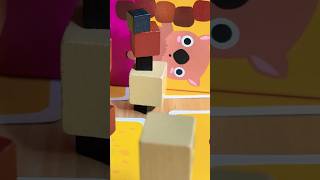
Each turn, a player must decide whether to "poo" (add another cube to the teetering tower) or "wipe" (cash out and score points). The cubes come in three different sizes, requiring players to balance them as the tower grows increasingly unstable. If a player knocks over the tower on their turn, they score nothing. Everyone else wins points equal to the number of cubes that were stacked. This creates a tension between greed and caution: do you take the guaranteed points and let the next player risk the tower, or attempt to build it higher and claim more points before the inevitable tumble? Designers at Joey Games framed this as a dexterity mechanic where physical skill matters, though reviewers noted this introduces a variable that traditional push-your-luck games control through randomness.
Thematic Cube Components
The cubes themselves are the game's most distinctive feature. They represent wombat feces, and the designers committed fully to the concept. Different sizes mirror the variety in nature, and the wooden components feel tactile in hand. While reviewers appreciated the biological accuracy and playful theme, some noted that beyond the thematic appeal, the cubes are "just cubes": simple geometric shapes that don't add mechanical variety beyond their physical dimensions. The theme carries the experience more than the component design itself.
The Wombat Poo Experience
Lighthearted, Silly Fun
Wombat Poo leans into absurdist humor. The terminology alone (choosing between "poo" and "wipe" each turn) keeps the tone playful and embarrassing in the best way. Children find this hilarious; adults tend to find it charming rather than laugh-out-loud funny. The game broadcasts its intentions clearly: this is a goofy, quick filler that doesn't pretend to be anything else. The Australian nature angle adds cultural flavor, celebrating wombats as peculiar marsupials whose cubed droppings serve as the game's central conceit. Reviewers uniformly acknowledged the theme works, and the silliness serves as the primary draw for families or casual gatherings.
Tension and Risk
There is genuine tension in watching a tower grow unstable, knowing your turn is coming. The stakes feel real because the tower physically exists in front of you, teetering with each new cube. However, reviewers pointed out that this tension is complicated by a factor outside player control: whether the person stacking can physically manage the task without dropping pieces. This differs from dice rolls or card draws, which are purely random. The Dice Tower's Chris Yee articulated frustration with this: you're betting on someone else's fine motor skills, not on random chance or your own decisions.
What Makes Wombat Poo Stand Out
Accessible Entry Point to Dexterity Gaming
The game succeeds as an introduction to physical gameplay for children ages six and up. Rules are trivial to teach, and a new player can join mid-game without penalty. Grant Lyon noted it's playable with "all ages," and the Dice Tower reviewers confirmed it works as a light filler where anyone can hop in and take a turn. This accessibility is genuine: no special knowledge, no hidden information, no rule lawyering. You flip a card that says "poo" or "wipe," and you know exactly what happens next. Families lacking board game experience find this approachability valuable.
Biological Authenticity in Theme
Few games commit to scientific accuracy in their humor. Wombat Poo does. The cubes are inspired by real wombat droppings, which are indeed roughly cubic in shape and serve a territorial marking function. Reviewers noted this genuine fact grounding makes the theme land better than it would if it were pure fiction. The game educates while entertaining, which matters for games marketed to families exploring the natural world together.
Potential Drawbacks
Luck Dependent on Other Players' Dexterity Rather Than Randomness
The most consistent criticism from serious gamers centers on how push-your-luck works in Wombat Poo. Traditional push-your-luck games isolate player risk through dice rolls or card draws. Here, whether the tower falls depends on whether the player stacking can physically keep it upright. As Chris Yee put it, their push-your-luck calculation hinged on "whether or not six-year-old Chris is going to knock down the tower," meaning their own ability to control the outcome was limited. This creates a mismatch: you're pushed to take risks (by the scoring incentives), but you're not the one managing the physical risk. This variable frustrates experienced players who expect pure randomness or pure skill tests, not a hybrid they can't reliably evaluate.
Minimal Strategic Depth and Repetitive Gameplay Loop
Reviewers noted the game offers few meaningful decisions beyond "poo or wipe." Once you understand the scoring track and pot size, the strategic choice becomes mechanical. Wendy Yee summarized it bluntly: the game is simply "stacking blocks and hoping" it survives until your next turn. Component variety (the three cube sizes) was mentioned as basic compared to other stacking games like Animal Upon Animal, which uses varied shapes that teach gravity and balance through geometric complexity. Wombat Poo's cube-only approach, while thematically justified, offers less mechanical learning and less reason to replay once the novelty of the theme has worn off. For players seeking depth or teaching moments, the game falls short.
If You Enjoy Wombat Poo
Players drawn to Wombat Poo's lighthearted dexterity will find similar satisfaction in Animal Upon Animal, which offers the same stacking-tower mechanic with more varied piece shapes and deeper physical puzzle-solving. The comparison was explicit among reviewers, who noted Animal Upon Animal's educational value and strategic richness. Those who enjoy the push-your-luck aspect and the silly theme without demanding complex strategy might also explore Cats Knocking Things Off Ledges, another physical dexterity game with a similarly whimsical tone and comparable strategic weight. For families specifically seeking quick, accessible games with humor and low rules burden, Overcooked-inspired games offer similar cooperative chaos (though Overcooked itself is a video game). Finally, if the accessible, anyone-can-join nature appeals to you, filler games that maintain that grab-and-play quality while adding slightly more mechanical meat, such as quick push-your-luck titles from other designers, provide incremental depth without losing the party-game ease.
What Reviewers Are Saying
"It's a light Australian game. I love it."
— Watch Review
"You are going to be stacking different size cubes and you're pushing your luck. Do you pull out and score the points right then or do you try to stack more and more and earn more points potentially if the tower doesn't fall?"
— Grant Lyon
"My biggest struggle with this particular game is that when I push my luck in a push your luck game is I want that luck to be affected by either me or some random card, dice, something, right? But instead, my luck is dependent on whether or not the other person is going to knock down the tower."
— Chris Yee, The Dice Tower