




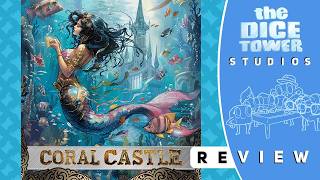


Coral Castle Deep Dive
What the Community Thinks About Coral Castle
Coral Castle has earned genuine praise from the board game community for its fresh take on card drafting. Reviewers consistently highlight the game's engaging draft-and-combo system and approachable design that works for both casual players and strategy enthusiasts. Across multiple reviews, the game received solid scores: a 7.5 out of 10 from Tom Vasel, a 7.5 from another Dice Tower reviewer, and recognition as a standout drafting title worth exploring. The game resonates particularly with players who enjoy the simultaneous action of drafting and the satisfaction of building synergistic card combinations.
Core Mechanics That Define Coral Castle
Card Drafting with Economic Depth
At its heart, Coral Castle uses card drafting similar to Sushi Go, where players pass hands of cards around the table, each player selecting one card per rotation. What sets Coral Castle apart is the pearl economy woven throughout the draft. Players not only gain cards they select but also pearls from cards they don't play. This means a single card might be drafted purely for its economic value rather than its immediate effect, creating layered decision-making during the draft phase. The three-round structure lets players build momentum, as they keep four cards between rounds to springboard their engine into rounds two and three. Gold cards, however, must be discarded after use, preventing indefinite card reuse and maintaining strategic tension.
Synergistic Combo System Across Three Scoring Tracks
Playing cards triggers effects that advance players along three interconnected tracks: tentacles, mermaids, and tridents. The real depth emerges from card combos. Cards synergize when played together; for example, a card might give a bonus to mermaids if played alongside plant cards, or double all tentacle movement if certain conditions are met. Players chase these synergies, trying to assemble cards that amplify each other's effects. The tracks themselves create cascading bonuses: when a player lands on a trigger space, they advance further on a different track, rewarding clever combo construction. This system allows players to interpret card interactions creatively, with reviewers noting that cards can be "interpreted as offensively as possible" to uncover powerful strategies.
The Coral Castle Experience
Whimsical Underwater Charm
Coral Castle embraces a lighthearted, enchanting theme where players build the prettiest mermaid garden under the sea. The component design reinforces this whimsy: sea creature meeples (a dolphin, turtle, octopus, and stingray) advance along tracks, and collected pearls nest in decorative clamshell holders. While reviewers noted that the plastic shells feel costume-jewelry-like rather than premium, this lightheartedness actually suits the game's family-friendly nature. The artwork on the cards is charming if not elaborate. The modular card system adds thematic depth: different card sets (with names like the Mariana Trench expansion) introduce distinct environments and creature types, allowing players to experience different strategic flavors depending on which modules are in play.
Engaging Drafting Tension
The game creates meaningful tension during the draft phase. Each decision cascades: picking a card with high pearl value might fund future plays but leave stronger cards for opponents. Choosing a synergistic combo card early telegraphs your strategy, allowing astute opponents to block your pieces or pivot their own plans. The simultaneous nature of card play and scoring heightens engagement, allowing players to resolve all actions at once if they wish, or revealing plays gradually for dramatic effect. Round two emerges as the pivotal power round, where established strategies explode into full-blown engines; many players report finding their draft payoff most satisfying in the middle round rather than the final push.
What Makes Coral Castle Stand Out
A Unique Pearl Economy and Card-Keeping Mechanic
Coral Castle introduced a mechanic rarely seen in card-drafting games: the ability to draft cards purely for their pearl value and hold them for future rounds. This creates a secondary meta-game around hand management and resource planning. Unlike pure drafting games where every card enters play, Coral Castle rewards long-term thinking. Players may draft a card with no immediate value, hold it across rounds, and suddenly unleash it when conditions align. This persistent deck-building element, combined with the modular card pools that shift based on player count, ensures no two games feel quite the same.
Combo System That Rewards Creative Interpretation
The combo system stands out because it invites players to push the boundaries of card interactions. A card that gives bonuses "for each plant you play" triggers itself if it is a plant, creating self-referential engine loops. Doubling effects can be stacked; placing two doubling cards in sequence multiplies their effects exponentially. This encourages experimentation and rewards close reading of card text, letting experienced players uncover strategies newcomers haven't imagined. The game balances accessibility with depth: the base ruleset is simple enough to teach in minutes, but the interaction space expands as players learn to compose synergistic sequences.
Potential Drawbacks
Component Quality Limitations
The physical production has clear weak points. The plastic mermaid shells and pearl tokens feel more like craft supplies than premium board game components. Reviewers described them as resembling a child's jewelry kit rather than an elegant thematic touchstone. While the whimsy works thematically, the quality disconnect may disappoint players accustomed to higher production standards. The card artwork, while pleasant, is functional rather than showstopping. For a game with such a charming undersea aesthetic, more ambitious art direction could have elevated the experience.
Modular System Complexity and Card Type Confusion
The modular card system, while strategic, introduces a learning hurdle. Different card sets are labeled A through E based on player count, and not all players will immediately grasp which types belong where or how the modules interact. Card types (coral, sea creatures, plants, mermaids, shells, items) have overlapping abilities that can feel confusing in the opening turns. The rule that "big fish" are distinct from "fish" tripped up even experienced players during teaching moments. Once understood, the modularity shines, but the initial ramp steepens the learning curve slightly compared to simpler drafting games.
If You Enjoy Coral Castle
Fans of Coral Castle should explore other drafting games that emphasize card synergy and simultaneous play. Sushi Go remains the gold standard for approachable card drafting, though it lacks Coral Castle's combo depth. 7 Wonders offers a more complex drafting experience with tableau building. For those who love the family-game feel with surprising strategic texture, Ticket to Ride and Splendor deliver rewarding decisions without overwhelming newcomers. Players seeking more elaborate production and heavier decision trees should explore medium-weight euros like Azul or Ticket to Ride: Nordic Countries, though these trade away the real-time drafting pace that makes Coral Castle snap-fast.
What Reviewers Are Saying
"This game does something I haven't seen before and that's where you draft a handful of cards. You can get money off all the cards."
— The Dice Tower
"You know, it also has these little clamshells where when you collect pearls, you put them in the clamshells. And that's fun. And I haven't seen that in a game before. And I'm a child and I love things like that that are in games. It makes me happy."
— Grant's GameRex
"So, in Coral Castle, we are building the prettiest mermaid garden under the sea."
— The Dice Tower