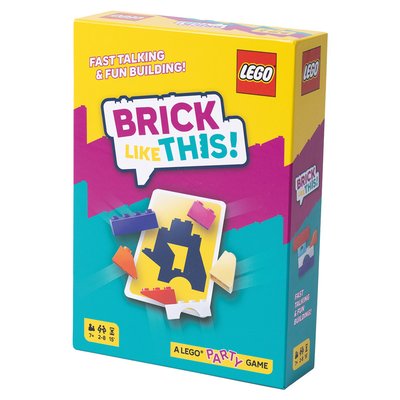
Brick Like This! - How To Play
[Music] Hi and welcome to Watch It Played. My name is Rodney Smith and in this video we're going to learn the two to eight player game Brick Like This Designed by Luca Bellini and published by Dotted Games who helped sponsor this video. Here you and your team will be racing to build models out of Lego bricks.
But only one of you knows exactly what you're trying to build. So, get ready to test your communication and building skills as you join me at the table and we learn how to play. To set up, find the challenge cards, which have these backs, and return them to the box for now. They're an optional component we'll learn about later.
These are known as the shape cards, which you'll separate by the numbers on their backs, shuffling each and setting them in a row within reach of the players. nearby. Also, put the Lego bricks where everyone can reach them along with this 30-se secondond sand timer. Now, organize everyone into teams of two players.
And they recommend that team members sit next to each other rather than across the table. In this video, we'll assume we have six players, which means there would be three teams. And if you have a mixture of kids and adults, they recommend pairing each kid with someone older. Either way, each team now chooses one player to take on the role of the instructor and the other becomes the builder.
Now, if you have an odd number of players, one team will have three players in that case and one of their members will take on the role of the observer. That player won't directly participate until the next round, but they can pick up a lot of good ideas about their team's communication style by observing, which can help later.
And that's the setup. In brick like this, teams will have an instructor who is the only one who can see what their team needs to build that round. They will have to give verbal clues to the builder about what bricks to collect and how to build them. Teams that complete their construction correctly will earn points, and the team with the most points at the end wins.
The game is played over six rounds and each round is divided into three steps. Starting with choosing shape cards. Beginning with the team that has the oldest player, they'll now decide which deck of shape cards to draw from. So, let's learn what these different decks represent. Each shape card has a value on its back and a unique model on its front.
During the game, players will be using the Lego bricks to build the shapes showing on the cards. The value on the back is the minimum number of Lego bricks required to build the model on its front and the number of shape points you'll earn for correctly building the related model. Now, I should point out the value five cards have an added feature where you can see the outlines of the individual Lego bricks that make up the shape you're trying to build.
And you won't find these outlines on any of the other numbered cards. So again, during the choose shapes step, the team with the oldest player will discuss which value card they want and then the instructor from that team will draw the top card. They just draw it, but they do not look at its face. Then the next team in clockwise order picks a stack and their instructor draws a card and so on around the table until each instructor has one.
Now it's time for the build model step of the round where the last instructor to take a card immediately says go. Each instructor now looks at their chosen shape card making sure they always keep it fully hidden from their teammate. And simultaneously all the instructors will start giving advice to their builder about how to put their team's model together.
And while they're doing this the builder should be building. For our example, let's say that as the instructor of my team, this is what I see on our shape card. Remember, I cannot show this to my builder. I'll instead describe what I'm seeing to help them figure out which Lego bricks to collect and how to assemble them.
Now, the builder can ask questions and we can talk to each other, but we can never point as part of our communication. As the instructors describe the parts their builders will need, the builders from each team and only the builders may touch the Lego bricks, collecting them from the central supply.
Once the builder has a Lego brick, no one else can take it from them. And although builders can collect several bricks at once, they can only collect Lego bricks the instructor has told them to take. They can't just hoard Lego bricks. And the instructor can only tell them to take ones that are needed for the model that they have on their card.
And the builder must always return any unnecessary Lego bricks that might have been accidentally collected. In this way, there will always be enough Lego bricks for every team, no matter what shapes they are trying to build. And keep in mind, the colors of the Lego bricks doesn't matter. All that matters is that you get the right shapes.
So, all of these examples I'm showing you here match the model on the card, even though the colors of the specific Lego bricks are different. For example, as the instructor of my team, if I had this card, I might tell my builder to start by grabbing the small piece with a hole in the center. And let's say they took this one, I'd confirm, yes, that's the one.
Then I might tell them, grab a similar piece, but with no hole, and put it on top. Now, they might ask, directly on top or off to the side. And I tell them, "No, directly on top." Then I might tell them to grab a triangle piece. Nope. Nope, not that one. Uh, nope, not that one either. Uh, look look for one that's kind of tall.
There's there's a blue one near your hand. Yep, that one. Now, put that beside the other pieces. Okay, not quite. And it will continue like that. Now, if a team breaks any of the restrictions I've described, for example, let's say I pointed at a piece I wanted the builder to take, then as a penalty, that builder must take their model apart and place the Lego bricks in front of themsel and start over.
So, in other words, they're getting kind of a time penalty. Now, remember, all the teams are going at the same time. So, as soon as a team thinks they're finished their model, they shout done. They cannot do any more building. their card stays hidden and now they must flip the sand timer. This puts pressure on the rest of the teams because when the sand timer runs out after 30 seconds, all the teams must stop building.
Then it's time for the third step of the round, getting shape points. Here, each team reveals their shape card and places their model on top of it so everyone can see if it exactly matches up. If it does, that team keeps their shape card and it will be worth the points showing on it here. Six in this case.
Now, if a team's model does not exactly match their card, perhaps like this, then they don't get any points and their card goes back into the box. The rule book suggests that teams keep their point cards hidden after they're scored. But you can decide as a group whether you wish to keep them hidden or visible.
And that ends the first round. Each team now takes their models apart and returns the Lego bricks to the pile. Then it's time for the next round. They suggest members swap rolls after each round. And you must do this if you have a team with three players. Each round works just like the first, except from now on, the first team to pick a new card from the shape piles is the one who shouted done during the last round, and then the rest pick in clockwise order.
You'll continue rounds this way until the end of the sixth round. At that point, each team totals the points on all the cards they scored, and the team with the most points wins. In the case of a tie, the tied teams share the victory. Now, if you want to add an extra challenge to your games, you can add in the optional challenge cards.
Separate these by their backs, which will show either one, two, or three coins, which represent both the number of points they are worth and the difficulty of the challenge you'll find on the other side. Shuffle each deck separately, and then deal a row with two single coin challenges, then three two coin challenges, and finally one with three coins.
The rest you return unseen back to the box. You now play the game exactly as before, but now before teams choose their shape cards, a challenge card is revealed. There is one challenge card for each round and you flip the farleft challenge in the first round. You'll reveal this challenge at the start of the second round, this one in the third, and so on.
During the build model step of the round, all players must follow the requirements of the challenge card that was revealed for that round. For example, this challenge means that at least some part of the model must be touching the table at all times while the builder is building it. So, as the instructor, you might want to give them a clue about a bottom piece first and then build up from there.
All the challenge cards are explained in the rules here. So, feel free to leave this overview open on the table while playing. All players need to ensure that the teams follow the challenge card for the current round. and players should call out any team they see breaking the challenge. If a team does break the challenge, that team's builder must take their model apart, set the pieces in front of themsel, and start over.
Otherwise, the round ends as usual after a team has shouted it done and the sand timer runs out after. In addition to the regular scoring, if the team that showed it done built their model correctly, they keep the challenge card and the points showing on it as well. If the team that showed it done did not build their model correctly, then they do not gain the challenge card and it is returned to the box.
In this way, only the team that showed it done can score the challenge card. But all teams, including them, can score their shape cards as usual. As you advance through the rounds, you'll find the challenges worth more coins are also more challenging. Once the sixth round is over, each team totals their points from all the shape and challenge cards they collected.
And once again, the team or teams with the most points wins. The game also comes with rules for playing with just two or three players, which is also known as the kid-friendly variant. And there are also extra tips when you are playing with kids, but those rules I'll leave for you to discover on your own, or you can pause and read them here.
Otherwise, that's everything you need to know to play brick like this. If you have any questions about anything you saw here, feel free to put them in the comments below, and I'll gladly answer them as soon as I get a chance. You'll also find forums for discussion, pictures, other videos, and lots more over on the games page at Board GameGeeek, and I'll put a link to that in the description below.
And if you found this video helpful, please consider giving it a like, subscribing, and clicking that little bell icon so you get notification anytime we post a new video. And if you'd like to support us directly, you can join our Patreon team, which I'll have linked below. But until next time, thanks for watching.