NATURE Review| A Revelation in Gaming with Expansions (Natural Disasters & Arctic Tundra)
Games in This Video
1 game is featured in this video — it unlocks as you watch.
Transcript
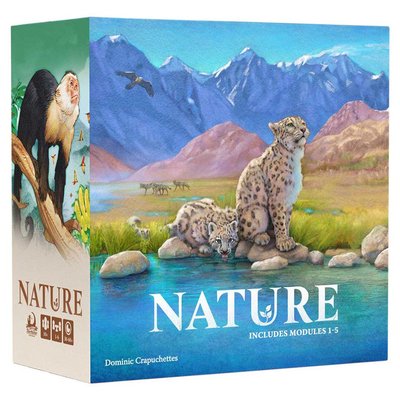
Hey everybody. Oh my gosh, Northstar Games did it again. Nature is the game I'm talking about today. I want to talk about just the base game and how the modules really make this game something special and replayable. So, you'll probably recognize this kind of system from earlier games that Northstar has put out. Evolution, Evolution Climate, then you've got oceans and even Legends of the Deep expansion. I've covered pretty much all of those with the exception of climate on my channel or on Roto's channel because they're really, really good systems, but this one is something special. It gets you the same kind of game in 30 to 45 minutes. No joke. It is a fast game. I call it kind of like a little bit of a race game because you're wanting to bank population by feeding them before the end of the round. And that's going to be the victory points that you keep behind your little screen. So, let me just show you what the game offers as the base nature core game and then bring in a couple of those uh modules that I have to show you if those are the modules that you want to add to your nature game. So, this is the watering hole.
Very important. There's going to be some vegetation there. This is going to feed your herbivores. The meat stakes over here are going to be for omnivores like vultures or scavengers and also the hunters. So, this is the cool thing. Everything here is biodegradable. The cards are really, really nice. Super easy to use. Fantastic iconography. And you've got these cardboard trays that fit together. They're they come pre-made and you put in Oh gosh, look at that. All the vegetations, your populations. So, you've got two boxes of population markers. And again, these guys are your population markers. You're going to see them. Uh-oh, they died or they went lost. And you're going to keep them there. So, there's your little meat stakess. And here's your vegetation for different types of uh animals. Then you've got these these uh discs right here are dials. So, your dial is going to tell you how big your species is. So this forager right now starts at a level one. Everyone gets one in the very first round and you put one population next to it. So this is my one. If my population if my animals get bigger in size, I move the dial and I go, "Okay, so I still have one, but he's a little bigger." And you can go all the way up to four. Yep.
Because then the dial goes back to the blank side. So you can have some really, really big animals. And the bigger you are, the harder you are to hunt. So you've got population markers. You're going to add population. Now you've got a lot of little guys, right? So if you keep adding your population, you're going to have a bunch of them. They each have to eat if you want to bank their points, but they're kind of small. So they might be easy pickings. They might be easy prey. And if you want to become a hunter, you just flip your dial over and now you're on the hunter side. You've got these cards that tell you that you're a hunter. you switch from eating uh vegetation or or greens and now you eat meat steaks and you are a hunter like I am. I am the snow leopard. Um since I look like a snow leopard, I'm going to start the game now. Um what's really cool too is the game uh also provides you with um alternate art by different artists.
Uh oh, here's one by Vincent Detroit, my favorite. So these are these are just pretty. These are just really nice. Um, this this artwork is dynamite. I think they really did a great job with the biodegradable features, with no plastics, with having just cardboard in the trays. Everything fits into the box super super easy. And you get these massive like big tarot size player aid cards with the eight different cards that come in the base game. Now, this is what I'm talking about that the game is just so clever. So, this game is a 30 to 45 minute game and it can do so because it is so streamlined. It is so tight in the kinds of cards that you will see. You've got clawed, fast, horned, opportunistic.
Then you're going to flip it over and you're going to see, oh, plated, scavenging, social, and tusked. And they're going to help you eat. They're going to help you with defense. They're going to help you be really fast to escape uh particular hunters and things like that. All the icons on the back of the other player aid will tell you, yeah, the size dial. Flip it over from vegetation to um meat, your population markers. I told you about those killed population. I've already explained everything to you in like matter of minutes, if that. And you've got four rounds. This is a round and then you get to uh scoring at the bottom. If it's the end of the fourth round, the game is over. So, you are going to essentially look at your five cards. Every round, you get a new species to add to your group. And each species can have up to three trait cards. But you're not going to always be playing your trait cards down. You're going to look at your cards and you get to spend them in one of three ways. You can discard a card to the discard pile.
Let's say it's right there. And you can make your species bigger by one. or you can add a population marker. Okay, done. Then I will spend another one. Let's say I want to make it a two. Now I've got two at level two. And then I'm going to uh what about Claude? I'm going to play Claude as my trait. But the cool thing is when it's your turn to go, you're doing all of your actions at once in turn order, but you don't show people what your traits are. You show them you've got traits that you're adding, but they don't know what it is. They'll see your dial and they'll see your population. And the other thing you can indicate on your turn is whether you're going to become a hunter or not. And if you do that pretty early on in the round, players can respond accordingly. And so your hunt may not be successful.
I would say sneak in a hunt when you're last in turn order to play and nobody else is a hunter and you really surprise people and you can maybe take down some of their animals so they don't score and you score. So the difference in points is really big. Um you can keep a card. Let's say I keep my uh opportunistic. I keep this card because at the bottom I can play it on my turn during the eating phase or the feeding phase and I can add four greens to the watering hole. Now, I may not be able to eat them all, um, but I will be able to feed what I want. And then, of course, if there's any in the watering hole, people can go and get it, too. Um, so let's say I play uh scavenging out and I say I'm going to get myself another population. So, I got two population. I made them bigger, a little bit harder to get. I've got a trait and I've got saved one right here.
That's it. That's pretty much my preparation. Um, that's my adaptation phase. That's my free actions. And then once every player does that, you move into feeding. Everyone's going to reveal their card. Well, I'm pretty good at hunting. I can turn hunter pretty fast. I have a plus one shell for my shield. So, it's two my size plus one. So, someone has to have three attack, which is their size plus their attack value to even come and get one of my guys. And my guys feed two different foods for just one uh population. So, I'm trying to make myself hard to get and also versatile. And I also eat two more when eating a grass. So, whenever I eat a green, I'm going to say, well, I can normally eat two cuz that's the size of my uh animals. So, I eat two. And then it says I get plus two when eating.
Well, I'm going to gain one more from here. And now I fed all of mine. So if you ever have any excess, you don't take it because you can't put more than one food marker on each population. So that was just one round I was able to feed. I took three of the nine uh food in here in my three-player game. And then we are just going to go around the table feeding. you get to feed one species um up to again they get to eat as much as their dial plus any specialty thing on their card and then you go all the way around. You just keep going in turn order until everyone has fed or everyone has starved and you can choose to pick a species over another cuz over the rounds you're going to keep gaining one more species. Now the cool thing about this game is that when you lose a population, let's say someone eats this animal and they get to feed themselves. This is not going to give me any victory points when I put these behind my screen. It's the end of the round. But this population is going to come back into play with the one that I get and my start dial for one. And now I have my two species. And this one's still got the claw. And uh I'm going to put my new one out. And this one starts with two. The one from the previous one comes over here. So players are not entirely out. They are not just skunked. they are not just taken down because it's really hard to generate that momentum and come back um into play. So it's really fascinating.
You can also lose a species by losing all the population. And there's a similar mechanism for species to help the new species come in stronger and bigger. And so there's this inherent catchup mechanism that is fair. And it is something that's necessary for such a short game and for that race game because it's always about the food. If you can get the most food behind your screen, you're probably going to win. And again, there's four rounds in this. If you have living species at the end of the four rounds, which the max would be four, you can get two points per species living. Let's say you lost one, you're probably going to be at six because the species number goes into the next dial for the next round. So, you want to keep your species alive. You want to bank as much food. And you have all these cards to adapt and to evolve and to essentially give traits to your species so that they can hunt, so they can defend themselves, so that they can eat and so forth. It's really good. It's really clever. It's just a dynamite system. And so, now I'm going to talk about those modules and how they adjust or change this system to give you a different feel while still keeping the same core game. All right, so I've got natural disasters components right here on this side. There is a stack of natural disasters. And boy, is it big.
Plus, there is this itty bitty cute little box of comets. And just like before, it slides. It's got the little handhold and it's got your little comets right here. This is going to keep track of how long these natural disasters are in play. Now, much like a regular game is four rounds, when you add this module, you are going to increase your game to five rounds. So, that's why on the box it says 60 minutes. And I will say too, this is a complexity level two out of five. And it is for players who love games that create stories. That's one reason why I wanted this specific module, this expansion, this this kind of like development of nature because I do. I really do. And this feels like the game is against you as opposed to necessarily your opponents are against you or it creates a little bit more conflict that is neutral as opposed to player versus player, which there is going to be that in the hunt phase if you have a hunter. Um, but it's it's good. It's still really really good. So, what you're going to do is you are going to reveal a card and it's going to say something in the bottom perhaps. This one's one of the rare ones that doesn't have something at the bottom, but some cards are going to have a lightning bolt at the top. And it says right now, rearrange the traits of the player to your left in any way you choose. This is a radioactive meteor shower. This absolutely,
you could see, throws a wrench in everyone's plans. So, you are going to look over to the player to your left and you're going to just go swip swap swip swippity swap. I mean, it's wild. Here's another one. Here's another example. Um, gigantic meteor. So, what you're going to do is you're going to put this many number of comets uh tokens on this card and it stays active for that many rounds. So, if the game is five rounds, this goes for the entire game. This is a gigantic meteor. And it says here, during preparation, don't add food to the watering hole. This is insanely changing up the game. Normally, you would add food. You'd flip over a card and multiply that times the number of players and add that number. In this case, none. Three. Immediately when this card gets flipped over, three population are killed from every species and return to the supply. This just pretty much wipes out possibilities for food and um massive amounts of species, but it hits everybody. This is insane. It's just bananas. Here's another one. Ice Age.
This lasts for one comet phase. Increase the cold level by five. Natural disasters rules page seven. So it will tell you what does that mean? How does this affect your game? These natural disasters are wild. Oh gosh, there's another radioactive meteor shower. This one is uh it says discard every trait in play and replace it with the top card from the draw deck. This feels less player to player and a little bit more wild. This one says, "After foraging or hunting, a population is killed and returned to the supply." This radioactive meteor shower isn't as wild as the other one. Here's a tsunami. Each player kills all the population from one of their species. And it lasts for one round down here. You cannot discard to add food to the watering hole. That's what I was saying before whenever I had a card that I saved on the side because I was saving it for adding food. Well, you can't do that with a tsunami. So, there is this massive stack and you're going to be, of course, putting these little comets on there. Okay, so now I've got Arctic Tundra. This is the module 4 and this is a level four out of five complexity. It says for a players for players who love a challenge. Yeah, I mean, come on. This is this is getting intense. Now, this module offers something that I played in flight when I did a demo of this a year or so ago and got it on my channel uh when I was playing it online. It offers a deck of
brand new cards. Now, these are all going to be the traits that are provided to add to your choice. So, all of these are going to be arctic traits that help you try to fend off the cold, much like there was cold with this nature uh natural disasters card. uh and you're going to essentially fend off for cold. This is going to have cold as a predominant feature. So, whenever you go to draw your five cards at the start of the round, you can draw any number of cards from the nature deck or from the Arctic Thunder deck. You can do two and three, you can do five and O, you can do whatever combination you want. And so, whenever you get the cards, you're then going to be playing them. However, there are a couple shifts. The first thing is five uh rounds instead of four, much like you get with natural uh disasters, which makes for a really interesting pairing of the two modules together in one game, which you can do. The other thing is that if you discard a card for its uh food down in the watering hole, every card just gives you one and it it it's they're all built into these cards, but these cards as well. So, every card you discard gives you just one food. And if you want to increase your population, I told you about discarding a card and you essentially add a population. In this game, it takes you two cards just to get one more population.
And that's just so costly. Now, at the end of the game, you will score for every species you have alive, much like I described in the base game. But in this one, you get to score two points every round that you have a species alive because you're going to have to roll for the cold. And this dye gets rolled at the beginning. You also have a new watering hole. Notice that it's like cold and barren and whatever. So, you roll this die and that's going to be your level that you have to reach or your species are going to freeze to death. So, if that's eight, I'm going to add together. Let's say I've got some stronger, you know, guys here. Let's say I've added white fur to my uh my collection. And then let's say I've got Oh, yeah. Hibernating. Okay. So, here we go. Let's say I've got those three traits on this particular uh group of animals. Um it's 2 + 3 is 5 + 3 is 8. I met the level of that and none of my population will freeze. But let's say I didn't have hibernating and I had five.
I'm three short. One, two, three, freeze. Terrible news. Terrible situation for that particular species. I really, really need to get that hibernating as part of it. Or maybe not roll an eight. There might be a chance for players to respond because the dice is rolled at the beginning of each round. So, you know what you're preparing for. You know it's going to be a cold winter. So, that's just another really, really cool part. And again, you've got all these brand new cards that you're going to play with that are part of the Arctic Tundra. One super cool feature that the uh Arctic Tundra offers is a card called Migratory Predator. It is a trait card that allows you to play it down and when you do when you flip it over, you become a secret hunter. No one knew you had that trait until you flipped it over.
And so you weren't identifying yourself as a hunter right away, but you became a migratory predator in the card flip prior to eating. And it's a nice cool sneaky way to become a hunter. Really, really cool card and a great way to add it to the Arctic Tundra module box that's not a possibility in the base game. Lot harder, a lot more unforgiving. It's just wild. So these different modules totally change up the game. If you want to play with flight, light operates wholly differently from Arctic Tundrram and definitely from natural disasters which has a different feel without the added deck of trait cards together. Super super interesting as a corebased game. Dynamite. So check out the modules and see what sounds good to you, what works with your gaming group and your gaming style andor just play the base core game. If you get nature as just a base box, your game is going to be 30 to 45 minutes and it is just going to be dynamite. And guess what? There's solo play. So there's going to be a chance for you to play one player. And I have not tried that yet.
I'm a generally a multiplayer gamer, so I I don't usually give those solos uh you know, a play before I do my reviews because that's just not my gaming style. But I want you to know that that's available to you. Um, so that's going to have the solo in all these. It's going to have your solo cards and your deck and your set of rules, and it's not that hard to add and to figure out. So that's going to be it for me. Golly, I mean, great theme, great mechanics, dynamite play in well under an hour. Nature's got it. I'm excited to continue seeing these two uh boxes, these two modules and the combinations of those traits with my species and just uh crushing the competition and outlasting nature itself, outlasting the cold and the natural disasters that these modules offer. All right, everybody. I'll see you later. Bye.
All right, for all of you who stayed to the end, I've got a little treat for you. Inside of nature, you are going to receive Elephant Graveyard. This is a mini expansion that you play with your game. It allows you to have a cool like 3D little elephant graveyard. And guess what? The rules are right there on the bottom. And it says, "When a population is killed for any reason, you add a meat to the graveyard to the elephant graveyard tile. Species with scavenging the trait eat one meat after hunt instead of two, which changes the game. And then species with scavenging may forage or hunt to eat a meat from the elephant graveyard. Cool, right? And then it even has solo rules on there, too." So, this is the coolest. And you get it in this nice little envelope. and it's part of your base game. It's not a module and it's not extra. It's just part of your nature box. So, don't forget about Elephant Graveyard.