Six Short Game Reviews - with Tom Vasel


Transcript
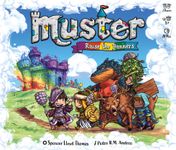
Hey everybody, I'm Tom Vassel and today we're taking a look at six different games here. Very, very different. I guess that's how my six different short reviews often go. So, let's take a look at them. We're going to take a look from smallest to largest. Stay tuned. Often my short reviews are full of games I don't particularly care for, but I enjoy several of these. So, here we go. Muster raise the banner. This is a game with some really cool little artwork from Play Monkey Games about controlling five towers in the middle of the table by playing cards on your side. Here's how it plays. In this game, you're going to be playing through a deck of cards. And when the deck of cards runs out, whoever has more icons on each side of these wins that castle and whoever wins the most castles wins the game. If there is a tie, whoever has more cards in their side wins. So, you're going to have a hand of cards that have different colors with different icons at the top. And on your turn, you can take an action. One action you can do is you can play a card down your side of the table. Now, it has to match the color that's there, and it has to be equal to or greater than the card that's already placed there. The only exception to that is rainbow wizards can be placed anywhere when you play them. You can also discard a card from your hand. And when you discard a card from your hand, you put it on top of one of these and then you draw a new card. After you take every action, you draw a new card. But either player can draw the card that's up here. The only exception to that is you when you discard a rainbow castle card to one of these spots here, you immediately make
that wild and now any color can be placed on that side and you don't need to worry about what the color of that castle is and that card can't be drawn. You can also if you have a card that would take the spot of a rainbow wizard, you can take that rainbow wizard in your hand. So, for example, here the four blue and then I can take this rainbow wizard. Even if the other player was the one who had played that card, if they were the one who played a rainbow wizard, they or this four blue on my side, that could go into their hand. You can also move a rainbow wizard. If you have a rainbow wizard at the top of one of your piles, you can move it to another spot. And then but then when you do that, you'll draw the top card from the deck and place it face up on a spot here on the board where it might go. And that's it. You're just going to go back and forth. You can see here that the cards have different numbers of icons.
There's a lot with ones. And whoever, like I said, has the most will win the game. I like this one in theory and in practice. I do not like muster raised the banners. There's some major issues with it. This is a game that's really similar in its concept to a very popular game from Rhino Kenichi called Lost Cities where you're playing cards on your side of the table and making runs, but you can also discard a card to the middle which people can then pick up and play. And if you start low, you have a chance to put more cards out there. And that would work okay if this was a sort of sideways cousin of that game. But the wizards in this game are simply too powerful. They really are. you the the the multiplayer tower. I can keep that in my hand and you play the cards at the right time. If you draw the better cards, you will win.
If I play a one, two, three yellow and never draw the four or five, I'm not going to win yellow. If you draw more wizards than me, I almost feel like the wizards should be evenly distributed between the two players. And knowing when to best use them and move them would be the core of the game. Unfortunately, I just can't recommend it though. I just don't think there's a lot of good strategy even for kids. I think kids would be frustrated by the I just didn't draw very well this game. Well, that's not very fun. So, five out of 10 for me. Must have raised the banners. Naishi is a very weird game in which your hand is also your board, which is also your hand sort of. I I'll show you. In this game, players are going to have the river here, which is five piles of six cards, which are all different types of scoring cards. You'll have five mountains here. This is called your line. Each player has five mountains in their line. And then each player is going to have a hand. You'll start with three mountains and two other cards. One that you pick and one your opponent gives you. You're going to shuffle your hand to start this game. And this matters because the order of the cards in your hand does not matter. And in fact, at the end of the game, you'll be placing them down to be part of your territory in general. So that's going to matter a lot for the how this game works. On your turn, you may take one action and you may also take extra actions if you spend these tokens here.
These So, the main action that players going to take is developing their territory. When this happens, you're going to pick a card from your hand or from the line and discard it. So, let's say I pick this card and discard it. I then replace that card with the same card that was in that spot. I would do the same thing if it was in my hand. I could discard this card and take this same one and put it into my hand in that same spot and then reveal the next card. Now, there's a couple things you can do when you put your tokens here. You put a token on the board. You have different ways here. You can discard the top two cards from the river and reveal a new one or I'm sorry, a top card from two different spots and reveal the cards in each of them. Or you could put a token here to switch two cards in the river.
Switch two cards in the line. Switch two cards in your hand. Or a card with your hand with one in the line that has to be in the same position. The person who has this card um is or whoever does it actually only one person can do it is they can place a token on this spot here. And when they put it on this spot, that token is locked there for the rest of the game. And they can exchange a card from both players hand in the same position or if both players line in the same position. However, since that token's locked, they only have one because another action you can do is take your tokens back. That's like an action that you can do. Recalling your emissaries, you can also declare the end of the game as an action when you do. You can only do that when one pile is completely gone in the middle.
And at that point, you'll put out your cards. Like I said, your opponent gets one final turn, and then you will score. Now, each card is going to score differently. So, for example, the mountains, the ones you have out there. If you have one mountain in your territory, you get five points. If you have two or more, you lose five points. And since you start with eight mountains, you're going to have trouble getting rid of all of them. And I'm not going to go over every scoring card, but I'm going to show you some of them. The ninja here copies another character in your territory. This one here, the rice field. Each group gets rice fields equal to their size. So if you have two of them next to each other, you're going to get 10 points. If you have four next to each other, you will get 30 points. The Ronin here, they'll score equal to the number of different cards that are in your territory. So if you have eight different cards, you get eight points.
If you have 10 different cards, you get 45 points. So they're all going to score differently like that, and whoever has the higher score is the winner. This game is really cool in its concept. You can't change the order of cards in your hand once you do that initial shuffle. Although, you can change the order by sort of playing a card here and then swapping it over there, then putting it back in your hand here. So, that part is is kind of cool. It starts with these bounces. You're getting rid of them. The token thing is really intriguing um to be able to put tokens there to get some extra movement, but you can't pull them back. And there's only two spots where you can flip cards or three spots you flip cards. It it's it's just interesting back and forth. The thing is for me, I like this concept. I like the idea of this game a lot. But the reason I can't really recommend it and it just misses it. My rating for this is a 6.5.
Just misses my recommendation. And that's because the symbology and stuff on the cards is just a lot of brain burning stuff. Because you have five cards in your hand. Those cards are technically the back five cards of your board. And for a lot of people, that's going to be a tricky thing to in your mind say this second card in my hand goes to this spot here, which is next to this, which is next to that. It's a cool concept, but then having you're constantly having to look up what all the cards do because you won't quite understand from the symbology what they do. And maybe after a few turns, but there's also sometimes I need a very specific card and that card just doesn't come up or it's in the bottom of a deck. And yeah, maybe I'll burn through a couple cards. The game also can end by a player basically saying it's over. You get one last turn, but it also has a little bit of antilimatic stuff. Now, all that sounds negative and I but I want to say I really do like the rest of it. I like the flipping and this is this is one I think actually several people will like. Just for me, it just missed it by a little bit. Some neat concepts here. Uh Nichi Top Frog is a game about frogs jumping on lily pads. A little bit of simultaneous selection here and a lot of stupidity about frogs wearing hats.
Who wants to wear a hat? In this game, you'll build a pond, and the size of your pond is based on a number of players. So, I'm showing you a pond for three to four players, and each player will have a frog that they're going to place in the middle. They're also going to get a set of cards that match their frog. One of these cards, the uh the catch card, will start in your discard pile. The rest are in your hand. And each round of the game, players are going to simultaneously play a card from their hand and reveal it. Now, if you reveal leap north, leap west, leap south, and leap east, you will move to those spots. If you are on a spot that's next to a whirlpool, so here, not here, and you move into that spot, you come up on the other side. Any card you play then goes to your discard pile until you play your rest card, which brings all the other cards from your discard pile back to your hand. If you rest when you're in the same spot as someone else, you will get a fly. And if you rest about the same time someone's catching one, you'll get two flies. Five can be spent uh to take a card from your discard pile back in your hand. Also, when you play a leap east, south, west, or north, if the catch card is in your discard pile goes your hand, and the rest card will also go into your hand.
Catching, if you're the only person on a card, you will catch that frog. If there's multiple people, nobody catches the frog, and flies will come out to the cards that are next to it. Sometimes cards when they enter the pond will also add flies. And when you win a frog, you win all the flies that are on it. Now, when you win a frog, you will put it in one of three lily pads in front of you. Each player has a special lily pad that they can stack frogs on. That will give them points at the end of the game. But otherwise, you'll put it down. And in the future, any frog that goes on top of it has to be the same weight or lower. So, four can go on top of a five. But if I take this five here, I can't put this on top of this frog because it's a four. Although, this one I could because this one's a three or a six. So, I'll say that it's a three. Frogs are going to be worth points at the end of the game.
Frogs also have special abilities. Some have special abilities when you take them. Others have special abilities when they come out. After people take frogs, the cards that are in the stream here next to that will come out into the pond. Some frogs are hat coupons. When you get a hat coupon, you turn it in for one of these hats here at the top of the board. You will find the matching hat and put that hat on one of your frog stacks on the top. Frog. No more frogs to be added to that stack. But then that stack will score you the points. Like this one scores you. If I have three of the pink frogs, I'll get six points. Let's say I have two of the blue frogs, I'll get two points. So this would be eight additional points for me. So you have to decide which hat you're going to want. Other things can do cool stuff. These purple ones, for example, give you bonus cards. So this one here says, "Take the gallop bonus. You get another action card." Some action cards are bonus action cards. So this one you play with a leap card to move an extra space.
Here you play with a leap card to move diagonally instead. Others are just completely new action cards. An extra catch card for your hand, rearranging your frogs. And there's just different ones that you get re um stealing an action to steal a fly from the other players. So you can get those, you can get hats, some just give special points and special features. And you're going to keep playing till all the hats are gone. And then you'll score. or you have three lily pads, remembering that one of them, like for example, this one says score six if this stack has three or more frogs that weigh six or more. Or this one here, score four if this stack has three or more frogs that weigh four or less lightweight. Or score six if each frog in the stack is from four to six. So you'll score that. You'll score the points for the frogs themselves, and you'll score points for the hats and points for leftover flies. And whoever has the most points is the winner.
This game is a goofy game. This game is a game that has some moments because we're both on that same hat and I'm like, well, okay, listen. We're both on the same hat. Can I play the catch card? You don't want to play the catch card. If we both play the catch card, neither of us gets anything. Come on. You don't want to play that. So, there's a lot of that in the game. It's a little bit of a pro, you know, the simultaneous selection. You play the card, then you pick that card up when you play other cards. And there's a bit of fuzziness on that. I I found a lot of people would forget that every time you play a jump card, you get your rest and catch cards back again. And when you play a catch card, um or when you play the rest card, you get every card back but the rest card. So, there's some odd oddities there. Really cool stuff, though. Really cool things about the hats. And the hats, you don't want a hat too early, which is a small negative about the game because if you get a hat too early, you don't want to play it because you want to score more points, but you're kind of just sitting there.
What do I do? take this hat and then they can clog up the middle a little bit. But the frogs are fun. The different cards are special powers. Trying to make a big stack of frogs is fun. You want to get a 10 weight one on the bottom or get a whole bunch and try to match your lily pad. I like that. I love the ones that give you a special action card that I can I have now two catches or I can move diagonally. That's really cool. And I like that stuff a lot in this game. So, it it comes together. It's a little chaotic. There's a lot of symbols, a lot of things moving around in a board, but I'm still amused by it. It's just is a amusing little game. Two to six. I don't know that I want to play with six. That might be too many. And two, there's not enough interaction between the players. This is a three to five player sweet spot, I think, but definitely one I would check out. I And I love the the really cute artwork of the frogs. I love the frogs stacked on top of each other. I like putting the little hats and the frogs, but the gameplay behind it is also fun. A seven out of 10 for me. Top Frog. Match me if you can, says Leonardo DiCaprio. The This is a game in which you are trying to match the answers of other players.
And so we are all writing something down and it's asking a generalized question. Um like what's your favorite food to bite into? They ask, but they're asking teeth this question. You're like, "What's a satisfying food to bite into?" And I'm trying to write down something other people ask. Answer. That's the whole thing. There are games that have done this before. This one does it in a slightly tiered way. Let me show you. In this game, each player is going to get a sheet of paper. You can use the parts of the paper if you want. It's weird, like you're supposed to cut these, but anyway, we just didn't cut them and just keep using it over and over again. What's going to happen is each round of the game, players are trying to get 13 points. So, you'll take a card and you'll flip it over and ask the question. You can pick whatever side you want. We ask 300 bowling balls. How many pins do you usually knock down in the first roll? Everyone's going to write an answer down to that question. Basically, you're saying you asked, they're not asking this. We asked 300 bowling balls is is not really a thing. You're basically saying how many, you know, on the average bowling ball, how many pins does it knock down in the first row?
Everyone writes it down. Anyone who matches gets one point. So, let's say pink, red, and green all match. They get one point. They're now going to go to round two. Blue and orange are out. However, blue and orange will take their betting tokens. And the next question from level two says, "Which one of you, we asked 1900 classic novels, which one of you did most students read in high school?" Pink red are answering it trying to match each other. And they're going to say there will be a match or there won't be a match. If they're correct, they'll get a point. And they will only get points if they match. But if they do match, they get two points and go to round three. And here they ask 100 Disney animated movies. which of your characters is the most heroic. Now, there's obviously no discussion and after round three, it restarts. If at any point on any of these numbers, nobody matches, then the no one gets any points. We go back to round one again.
That's why the round one cards are so big. And you can see example questions. Under house plants, how many times do you get watered in a week? Laundry dryers, what are clothing do you have the most fun shrinking? What kind of event did you provide access to to tickets? Um, here, personal computers, what application do you spend most time running? What shape of cookie do you make for cookie cutters? Women's handbags, what one item are you always carrying? The pink ones. Halloween customs, which is the most popular this year. What's the most common word contained in a pop song title, etc. These are obviously trickier. Anyway, the first person to get to 13 points is the winner. Yeah, this works. The questions, the the level one questions, if they ask toasters, how long will it take you to burn a slice? It says before you start, you need to talk to people about how exacting things work. You know, if you have an S at the end of your word and I don't, do they match?
Hint, you should say yes. If someone says water bottle and I say bottle, those match, too. Because you're not going to have a lot of matches in this game because they're also very open-ended questions. They asked 100 children, you know, what animal do you like to go see at the zoo? You probably write monkeys, right? But someone might write tiger and bears. And there's of I played this game often where there was lots of no matches. And if someone does match and you're like, "Oh man, they get to go on to other rounds." They can sure get a lot of points. I mean, the fact that you can get six points per round, matching to one, two, and three means the game could be over in three rounds. But it isn't. But even though you're not you're out of it, you know, to try to match, you're guessing whether people will match or not, and you can just say if you think people aren't matching much, then say they won't match. I find that to be a a nice little concept. This plays pretty well up to eight people. My biggest problem with the game is those sheets aren't cut for whatever odd reason. But I thought they did a good job with the topics. Even if it is a little weird that they will ask, you know, like we asked 300 rock papers and scissors, which one of you most often wins? That's that's a little weird way to word it. I get what they're saying, but it's still fun. Match me if you can.
Pencil Pirates is a drawing game in which you are going to be drawing on a treasure map, charting your path from island to island, but you're also passing these maps around the table, and you're just trying to draw your lines through stuff. Here is how it works. Each player is given a map. The maps are going to be different. There's a a bunch of maps, but it doesn't matter because you'll be using a map and passing that to other players. On your map, there's an island that's marked number one. You can see it here. And on each turn of the game in our seven turns, you're going to pick any vertice on the island that you're on. So, and then you will draw a line to another island. So, where can I go with this number one here? So, let's say I go up to this spot from here, I'll draw the line. And anything that I touch, this was not great. I get those things. I'll circle them. And then I'm going to score them.
Once I score them, I'll cross them off. I'm also going to write a number two here because that's going to once the round's over, I'm going to pass this map to the next player and they're going to start from round two. There's a couple things I want to note here about the map before I show you how scoring works. And that is if you go to an island that has something, you're going to get some bonus points. One of them is a telescope. If you go to the telescope, from the telescope, you can use the wavy side of your line to go to the next spot. You also can't go to whirlpools unless you spend one of your two whirlpool tokens. You can spend one and then you can draw. So let's say from this island I decide to draw to this whirlpool. And then from that whirlpool I can go to another island like that.
And I don't know why I would have done that. I should have gone to cross some more things. But that is how the game's going to work after seven lines. Also, if you go through stuff that's already been crossed off, you don't get it. So, everything's going to score slightly differently. Coins are the easiest. Each coin you get will score you one point moving on a track. And if you hit these stars, you get the bonuses there. Rubies are four points each. The mermaids, you just keep track of how many mermaids you have. And at the end of the game, it's 15, seven, and three. Whoever has the most. Sharks are negative points. Ships you only get if you get two ships in a round. Uh, so they can be worth quite a few points. and rum gets you a lot of points until it starts going down. Don't have too much rum. Finally, when you land on an island with treasure, you'll roll this dice and that's how many points you get. You can roll it up to three times, but each time you reoll the die, you must take the final roll. And if you ever roll this symbol, you get nothing and your turn's over. After several rounds, we add up all the points. And whoever has the most points is the winner. The people who are going to have a most problem with this game are the arguers. These are the folks who are going to sit there and go that pencil lead did not touch that object.
Let's pull out our mega microscope and see. And and I get it. So for some people that's going to be an issue. To me, if it looks like it touched, it touched. We're not going to play too much around it. The game also has a thing where someone's like, "Hang on, I want to look at my 700 billion possibilities of how to draw a line." But other than those two things, I find it's going to be very fun. There's different ways to score. You're trying to do things. The fact you can bounce off those whirlpools twice. At the beginning, it's you're like, "Oh, where am I going to go?" And I have these and sometimes you draw a line and you just get a lot of good stuff. And after a while, those you get the sheet, you're like, "Oh, all this stuff's crossed off." But it won't all be crossed off. There is plenty of treasure in the sea before with only seven turns of the game. And it's just it you get it. You're getting a little puzzle.
There's a line drawn on it. You went to an island. You can start off any verdict on that island and go from it and then the wavy line getting the telescope. There's just some neat stuff. Uh the biggest complaints that with the people I played it with the the treasure roll on the island. I mean when someone rolls a skull twice in a row they're a little myth that the person who also rolled seven twice in a row that's a difference of 14 points. I can see that. But I do like all the different symbols guaranteeing different things and you decide to run up one path or the other. How rum goes up and down. Little thematic there. I I enjoy this one a lot. Pencil Pirates is an eight out of 10 for me. I find it to be quick enough, different enough, drawing the straight lines, and everyone is involved the whole time, and there's a little bit of a little bit of interaction, but just passing the sheets itself is fun interaction. So, that's Pencil Pirates.
Check it out. All right, let's take a look at Holiday Hills. Holidays, a delightful strategic decorating game. There is not enough games with a Christmas theme, and there is not enough big grandiose games. Now, this is a bigger game in how it looks and how it plays. There's a lot of piece in here, and they did a great job, Chris Couch games, of putting them in and packaging them up, but the game itself is not particularly complex. Let me show you. In this game, players are going to be moving around and putting out Christmas trees. You'll start with one Christmas tree on the board, but as time goes by, you'll have the opportunity to put out more Christmas trees. They have a star of your color at the top to show that they're yours and you can place them in open spots around the board. Now, what players are doing, you're going to start with a couple objective cards and you have your sleigh that you're moving around the board and every time you stop at someone else's cottage, you get more objective cards. So, you'll have six at the end of the game and these are going to score. We'll talk about them in a second. But when you move, you can move as far as you want.
Although, you have to stop at a cottage as you move, but you can move to any space. So when I move to a space, I can decide if I'm moving on the blue line, the light blue line, or the dark blue line. So if I move, for example, here, if I move on to this spot, I I get to put out two candy canes. I didn't pass anything. It doesn't matter which line I move on. But let's say I went to this spot here. I say I'm going to go on a dark blue line. That gives me a present. If I go to this spot here, I move on a dark blue line, and I can take a blue present and a present of any color. or I can move in a light blue line, which lets me deliver a present. So, you decide which one you're going to do. When you gain presents, that's these dice over here. You simply take a die and roll it and put it in front of you. When you deliver a present, you're going to put that present underneath any tree you want on the board. When you deliver candy canes, same thing. You put them in one of the four decoration spots around the board. The same thing when you deliver the little ornaments here. If you get a string of lights, that string of lights you will put between two trees like that. And then some things also give you trees. And that's basically what you're doing, going around the board delivering presents. This matters because at the end of the game, if every spot has a decoration in it on your tree, you're going to get points. And if there's four presents delivered to your tree, you'll get points for that. Also, you'll also score points whoever has the most decorations on a tree. So, for example, let's say that pink has two
decorations here and red has one. Pink has the most. Pink will get points equal to the highest present delivered, which in this case is four. Red would get the second highest. So, those are going to be bonus points. And then players are going to score for their cards. Here, you have to build this pattern on the board. And if you do all four, you'll get 10. But if you only have part of the pattern, you'll get lesser points. Some of them are have these four presents around trees and some are build string lights in this particular formation. Uh you don't play with the lights if you want to play the very basic game. There's also a mean side of the board and there's a couple modules that include bells and ways to decorate your own tree. And there's also points for being the first one back to your cottage. That's it. You count up the points and whoever has the most is the winner. Now, I said Holiday Hill is not particularly complex, but I will say that that rule about moving on a pass is going to confuse some people. And the end result is going to confuse people a little bit, too. And therein lies my problem. Components, great job. Although that I will say, uh, I spent a lot of time putting the trees together. First, you have to put every tree together one at a time as you put this together. But, uh, the linen finish rule book, the art, the Christmas theme, when you see it done and all the trees all over the place, the fact that there's more modules in here, all that stuff is great. But where the game falls apart for me, and I actually don't like this one, I gave it a five out of 10 despite all that, despite me wanting to like the
game, is let me talk a little bit about scoring. So, at the end of the game, you get eight points for each tree of yours that has four decorations on it, and you get 10 for each of your trees that has four presents on it. You can score the strings, um the the the dice presents will give you points based on, you know, when depending on how much you have on a tree, you can get up to six points based on the present that's put on that tree. But the fact of the matter is the most points come from scoring your own trees. And I don't know that I love that. it doesn't encourage the interaction as much. The patterns on your cards, which can be worth quite a few points, frankly, um those push interaction more, but the presence and the different things, I I don't know. It just felt okay. And there's also no strong impetus to rush down these paths as fast as you can. There really isn't. You you you just kind of you want to move as slow, you get more stuff out. You'll occasionally jump a few spots, but this game, which has the ratchet mechanism, I call it, where you can move as far as you want, but you can never move back, should offer more tough choices, and for me, I'm like, I'll move one. Ah, you know what? I'll move two this turn. That is not that tough of a choice. And so, you're just putting out decorations, rolling dice, hoping you get high rolls, and putting them underneath trees. It's fine. Matching the patterns on your card. So, I could say, "Hey, this is good for basic games." But then I feel like there's almost too many rules for people who just want to play a really, really basic game. You know, if someone bought this, say, at a mass market store, they're going to take this rule book, this 20page rule book, and be
like, "Wow, there's so much in here." And yes, you can play it at a very easy level. The game says for your first game, play without the lights. If you are even a remote gamer, I cannot recommend to you to ignore that rule. Definitely play with the lights. I really wanted to like this game. I really did. It just felt like I was just kind of going through motions. Move, get some stuff, put it on these trees. I'm going to put it on my tree. Well, no. I'm going to match a pattern, so I'm going to put it on your tree, but I don't want you to have all the decorations, so I'm going to pick the person who has the fewest. It's fine, but it was just not something I like very much. So, that's Holiday Hills. Sorry, not very enjoyable for me. Well, there you go, folks. Six different games to play. Of course, you might have different opinions than me. Why not mention them in the comments below. Tell me which of these games you like and or dislike and tell people why. Until next time, I'm Tom Bassel and you've been watching the Dice Tower.
Hey everybody, thanks for watching another video from the Dice Tower. Hey, you want to learn more about us, communicate with us? We have a Facebook group. We have a Discord channel. Lots of different ways to get involved with the Dice Tower. And you can find that in our linkree link below. So, just click that. It will take you and you can communicate with us on Facebook. Join our Facebook groups. There's lots of cool things that you can find and become part of the Dice Tower. Thanks so much for watching. I'm Tom Bassel.