The Hungry Gamer Previews Rheinlander
Games in This Video
1 game is featured in this video — it unlocks as you watch.
Transcript
Oo, that looks tasty. Welcome folks. Day the Hungry Gamer is back with another crowdfunding preview. And today we're talking about Rhinelander designed by Riner Canitia and published by 25th Century Games with art by Ian Oul. And I do apologize if I mispronounce any of those names. Now, if you're thinking, "Wait a minute, didn't he already publish this game?" you would be right. This is actually a game from, I believe, 1999 that 21st Century Games has picked up and they are remastering just like they did with RAW and Totin Common and other games like that. And so this is the reprint redevelopment with a couple of new modules. So if you are thinking that, you are correct. But with that said, this is a game of area control in which you're going to be drawing cards and those cards are going to be determining where you can place your influence out on the board. And what you'll be doing is you'll be developing these duchies.
And in these duchies, whoever has the most influence will take control and they will get to place their duke there. And as you go through the game, people will be taking control back and forth. And as people take control from people, then what'll wind up happening is the player that just lost control will wind up scoring that duchy right then and then it continues to grow and at the end of the game you'll score everything again based on who still controls it. Now, if you are not interested in how this game is played and we'll jump into my final thoughts, then you want to go to the time stamp on the screen right now for those of us still here. Let's talk about how this game is played. So, first of all, every player will get their in will get their influence tokens and they'll get their dukes. And then, and in addition to that, you'll put the bishop with the church tokens down here.
And this little ship is something I'll talk about in a bit. That's actually one of the modules. Then, the other thing that's going to happen is you're going to put into your bag all of the tokens to go around the board here. And these are going to be cities, churches, or castles. and you will randomly place them out every game like so. Then once that's ready to go, you're ready to start the game. And so each player is going to have five of the basic cards like so. And as you can see, each of the cards has a number on the card. And this corresponds to the numbers on the river or which I assume is the rind. And what it means is when I play a card, I'm allowed to place one of my influence in that numbered area. So if I play this 28, I can place here or I can place on the other side of the river here. If one person had already placed on this side, another player could then later on play the 28, and I'll tell you how that happens in just a minute, and play on this side of the river. Then if later on a third player plays that 28, or a player that's already done so, they could then place in the river.
Now, the reason that you're doing all this is you're trying to form duchies. And a duchy has been formed when there are two areas directly connected orthagonally, not diagonally. So at this point, this is technically a duche. And then you want to see who's controlling the duche. In this case, no one is controlling the duchy because blue and yellow have the same influence strength. And then even if we had another one like this, now blue, purple, and yellow each have the same strength. So in this setup, no one's controlling that duche. However, if we were to do this now, in this duche, blue has the most strength. So, they are now controlling the duche. Like so. Additionally, you'll notice that we are connected to this city here.
That makes this particular duche worth four extra points. You'll also notice right up here we have this castle. And the way castles work or you can place one there and then now the castle is going to be worth one point. and whoever's controlling the duche will get to place one of their influence on the castle, thus giving them more strength in that duche as far as control goes. It'll also end the game slightly faster. And I will explain how the game ends in just a bit. Now, the other thing that you'll see here, and I'm just going to swap these two over like so, is we have churches. And churches can be controlled just like anything else when you have connected the dut. So in this case, this is not a duchy and is not connected over there.
But if say we had this like so now we have a small purple duche here that is connected to the church. And what that means is they would take one of these tokens right here which means they now have the most favor with the church. And I'll put that over by purple. You'll see that when I zoom out. And whoever has the most of those will have the favor of the bishop. And the favor of the bishop will matter at the end of the game because whoever has the bishop will gain five points. So now we're in this situation where you see we have two different duchies. However, if someone were then to play the 27 or the 28, they're able to fill in in the river. So we'll just pretend that yellow made that play right here. So now both of these two duchies are connected into one. And now we have to see who has the most strength. Well, in this case we have one, two, three blue, one, two, three purple, and then two yellow. So since nobody is controlling then both of these would actually go away and they would score the strength of their duche before they combined. So in this case purple would get one point for the church and then one point for their duke. While blue would get one point for the castle, four points for this city right here and one for their duke for a total of six.
Then they would remove that. they would also have to remove their influence from the castle and purple would remove that there. So now if say the next turn purple decided to come in and do this then they would claim this entire duche and also claim that castle and that's the bulk of how this game's going to work. However, there's one more thing that you're always allowed to do. If you decide you don't want to play one of the cards for their particular number region that you have, you are always allowed to place next to your influence as long as what you're placing next to your influence is not next to another player's influence. So what I mean by that is purple could play right here if they wanted. They could play right here if they wanted. In fact, they could play just about anywhere except for in the water. However, let's just say that blue was here and blue was just also right down here almost off camera. Now, purple has fewer things that they can do. They could not place here cuz that is next to blue. They could not place here as that's next to blue. So, the only place on this portion of the map that they could play would be right here with that card. And that's how the core game works. You're simply going to play until one person runs out of their influence tokens, at which point everyone gets equal turns and then the game will end.
When the game ends, you're going to go through the entire river and you are going to score every single duchy as it stands in that moment. So this duchy here would be worth 1 + 4 + 1, so for a total of six. And then at the end of the game, your duke is actually worth five points instead of one point. So it would be worth a total of 11 points. However, that's just the very basic game. There's several modules that you can introduce into the game. And the first thing I'm going to show you, which is just the advanced play for the core game are walls. Each player gets three walls. And on your turn, you are allowed to place a wall anywhere on land that you would like. You can do one per turn and it's a free action. So perhaps purple would place one right here to kind of keep blue from encroaching up that way. And those are how the walls work. Last thing I want to explain before I move on, which I should have explained earlier, but I didn't, is how you are able to get the same number over and over again.
What'll happen is every turn after you play your card, you'll wind up drawing a new card from the deck. However, inside the deck, there is one of these joker cards. When the joker card comes up, you immediately take the entire discard, you shuffle it back into the main deck, and then the player that drew the joker will draw a new card to replace it. Now, in the same vein, let's talk about the ship module. And to do that, I'm going to zoom out a little bit for just a moment. And as you can see, the purple player has the most of these church tokens and they control the bishop right now. And I should also point out that as control of churches shifts, then so does whoever so does the person who controls those tokens. But we also have the ship. And the ship will start over here at one. And then as you play, you would have shuffled into the deck these ship cards here that just have a simple number on them. And every time one gets drawn from the deck, the player that drew it will discard it and draw another card. But but the ship will also move. So in other words, if this five came out, then the ship would move 1 2 3 4 5. And what it does is it gives you another option of how to play your cards. So I could play this 36 right here and I could place here or here. I could also place assuming I was blue in an empty space next to one of my influence. So here or here or I could place next to the ship which would then allow me to
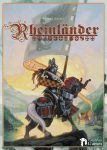
place right here if I wanted. And those cards will stay shuffled into the deck and the ship will constantly move around through the board like so. Next, you have the titles, and these are just out in the game, and they're extra ways to score points based on meeting certain objectives. As you're playing through the game, the first player to meet the objective takes the title. And then the last one has to do with all of the churches. You can have each one of the churches has a unique ability attached to it. And so what happens when you do that is instead of placing just these churches like this, you actually have a whole another set of churches that you put out, each one has a different symbol on it. and it matches the artwork here again telling you that you're able to do something when you control that church. But that's how this game works. So, what do I like about this game first, the production on it is really good. I really like the cover art on this. Like, I really like the cover art on this game and the card art really, really cool.
The bits are great. They're just chunky enough that I'm a big fan of just the overall aesthetic of this game. It really Well, I like it. So, there you go. Next thing I'll say is this game is lightning fast. I'll talk a little bit later about how it can slow down a little bit, but overall it's lightning fast. And there were actually moments when we were playing that it was almost playing at the pace. Have you ever seen movies where there's old men playing dominoes and they're like wap wap wap wap. There was times when it felt like the game was going that fast. And to me that is awesome when it's really cooking and going that fast. And sometimes it really really can. Now that would imply that there's not a lot going on. And in some ways that is true, right? You have a card, you play a card, you put a thing down in the number that it says you place it in, draw a new card, move on.
And there's some expansions that can get added in and sometimes you can just place it next to something else. But overall, it seems very very simple, but it is deceptively strategic in the way that you don't think there's much going on. In fact, the first time that original Don and I played, we were I was playing, I was like, well, what's what's the point? Like, what's the game? Yeah, I'm picking what side of the river, but yeah, whatever. But as you get through, you're like, "Oh, no, no, no, no. There are some real hard choices here. When do I want to make this a duchy? When do I want to try to take it over? When do I want to maybe set it up to where I will lose it because I know I'm going to get points when I go? When do I want to take this side to that side because I want to get the church and not the city and all these things. There's actually a lot more choices than you think there are with how basic and simple the rule set is. The next thing is I really like that you score points when someone takes your duche. And I don't know if that's just so it's less punishing, but it's really satisfying to know that, oh, I got some points because I lost this thing. But if I can take it back in two rounds, then I've lo I've gained those points and now I got the thing back again. Of course, now I gave them points. But there's this interesting little back and forth that can happen. And I actually find it quite satisfying the way that works. And I already alluded to it, but I like that the different scoring tokens on the board, the way that they work on the surface, you want to get cities because they're going to be worth more points, but the way the castles work that let you put out another influence, which makes it harder for you to lose that
area and pushes the end of the game because you now have an extra token out there. I like how that works. I like how you have the bishop moving around based off the churches. And I really just I think it is very very clever with again such a simple game of how you have to make these decisions and I really think that works well. Then I want to briefly talk about a couple of the mini expansions. I'm going to highlight I really like the boat. This is one that when we played at a local convention, we didn't use it cuz people were just learning and I've been playing around with it for the past day and a half or so with this boat. And I love the boat. I love the way that works. I love that one more option that you have as you're going through and you know where that boat is. It doesn't move all the time and you don't know how far it's going to move, but it's just very, very clever. I love the boats and I also like the alternate churches. All those different things that those different churches are going to do when you claim them. It again just kind of adds a little bit more to the game that I think makes it a little bit more interesting sometimes. Sometimes you just want that fast w but other times you want to be able to say, "Ah, no. If I get this one, it's gonna do this." It really just opens the game up a little bit in a very satisfying way, I think. So, what are my quibbles with the game? Now, I talked about I I like the card art and I like the box art and the bits. The board still looks old. And I say it looks old because if you go back and find pictures of the original 1999 game, you're like,
"Dang, that looks like a game from 1999." And so what this board does is it's honoring that look, but it still has a bit of that look. And while I'm not saying it is a bad looking board, because this is not a bad looking board, it's actually a lovely looking board, but it looks like an update of something from 1999. And when you're used to all these like flashy, crazy boards, that's not what this is. I think it's very effective and it's really easy to play on, but you're going to look at and say, "Huh, that doesn't look like what we see often nowadays." Next thing I will say is it can feel like you are just at the whims of luck. What cards are you pulling out of that deck? When is that jester going to show up and make you reshuffle? When is the boat going to move? And sometimes you can feel like you just can't get anything really useful. And I think it actually happens far fewer times than it feels like. But sometimes you're sitting there playing like I just need something in between a 10 and a 25 and I can do something and all you're getting is 50s. And that brings me to the only other thing that I alluded to earlier.
There are some weird moments where suddenly people get oddly AP prone. You're going through, you're doing all this stuff fast and suddenly someone's like, "Wait, wait." And they're stopping one, two, they're counting up this, they're counting up that and they're looking at their cards and they're looking here and do the and it just every now and then comes out of nowhere. So, what I'm saying is if you are with a group of people who are super AP, then I don't know, this might not be the game for you. It still feels really fast all the time, but it's just something that popped up every once in a while. But there you have it, folks. That is Rhinelander. This game was an awesome surprise when Chad from 25th Century reached out and asked me I wanted to cover it. I didn't know anything about it, but he gave me a great pitch. He was like, "It's a Rander Kenitia area control game from 1999." I was like, "That's crazy pants, man. All right, we're going to do this thing." And then I was reading through through the rules and I was talking to Original Don about it and I asked him to read the rules because I was just having a brain dead day.
And both of us agreed after we played it that this was an awesome surprise. We both liked this game way more than we thought we were going to. And neither he or I are really big into area control, but this one was just really satisfying. Like this is another one that I'm actually going to be pretty sad. I have to send it back to 20th Century because I kind of want to keep playing it, but you know, I have to send it back. This is one that if you are area control curious and you are a Euro fan, then this one is just going to knock your socks off. It's delightful. I don't think this is a game and you are an area control person and that's the kind of game that you like. Well, this might not be for you. Say, well, that's a little bit too light and a little bit too random for me. But I think it's a delightful game and I'm very happy that I played it and I think this is one that is different than a lot of games out there and I think it's one that's worth you checking out. I think you're going to pretty quickly know if you're interested or not if you watch a little bit of gameplay and you just see how that card play works. You're going to know pretty darn quick. But there you have it folks. That is Rinlander. As always, if I made any mistakes in the rules overview, please let me know in the comments with the time stamp so I can get that in the clicking on subtitles. If you found this video useful, please like, subscribe, share, maybe become a channel member. As always, thank you so much for watching.
Have a wonderful, wonderful day.